A medieval royal charter granting William de Montacute custody of the Isle of Man and its appurtenances for a period of one year from Michaelmas 1334, with an obligation to render annual payments to the royal exchequer. The document is presented in both English and Latin versions, establishing early medieval Crown control over the island and revenue arrangements.
A royal letter patent from King Henry IV (7 Hen. IV) granting John Stanley the Island, Castle, and Lordship of Man with all royalties, franchises, and profits for his lifetime. This document establishes the Stanley family's long tenure over the Isle of Man and represents the foundational grant that would remain in effect until the 1765 Revestment. The text is presented in both English and Latin versions.
A royal charter from King Henry IV granting charitable scholarship support (particles) to Luke Macquyn, a scholar of the Isle of Man. The grant perpetuates earlier royal concessions to support poor scholars in the island. This document demonstrates early royal governance of the Isle of Man and the church's role in educational provision.
A dual-language (English/Latin) royal patent from Henry VIII granting the vacant bishopric of the Isle of Man to Henry Man, professor of sacred theology. The document conveys all spiritual and temporal rights, revenues, properties, and privileges of the see, and exempts the bishop from paying Tenths and First Fruits taxes due to the island's proximity to enemy territories and the high seas. Relevant to understanding pre-Revestment ecclesiastical governance and the Crown's direct patronage over Manx institutions.
A dual-language (English and Latin) royal charter from Henry VIII granting the vacant Bishopric of the Isle of Man to Henry Man, a professor of sacred theology. The document establishes the king's patronage over the bishopric, enumerates its spiritual and temporal properties, and notably exempts the bishop from payment of Tenths and First Fruits during his lifetime due to the island's proximity to enemy territories and maritime vulnerability.
A 14th-century royal charter (Rotuli Scotiae, 16 Ed. III) granting permission to the people of the Isle of Man to negotiate truces with Scotland and to engage in commerce with both enemies and allies, provided they do not supply arms or provisions to Scottish enemies. Presented in parallel English translation and original Latin. Relevant to long-term Manx autonomy, commercial privileges, and constitutional status.
A medieval royal charter (14th century) granting permission to the men of the Isle of Man to negotiate truces and conduct trade with Scotland, even with enemies of the Crown, provided they do not supply arms or provisions. Presented in both English translation and original Latin. This establishes early precedent for Manx autonomy in foreign relations and commercial matters.
A bilingual (English and Latin) royal charter from King Henry IV granting ecclesiastical alms ('particles') to Luke Macquyn, a scholar of the Isle of Man. The grant provides for the support of poor scholars and specifies that the alms remain his so long as he pursues scholarly work for the Church and is not promoted. This document illustrates early medieval Crown-Island administrative relations and ecclesiastical patronage.
A 14th-century royal writ from King Edward II commanding Gilbert Makaskill, keeper of the Isle of Man, to deliver royal funds to Gilbert de Bromley (receiver of stores at Carlisle) for the purchase of victals and supplies. This is an early administrative document demonstrating royal control and fiscal organisation of the Isle of Man as a crown possession.
A 14th-century royal writ (Edward II) commanding Gilbert Makaskill, keeper of the Isle of Man, to deliver Crown revenues to Gilbert de Bromley for the purchase of victuals. This document demonstrates Crown administration of the Isle of Man in the medieval period and the flow of financial resources from the island to the English exchequer.
A collection of three interconnected letters from 1779 authorizing and promoting a charitable collection for the Society for the Propagation of the Gospel in Foreign Parts. The Royal Letter from George III (10 May 1779) grants permission for a nationwide church collection to support missionaries in North America and other provinces; the Archbishop of York (W. Ebor, 19 June 1779) transmits this to the Bishop of Sodor and Man; and the Bishop of Sodor and Man (R. Sodor & Man, 1 July 1779) directs clergy to implement collection in their parishes. The correspondence addresses the financial exhaustion of the Society and explicitly references the American Revolution, discussing support for loyalist clergy who refused to renounce allegiance to the Crown.
A letter of protection issued by King Henry III to King Olave of Man in 1218, instructing him not to interfere with Furness Abbey, which was under royal patronage. The document appears in the Monumenta de Insula Manniae collection and illustrates the feudal relationship between the English Crown and the Kings of Man, as well as ecclesiastical privileges in the medieval period. This provides context for understanding pre-Revestment Manx sovereignty and the Crown's historical claims over the island.
A Latin royal letter (Littera Regis) from Olaus, King of the Isles, addressed to the Dean and Chapter of Iona Cathedral, concerning the consecration and dispatch of Nicholas, an elected Archbishop. The letter emphasizes ecclesiastical authority and the duty of the Iona Chapter to remit the elected prelate without delay. This document is relevant to medieval Manx-Scottish ecclesiastical jurisdiction and the Island's relationship with the Scottish church hierarchy.
A Latin royal letter (Littera Regis) from King Olaf of the Isles to the Dean and Chapter of York Cathedral, concerning the consecration and dispatch of Nicholaus as elected Archbishop. The letter emphasizes ecclesiastical authority and obedience, threatening spiritual consequences if the appointment is not honoured. This document provides evidence of the Isles' medieval ecclesiastical structures and royal authority.
A bilingual (English and Latin) transcription of 13th-century royal letters patent from Henry III granting protection and safe conduct to Reginald, King of Man, in recognition of his homage and fealty. The document includes a conditional clause committing the English Crown to defend Man's territory should enemies threaten it, provided Reginald remains faithful. This illustrates the feudal relationship between the English Crown and the Kings of Man in the medieval period, foundational to understanding the constitutional status that would later become contested in the 1765 Revestment.
A royal grant (letters patent) from Henry IV to William Stanley (Knight, Lieutenant of Isle of Man) commanding delivery of the Island, Castle of Peel, and all dominions, royalties, franchises and profits to John Stanley for life. This document exemplifies early feudal-style governance of Man before the Revestment period, establishing the Stanley family's claim to the island and providing constitutional context for later 18th-century disputes over sovereignty.
A licence granted by King Henry IV permitting William Hobbesson, servant of the Earl of Northumberland, to purchase 12 crannocks of barley and transport it to Mann Castle for victuals. The document is presented in both English translation and original Latin patent roll text from the Irish Chancery records (Rotuli Patentes et Clausae). This demonstrates early medieval provisioning of the royal castle on the Isle of Man and the administrative mechanisms by which the English Crown controlled island commerce and supply.
A Norman French royal writ (4 Ed. II) commanding the bailiffs and officials of Sutton-on-the-port of Plymouth to send a well-equipped naval fleet to the Isle of Man and thence to Scotland in support of the Crown's war effort. The fleet is to be placed under the command of Simon de Mountaigne, designated Admiral of the royal fleet. This document illustrates medieval royal naval administration and the strategic importance of the Isle of Man as a naval staging post.
A bilingual (English and Latin) royal writ from Henry IV commanding John and William Stanley to take and hold the castle and island of Man on behalf of the Crown. This document records the formal transfer of Man from private lordship into royal custody, establishing a precedent for Crown authority over the island that precedes the 1765 Revestment by 360 years. It is drawn from the Monumenta de Insula Manniae collection, a primary source compilation on Manx sovereignty and lordship.
A bilingual (Latin and English) royal patent from Edward I appointing three justices (Nicholas de Segrave, Osbert de Spalding, John de Suthewell) to hear and determine complaints from the people of the Isle of Man against trespasses and injuries by royal bailiffs and others. This document demonstrates early English royal oversight of Manx affairs and the mechanisms of complaint and justice in the medieval island.
A 14th-century royal charter (7 Ed. III) granting custody of the Isle of Man and its appurtenances to William de Montacute for a term from Michaelmas 1334 for one year, with annual rendering of extent to the royal exchequer. Provided in both English and Latin versions. This document illustrates early medieval English sovereignty and administrative control over the island prior to the Revestment period.
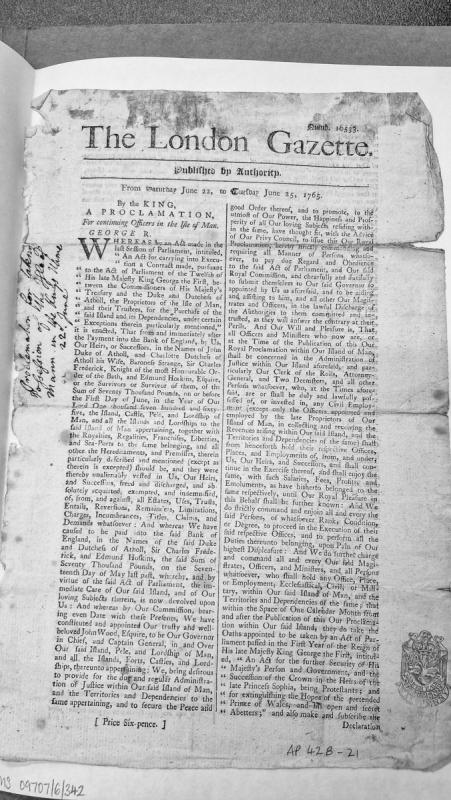
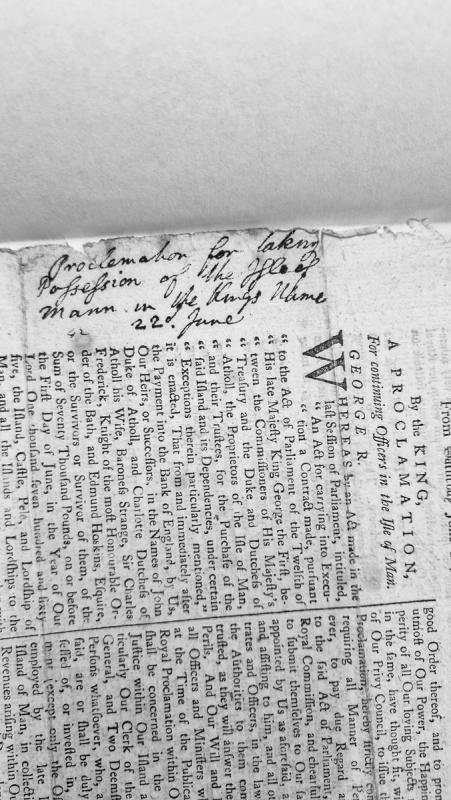
A Royal Proclamation issued by King George III published in the London Gazette, establishing the Crown's governance of the Isle of Man following the purchase from the Duke and Duchess of Atholl for £70,000. The proclamation confirms the appointment of John Wood as Governor and requires all existing civil officers to continue in their positions under Crown authority, with directives to take oaths of allegiance.
A printed royal proclamation issued by King George III regarding the continuation of officers in the Isle of Man following Parliament's enactment of a contract for the Crown's purchase of the island from the Duke and Duchess of Atholl for £70,000, payable by June 1, 1765. The proclamation directs the continuation of existing officials and officers in their posts.
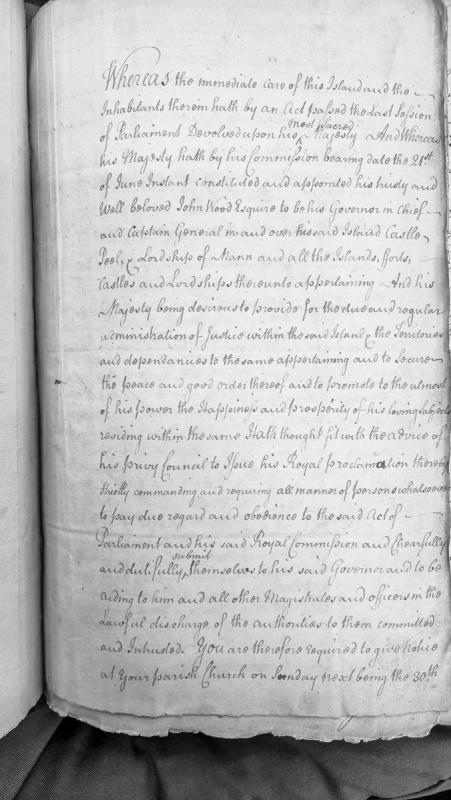
A royal proclamation issued on behalf of His Majesty, commanding inhabitants of the Isle of Man to recognize and obey John Wood, Esquire, who has been constituted Governor in Chief and Captain General by Royal Commission dated 21st June. The proclamation emphasizes the importance of maintaining justice, peace, and good order within the island and its dependencies.
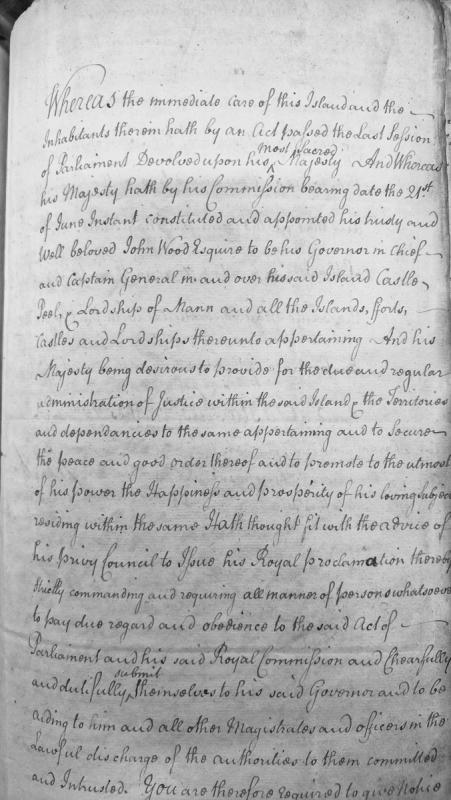
A royal proclamation issued on behalf of His Majesty establishing the governance structure for the Isle of Man following an Act of Parliament. The document appoints John Wood Esquire as Governor in Chief and Captain General, and commands all persons to obey the Act of Parliament, the Royal Commission, and the appointed Governor.