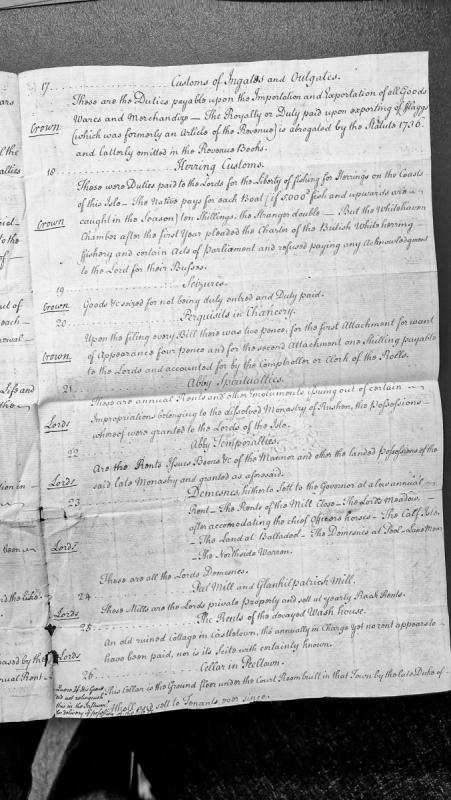
A detailed enumeration of revenue sources payable to the Lords of the Isle of Man, covering customs duties on imports/exports, herring fishing licenses, court fees, ecclesiastical rents from dissolved Rushen Monastery, and demesne lands. The document provides historical context on statutory changes and property management practices.
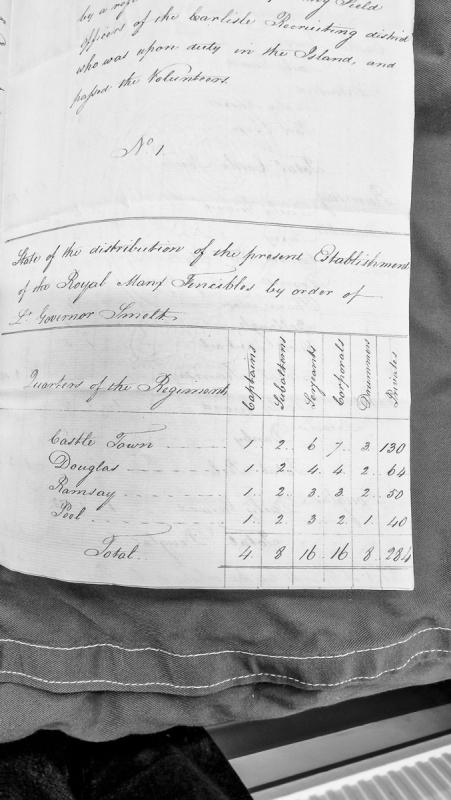
A tabulated revenue abstract showing financial data across four Manx towns (Castle Town, Douglas, Ramsay, and Peel) with columns of numerical values and totals. The document appears to be part of administrative or fiscal records tracking revenue distribution or assessments.
Clergyman who accompanied George Moore to London on the second deputation in April 1766. Made the expedition's most significant discovery, and it was accidental: he found a copy of the James I charter confirming Manx rights — 'until then forgot and unknown.' A constitutional document that should have been in the Island's own archives, lost, turned up in a London library by a clergyman who happened to be looking.
Clergyman whose appointment as Vicar of Kirk German was blocked by George Moore in 1754. Moore wrote to John Quayle asking him to involve the Deputy Governors because Gell's 'Behaviour in all Instances and upon all occasions has shewn his Disposition to prejudice the trade in this Isle.' The Governor shared their view. Mr Gell did not become Vicar of Kirk German. The trading interest reached into Church patronage as easily as it reached into the customs house.
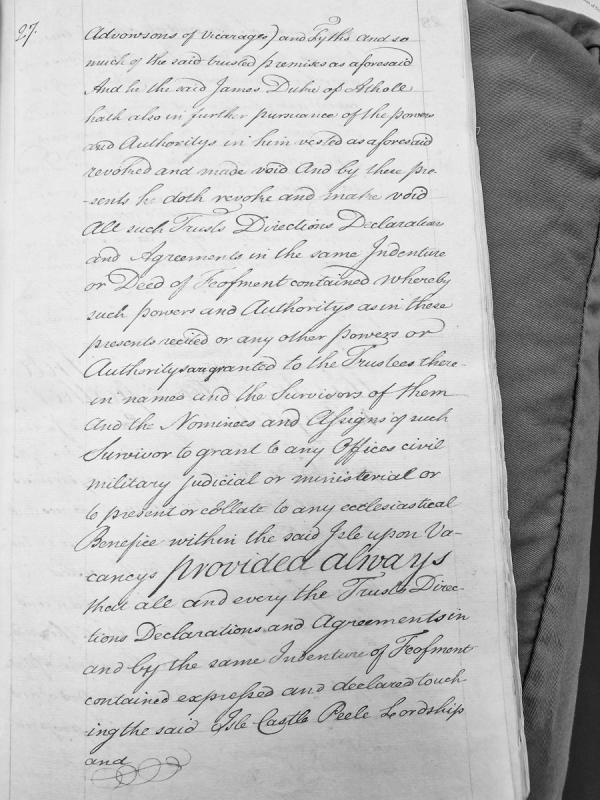
A legal document recording the Duke of Atholl's revocation of trusts, directions, declarations and agreements contained in a prior Indenture of Feofment. The revocation concerns powers to grant offices (civil, military, judicial, ministerial) and to present or collate to ecclesiastical benefices within the Isle of Man, with certain provisions preserved regarding Castle Peel lordship.
Collector of Customs at Douglas. His position brought him into daily contact with every captain who entered the harbour. His daughter Elizabeth assembled a shell collection from specimens seafarers brought from their voyages. She married William Bligh at Onchan in 1781. Paul Bridson, the Duke's revenue officer, was the largest importer of Guinea goods on the Island — the customs establishment and the slave trade supply chain overlapped in the same harbour and the same offices.
Soldier on the indicting jury that returned the treason charge against Illiam Dhone. Halsall is a Lancashire place name near Ormskirk, directly in Stanley territory. The Castle Rushen teachers' guide confirms many garrison soldiers were from Lancashire. Not a Manx neighbour — a Lancashire man.
King of England killed at the Battle of Bosworth, 22 August 1485. He took Thomas Stanley's son Lord Strange hostage to ensure Stanley's loyalty, but Stanley held the balance and chose Henry Tudor. Richard died in the charge against Henry's position.
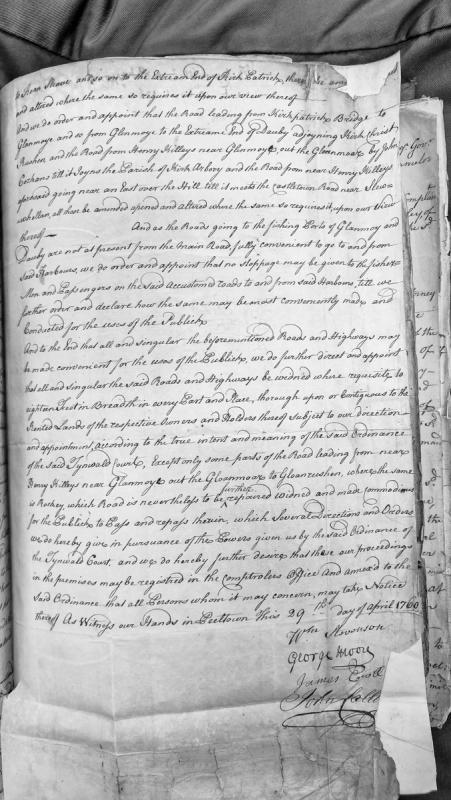
Official order from Tynwald Court officials directing the widening, opening, and repair of various roads in the Kirk Patrick and surrounding parishes to eighteen feet in breadth. The document specifies roads to fishing ports at Glanmoye and Dauby, and ensures no stoppage is given to fishermen and passengers until further notice.
Descendant of William and Jonathan Christian who emigrated to Virginia in 1655. Chief Magistrate of New Kent County — 'Washington's devoted friend.' His son Colonel William Christian chaired the Fincastle Resolutions committee. His granddaughter Letitia married John Tyler, the tenth President of the United States. The family carried the governing instinct from Milntown to Virginia and planted it in soil where it could grow.
Launched the Mona's Herald in 1833 and began a thirty-year campaign for a democratically elected House of Keys. His method was straightforward: he published what the Keys did, and the publication itself was the argument. A self-elected body operating in secrecy could maintain its authority only as long as nobody outside the chamber knew what happened inside it. Fargher opened the doors with newsprint. The Keys responded by prosecuting him for libel. He was imprisoned. The imprisonment produced public petitions for reform. He had argued in 1844 that the Keys should not be given financial authority because they were unelected. Twenty-two years later, Governor Loch used precisely the same argument to force the Keys to accept popular election.
Wealthy Douglas merchant who bought Bemahague from Edward Christian in 1789 — the Christian family home from at least 1600, sold because the Revestment's economic consequences had ruined the family. Part of the interconnected web of Manx families. The Manx Government purchased the property in 1904 and turned it into Government House.
King of Scots who invaded the Isle of Man in 1313. Castle Rushen fell to his forces and the Island was ravaged. His invasion marked a violent interruption in the Norse-Manx political order.
An Irishman convicted in 1724 of bringing counterfeit half-crowns and shillings into the Island and passing three of them. He was hanged. The Manx system distinguished between a local man who made a penny to test his metal and a foreigner who imported counterfeit coin for profit.
London lawyer hired by George Moore in 1766 to prepare the Manx case for the Treasury. Weeks of delay followed. The document Rolt produced emphasised 'the prerogatives of the Lord rather than the rights of the people.' He later wrote a history of the Island in 1773.
Site of the Isle of Man's airport, in the south of the Island near Castletown. The flat coastal land at Ronaldsway has served as the Island's principal airfield since the 1930s.
Derby's spy, sent to the Three Anchors tavern in Milk Street, London, to infiltrate the Christian family's appeal against the execution of Illiam Dhone.
Letter from the Duke of Grafton (Secretary of State) to the Lords Commissioners of the Treasury reporting His Majesty's approval of barracks plans for the Isle of Man, drawn by Engineer Captain Dawson. The King approved the plans except for the removal of stables, as cavalry were being withdrawn from the island. The letter confirms post-Revestment military fortification of the island.
A royal letter patent from Queen Elizabeth I granting assent to the nomination of John Mericke (M.A.) as Bishop of the Isle of Man, following the death of Bishop John Salesbery. The document affirms the Earl of Derby's hereditary right of patronage over the Manx bishopric and directs the Archbishop of York to confirm, consecrate, and invest Mericke. It demonstrates the overlapping jurisdiction of the Crown, the Earl of Derby, and the Church over Man's ecclesiastical affairs.
A dual-language (English and Latin) royal warrant from King Charles I granting assent to the nomination of Richard Parre as Bishop of Man and Sodor. The document confirms the Earl of Derby's patronage rights over the bishopric (granted by Parliament in James I's reign) and directs the Archbishop of York to consecrate and invest Parre. Relevant to understanding Manx ecclesiastical governance and the Crown's relationship with the Island during the Stuart period.
A dual-language (English and Latin) royal writ granting Charles I's assent to the nomination of Richard Parre as Bishop of Man and Sodor. The document records the patronage chain from Parliament through William, Earl of Derby, and directs the Archbishop of York to consecrate and invest Parre. It illustrates the constitutional relationship between the Crown, the Derby family's lordship of Man, and ecclesiastical authority during the 1630s.