Southern fishing port at the foot of the Meayll peninsula. The herring fishermen of Port St Mary, like those of Peel, had boats and skill but nowhere else to take them after the Revestment.
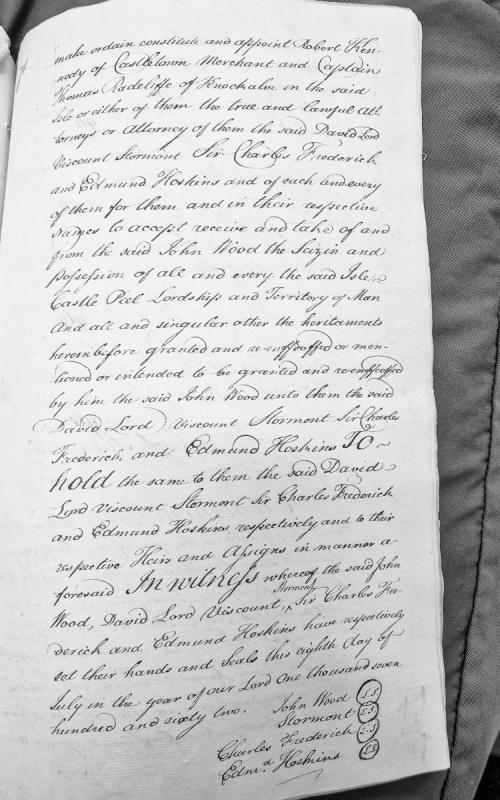
A legal instrument appointing Robert Kennedy and Captain Thomas Radcliffe as attorneys for David Lord Viscount Stormont, Sir Charles Frederick, and Edmund Hoskins to accept seizin and possession of the Isle of Man, Peel Castle, and associated lordship and territory from John Wood. Signed and sealed by all four principal parties on 8 July 1762.
Preface to a 1965 popular history of the 1765 Revestment Act, outlining the scope and structure of the work. Covers smuggling, constitutional issues, compensation disputes between the Atholls and Crown, and enforcement of the Act. Acknowledges reliance on contemporary newspapers and official documents.
Preface to a 1965 popular history of the 1765 Revestment Act. Outlines the scope of the work: examination of causes and effects of the Act, the smuggling trade, constitutional conditions, and enforcement. Notes that legal battles between the Dukes of Atholl and the Crown extended over 25 years with compensation approaching £500,000. Acknowledges archival and museum sources.
Preface to an early 19th-century descriptive and historical account of the Isle of Man, covering its geography, constitution, laws, and history. The author discusses the scarcity of reliable published works on Mann and references Nathaniel Jefferys' 1808 competing publication. Relevant for understanding contemporary perceptions of Manx exceptionalism and constitutional uniqueness post-Revestment.
Preface to a historical work on the Stanley family published in 1864. The volume compiles chapters originally serialised in the Ormskirk Advertiser and includes additional notices on various Stanley properties and family branches. Relevant to the Revestment project as the Stanleys were major landowners with connections to Isle of Man affairs and the ducal interests involved in the 1765 transaction.
Editorial preface to a scholarly collection of historical documents relating to the Isle of Man, compiled by J. R. Oliver. Discusses the scope and sources of the collection (Patent Rolls, Close Rolls, monastic records, charters), the challenges of archival research, and the loss of historical documents. Includes discussion of the Chronicon Manniae manuscript and acknowledgments of archival contributors.
Editorial preface to a 19th-century collection of historical documents relating to Isle of Man. Discusses manuscript sources, archive locations (Record Office Fetter Lane, British Museum, Duchy of Lancaster), the condition and loss of early records, and provides scholarly context for the Chronicon Manniae and other primary sources. Identifies key repositories and limitations of surviving documentation.
A formal petition from Presbyterians resident in the Isle of Man, dated August 1763, requesting the Duke of Atholl's permission to establish a Presbyterian minister on the island. The petitioners emphasize their loyalty, their harmonious relations with the established Church, and the lack of opposition from civil or ecclesiastical officials. This document reflects religious governance, toleration policy, and the Duke's authority over the island two years before the Revestment.
A formal petition from Presbyterian residents of Isle of Man (primarily Douglas) to James, Duke of Atholl, requesting his consent to employ a Presbyterian clergyman. The signatories had formed articles of agreement for the minister's subsistence and sought recommendations from Scotland. The document illustrates religious toleration and community organisation on the island prior to the 1765 Revestment.
Consort of Queen Victoria. Came ashore at Ramsey in 1847 when the weather was too rough for Douglas and Victoria was seasick. Was rowed to Ballure beach, walked up the hill at Lhergy Frissel to admire the view, chatted about the potato blight, and returned to the yacht. The Manx people built a forty-five-foot granite tower on the spot where he had stood. They named the hill after him. They erected an inscription recording the date and the fact of his visit. The Manx response to the afternoon her husband looked at their view was to build a permanent monument to it.
The Princess Royal. Presided at Tynwald Day in 2008 and 2021 as the monarch's representative. One of the few members of the Royal Family to attend the ceremony.
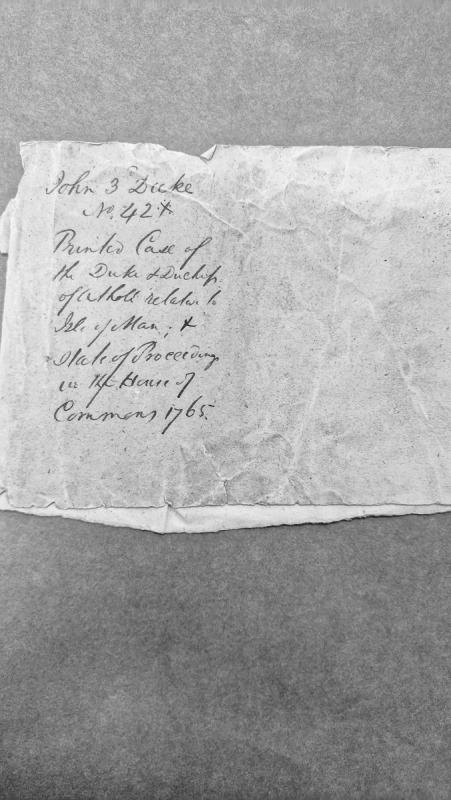
A printed pamphlet presenting the case of the Duke and Duchess of Atholl regarding their interests in the Isle of Man, accompanied by documentation of proceedings in the House of Commons during 1765. This appears to be a formal legal publication of proceedings and arguments related to Atholl family claims.
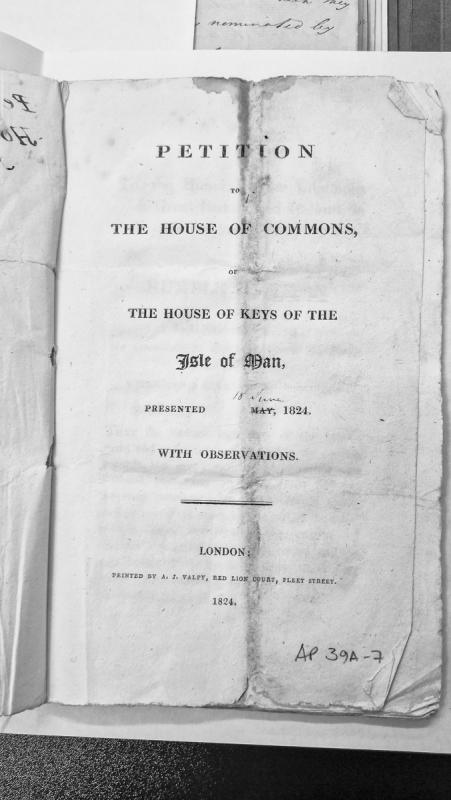
A printed work produced by the London printer A. J. Valpy at Red Lion Court, Fleet Street in 1824. The document appears to be a title page or colophon indicating the printer and publication location.
Historical account of the Priory of St. Bee's in Copeland, Cumberland, detailing its founding (c. 650), reconstruction under Henry I, and its holdings including lands in the Isle of Man. The prior held baronial status in Man and was obliged to attend the king and lords of the island. The text documents ecclesiastical landholding patterns relevant to understanding Man's feudal structures before the 1765 Revestment.
A historical account of the Priory of St. Bee's (or Bega) in Copeland, Cumberland, documenting its foundation circa 650, destruction and rebuilding under Henry I, its status as a cell of York Abbey, and its landholdings in the Isle of Man. The text details royal grants and confirms the prior's baronial status in Man, making it relevant to understanding pre-Revestment feudal relationships and ecclesiastical property interests in the island.
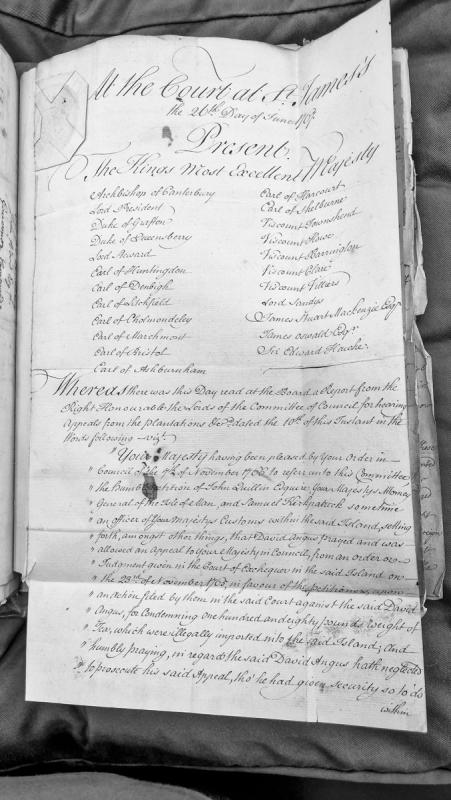
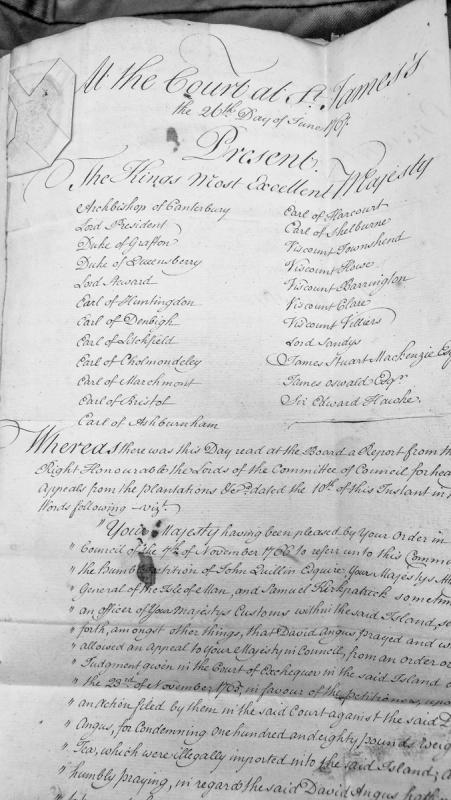
A report to the Privy Council dated 26 June 1767 concerning an appeal by David Angus from a Court of Exchequer judgment in the Isle of Man. The appeal relates to the condemnation of 180 pounds weight of illegally imported tea, with petitioners John Quillin (Attorney General) and Samuel Kirkpatrick seeking resolution regarding Angus's neglect in prosecuting his appeal.
The Privy Council — the King-in-Council, not Parliament — intervened after Illiam Dhone's execution. The Deemsters were committed, the Christian estates restored, Edward Christian reinstated to his judicial office. This was an exercise of the Crown's personal authority over a feudal subordinate, not Parliament's legislative reach. The distinction would prove crucial a century later when Parliament assumed legislative authority over the Island during the Revestment.
A report to the King in Council from the Lords of the Committee of Council for Hearing Appeals from the Plantations, dated 10 June 1767. It concerns an appeal by David Angus against a judgment in the Isle of Man Court of Exchequer (23 November 1763) favouring John Quillin and Samuel Kirkpatrick, relating to the condemnation of illegally imported tea.
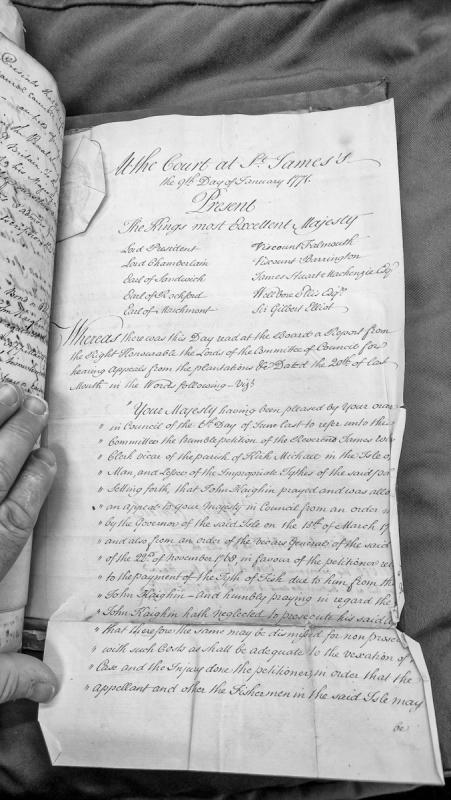
A report from the Lords of the Committee of Council for hearing appeals from the plantations, dated 20 December 1770, concerning a petition by Reverend James Wi[—] regarding a dispute over the tithe of fish owed by John Kaighin in Kirk Michael parish, Isle of Man. The petitioner seeks dismissal of Kaighin's appeal for non-prosecution and costs.
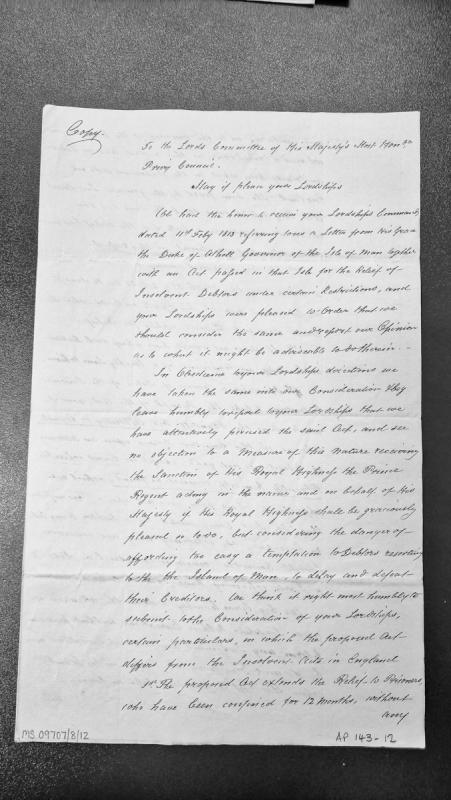
A legal opinion submitted to the Lords Committee of the Privy Council regarding an Act passed by the Isle of Man for the relief of insolvent debtors. The report examines the proposed legislation against English Insolvent Acts and raises concerns about potential abuse, particularly regarding prisoners confined for 12 months.
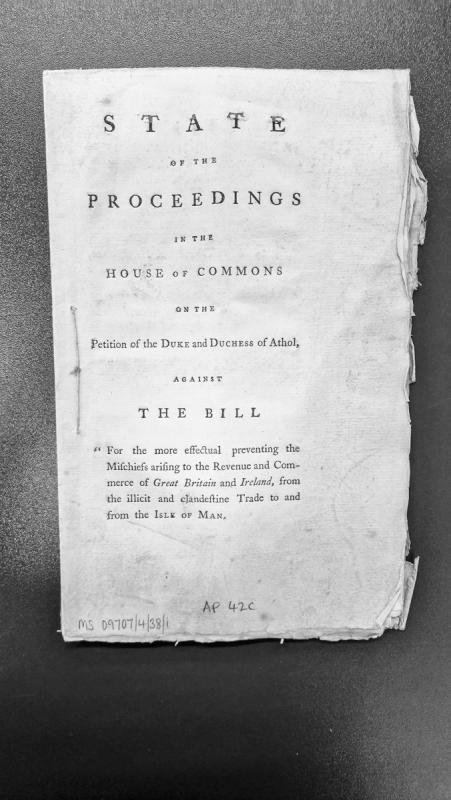
A printed pamphlet documenting parliamentary proceedings in the House of Commons concerning a petition by the Duke and Duchess of Athol against a bill designed to prevent illicit trade to and from the Isle of Man. The bill aimed to protect the revenue and commerce of Great Britain and Ireland.
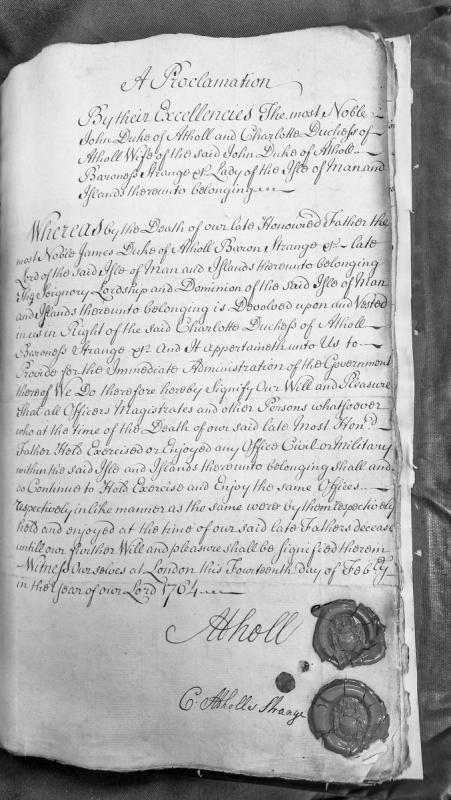
A proclamation issued by John Duke of Atholl and Charlotte Duchess of Atholl following the death of James Duke of Atholl, their predecessor as Lord of the Isle of Man. The proclamation directs all civil and military officers to continue in their positions pending further instructions from the new rulers.
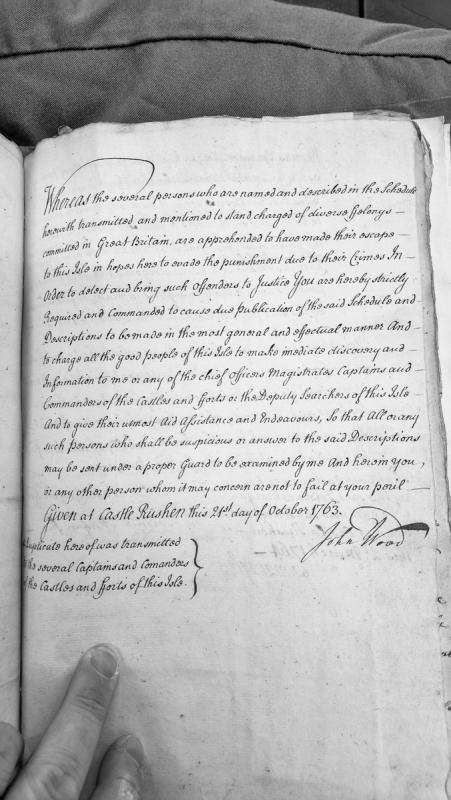
An official proclamation issued by John Wood commanding the publication of descriptions of criminals who have fled from Great Britain to the Isle of Man. The document orders all inhabitants and officers to aid in detection and apprehension of these felons, with copies distributed to castle and fort commanders.
Official proclamation from the Isle of Man Attorney-General J. Clarke to shipowner agents and insurance office representatives regarding procedures for wreck recovery, salvage rights, and legal obligations. Emphasizes preservation of life and property, lawful salvage compensation, and penalties for plundering or concealing wrecked goods. Reflects post-Revestment governance and the Island's maritime law administration.