Principal revenue officer at Douglas — 'which always has been, and will probably continue to be, the first port of the island.' Paid three pounds Manx per year. Also the largest importer of Guinea goods on the Island — gunpowder and trade goods for the slave trade supply chain, stored in Douglas warehouses 'for their African trade.'
Extract from Paulus Orosius's historical account (Historiae adversum Paganos, Book I), describing the geography of Britain and surrounding islands including Mevania (the Isle of Man). Presented in both English translation and original Latin, with editorial annotations. A foundational classical source for early references to the Isle of Man by name.
Classical Roman geographer Paulus Orosius's description of the British Isles, including the first known written reference to the Isle of Man under its Latin name 'Mevania'. This passage provides early geographical and ethnographic context for the island's settlement by Scots. Included in Manx Society vol. IV as foundational background to Manx history.
Extract from the Rotuli Litterarum Patentium (Patent Rolls) of 1212, recording a payment of ten marks by King John to Stephen de Oxford for conducting the King of Mann (Reginald) into his own country. The annotation clarifies this relates to Reginald's fealty visit to London. Provides early evidence of the vassalic relationship between Mann's rulers and the English crown.
A brief entry from the Rotuli Litterarum Patentium (Patent Rolls) of King John, recording a payment of ten marks to Stephen de Oxford for escorting the King of Mann (Reginald) back to the Isle of Man following his homage to King John in London. The footnote clarifies the monetary value and historical context.
Fishing port on the west coast, dominated by Peel Castle on St Patrick's Isle. The herring fleet operated from here. After the Revestment, Peel's fishermen — who had no obvious alternative livelihood — stayed and endured. Captain Murray served as Crown searcher at Peel. Caesar Parr's single surviving smuggling boat was the last of a fleet of fifty.
Castle on St Patrick's Isle, connected to the mainland by a causeway. Site of the cathedral of the diocese of Sodor and Man. Waldron recorded the legend of the Moddey Dhoo — the phantom black dog that haunted the garrison — during his time on the Island in the 1720s.
The castle on St Patrick's Isle, connected to the town of Peel by a causeway. Site of the cathedral of St German, seat of the Bishop of Sodor and Man, and the location of the Moddey Dhoo legend. The cathedral was described as totally useless by the time of the Crown administration. The castle housed the English garrison whose soldiers adjusted their behaviour for a ghost.
One of the principal trading fairs on the Island, held at Peel. The fairs were not just markets but social institutions where the scattered farming communities came together, news was exchanged, bargains struck, and the wider world connected to the parish. The fairs survived the Revestment because they served practical needs that no administration could replace.
Letter from Thomas and Richard Penn to Benjamin Franklin agreeing to allow the Lieutenant Governor to assent to a money supply act for Pennsylvania's defence and public services, despite ongoing disputes between the Proprietors and the Provincial Assembly before the Attorney and Solicitor General. The letter references a previous act for raising £60,000 and striking £55,000 in bills of credit, indicating financial and constitutional tensions in mid-18th-century Pennsylvania governance.
Two related documents from the Penn Proprietors responding to Benjamin Franklin's 'Heads of Complaint' (August 1757) on behalf of the Pennsylvania Assembly. Ferdinand John Paris's formal Answer (27 Nov 1758) addresses grievances over proprietary instructions, taxation of quit-rents, and the Proprietors' contribution to colonial defence. The Penns' Message (28 Nov 1758) criticises Franklin's procedures and proposes free conferences with authorised representatives. These documents reveal the constitutional conflict between proprietary prerogative and assembly authority in Pennsylvania.
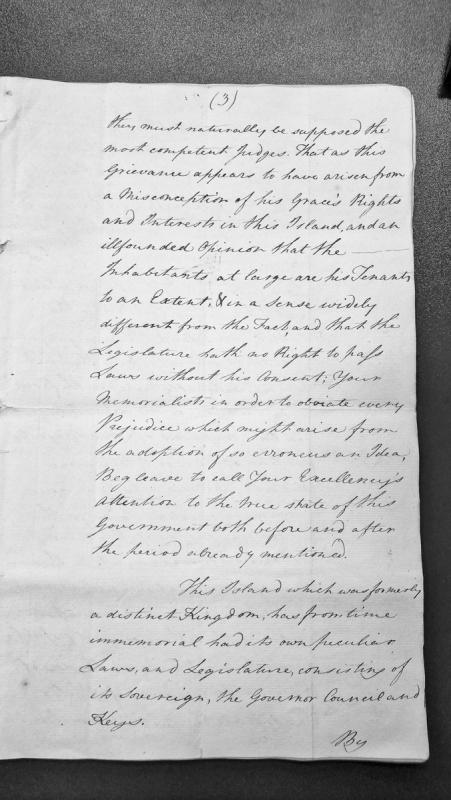
This is a formal petition (page 3) addressing misconceptions about the Duke's (His Grace's) rights and interests in the Isle of Man, and clarifying the island's legislative independence. The memorialists argue that the inhabitants are not tenants to the extent claimed, and that the Legislature has the right to pass laws without the Duke's consent, referencing the island's historical status as a distinct kingdom with its own laws and government.
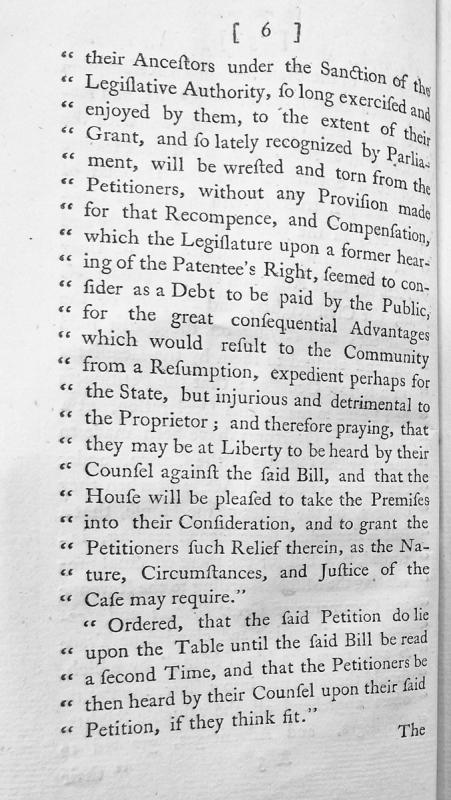
This is a petition (likely to Parliament) from proprietors objecting to a bill that would rescind their long-exercised legislative rights and grants. The petitioners argue that Parliament previously recognized their patent rights and seek compensation for the loss of privileges that have been held since their ancestors' time, requesting to be heard by counsel against the bill.
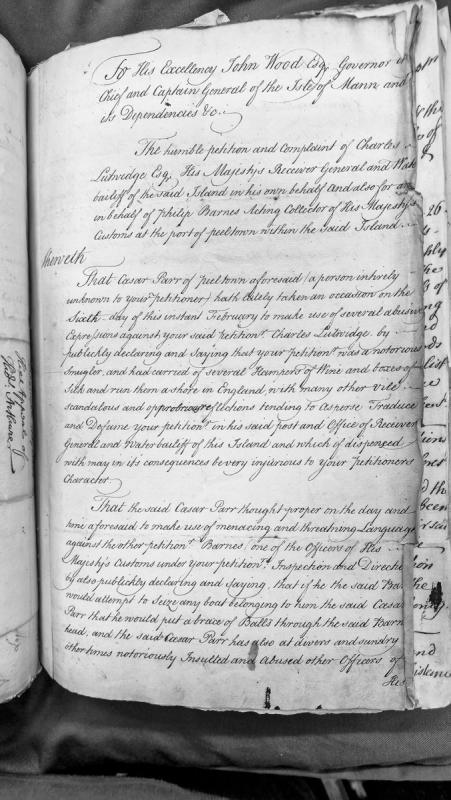
A petition to the Governor of the Isle of Man from Charles Lutwidge (Receiver General and Water Bailiff) and Philip Barnes (Acting Collector of Customs) complaining of defamatory statements and threats made by Caesar Parr of Peeltown on 6 February. Parr allegedly called Lutwidge a smuggler and threatened to shoot Barnes if he attempted to seize Parr's boat.
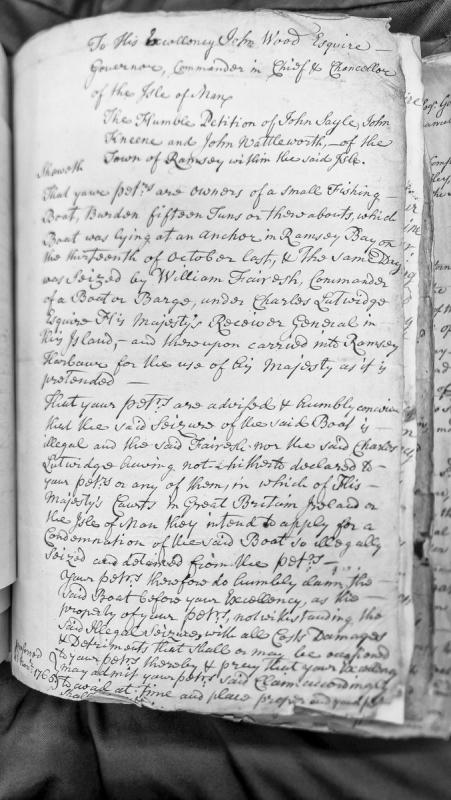
A petition by three Ramsey men (John Sayle, John Kneene, and John Wattleworth) to Governor John Wood protesting the illegal seizure of their fishing boat by William Fairish on 13 October 1765, acting under authority of Charles Lutwidge (His Majesty's Receiver General). The petitioners claim no court jurisdiction has been declared and seek recovery of their vessel with damages.
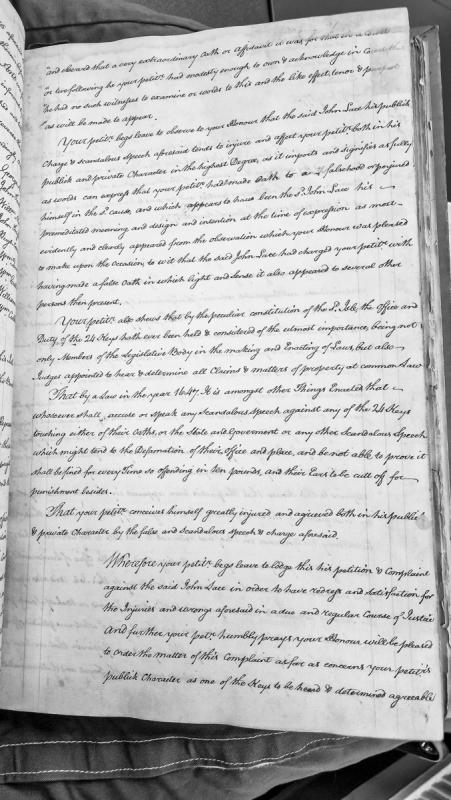
A petition lodged by a member of the House of Keys against John Lace for making false and scandalous accusations regarding a perjured oath. The petitioner seeks redress for injuries to both public and private character, citing Manx law of 1647 which prescribes penalties for scandalous speech against members of the Keys.
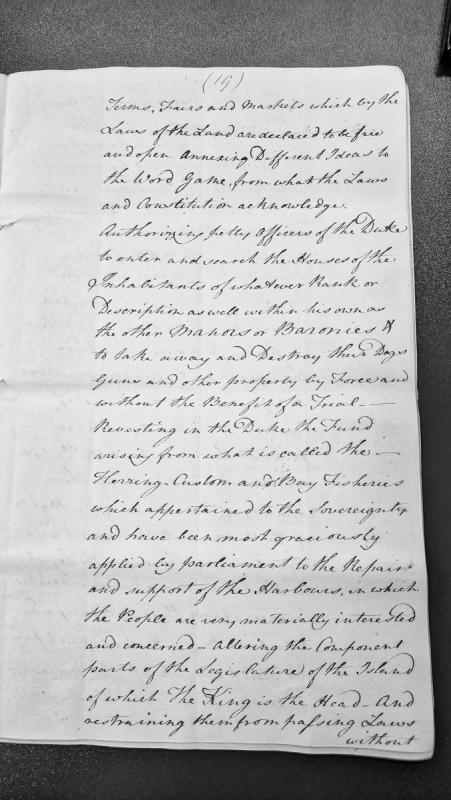
A petition objecting to proposed changes to Manx law, including restrictions on free markets and fairs, new definitions of 'game', authorization for officers to search homes and seize property, reallocation of herring customs revenue, and alterations to the island's legislature. The document expresses concern about loss of parliamentary protections and sovereignty.
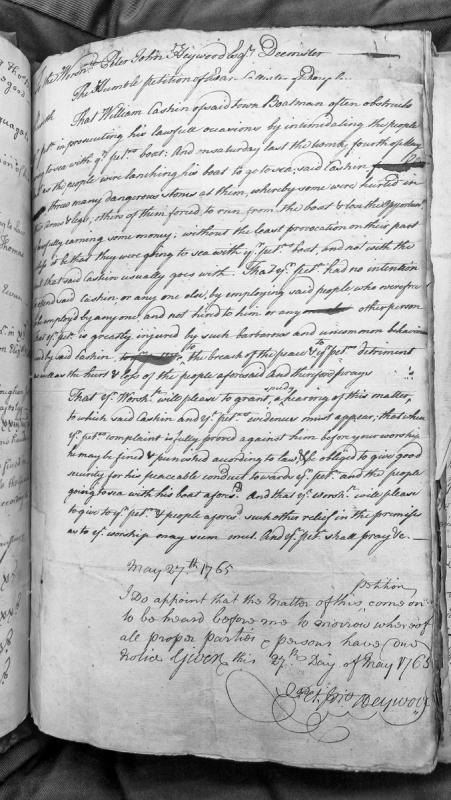
A petition from Daniel Laimster of Ramsey to Deemster Peter John Heywood alleging that William Cashin, a boatman, has obstructed his lawful business by intimidating people and throwing stones at those boarding Laimster's boat on 24 May 1765, causing injury and loss of earnings. The petitioner seeks a hearing, fine, and security for future peace.
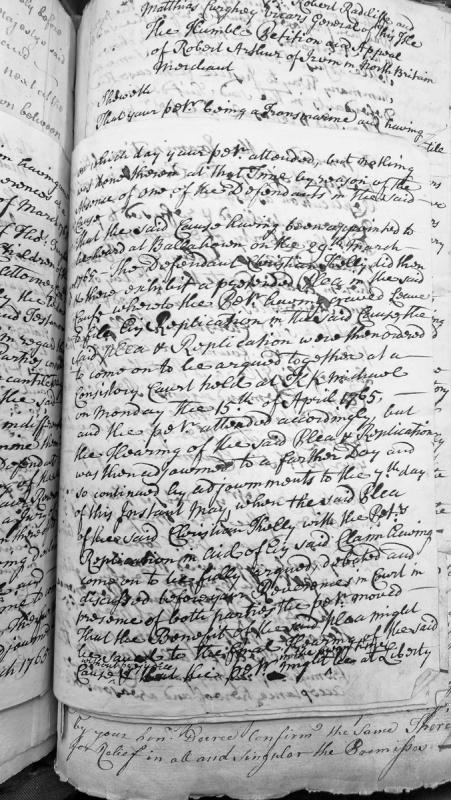
A petition and appeal by Robert Arthur, a transmarine merchant from Irvin in North Britain, to the Vicars General of the Isle of Man regarding an ecclesiastical cause involving defendant Christian Kelly. The document describes proceedings held at Ballahorn on 29 March 1765 and at a Consistory Court at Kirk Michael on 15 April 1765, with arguments heard on 9 May 1765.
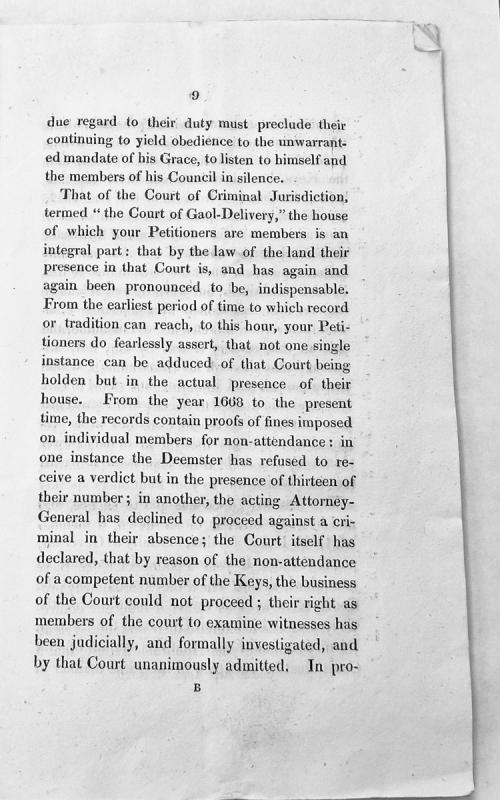
This is an excerpt from a petition by members of the House of Keys asserting their indispensable constitutional role in the Court of Gaol-Delivery (criminal court). The petitioners cite historical precedent from 1668 onwards, including fines for non-attendance, judicial recognition of their right to examine witnesses, and instances where proceedings were halted due to insufficient Keys members present.
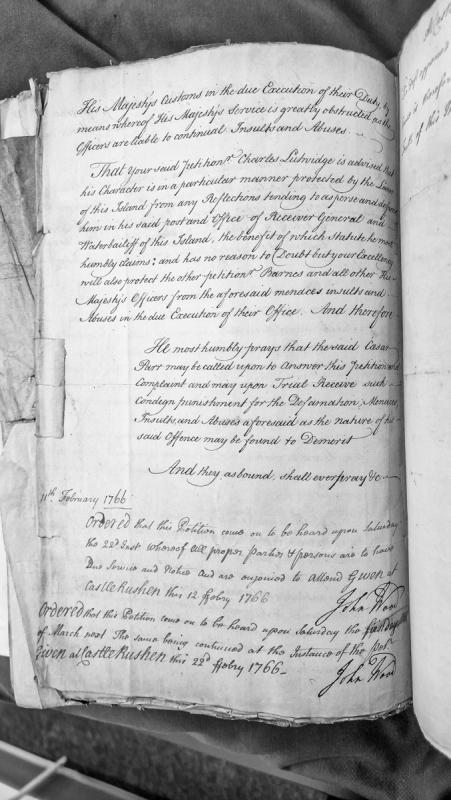
A formal petition to His Majesty's representative requesting protection for customs officers Charles Lutwidge (Receiver General and Waterbailiff) and Barnes from defamation and abuses by Cæsar Perr. The petitioners invoke island law protecting their characters and seek condign punishment for the offender. The document includes court orders scheduling hearings on 22 February and 1 March 1766.
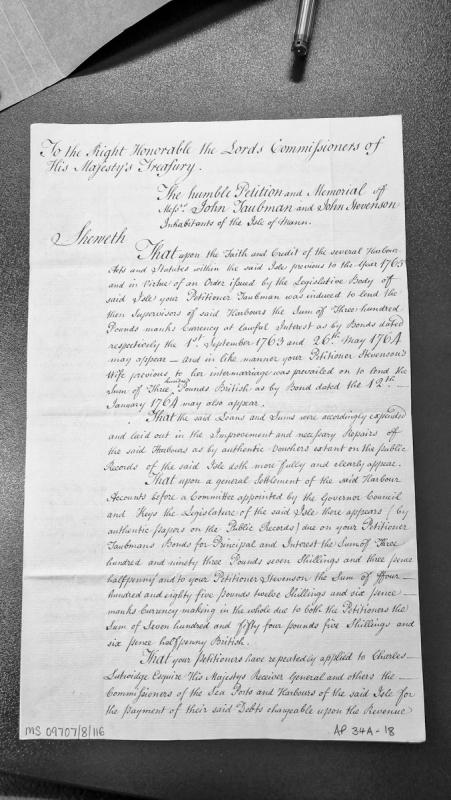
A petition to the Lords Commissioners of His Majesty's Treasury from John Taubman and John Stevenson seeking repayment of loans made to the Isle of Man harbour supervisors. The petitioners lent sums (£300 Manx and £300 British respectively) between 1763-1764 for harbour repairs and improvements, with interest accrued totalling £754 5s 6½d, and request payment from the port revenue.
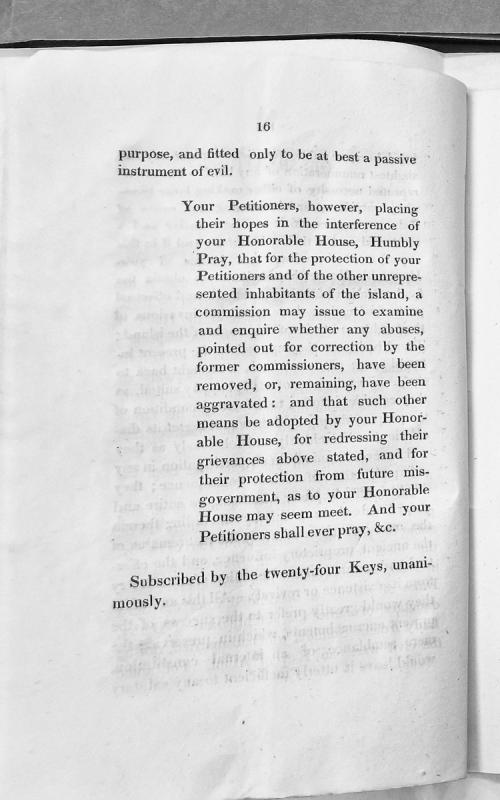
This is the concluding section of a petition from the Keys (House of Keys members) requesting intervention by an honorable House to investigate whether previously identified administrative abuses have been corrected or worsened, and to implement measures for redressing grievances and protecting unrepresented island inhabitants from misgovernment.
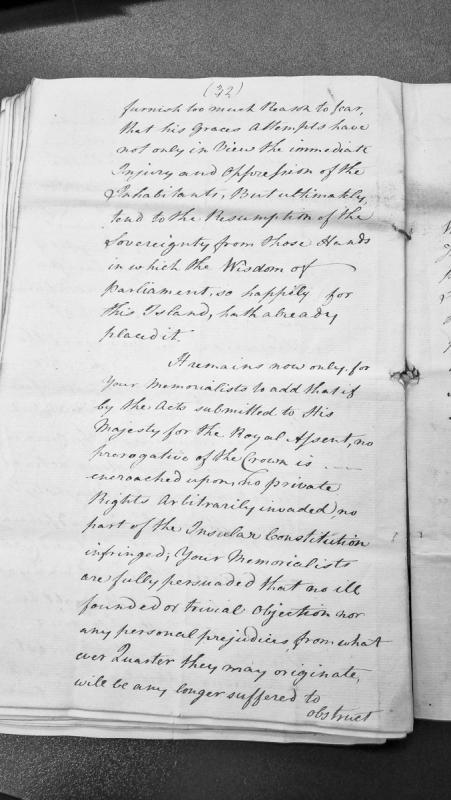
This is an excerpt from a formal petition (memorialists' address) to His Majesty regarding concerns about administrative attempts that threaten local sovereignty and the Island's constitutional rights. The petitioners argue that their proposed acts do not encroach upon Crown prerogative or infringe the Insular Constitution, and request that unfounded objections cease.