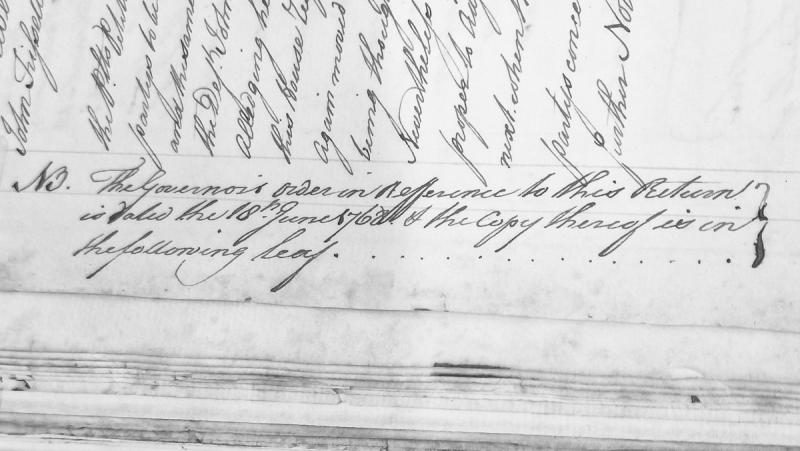
This is an administrative note referencing a Governor's order dated 18th June 1761 concerning a return document. The note indicates that a copy of the Governor's order is located on the following page. The upper portion of the document is partially obscured and cut off in the image.
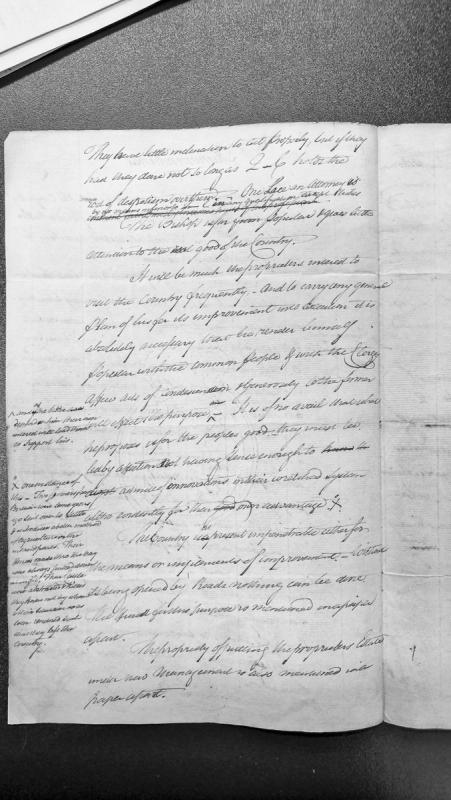
A fragmentary manuscript discussing the governance and economic development of the Isle of Man, with criticism of the proprietor's engagement with the populace and clergy. The text advocates for improved infrastructure (roads) and agricultural methods, and references separate papers on estate management and funding.
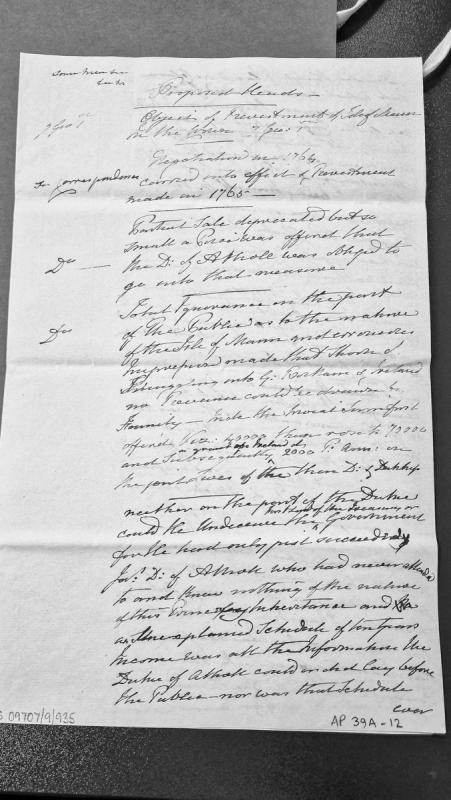
Draft notes outlining proposed discussion points regarding the revestment of the Isle of Mann to the Crown, including historical negotiations (1764-1765), contract details, and issues surrounding public understanding of Mann's revenue potential and smuggling concerns.
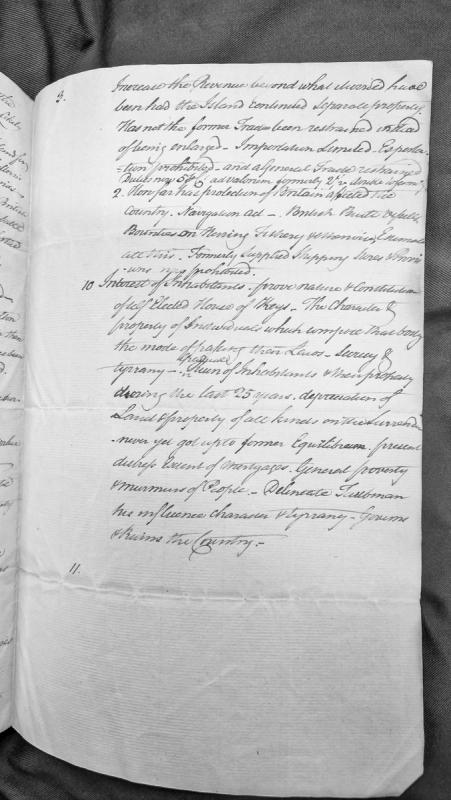
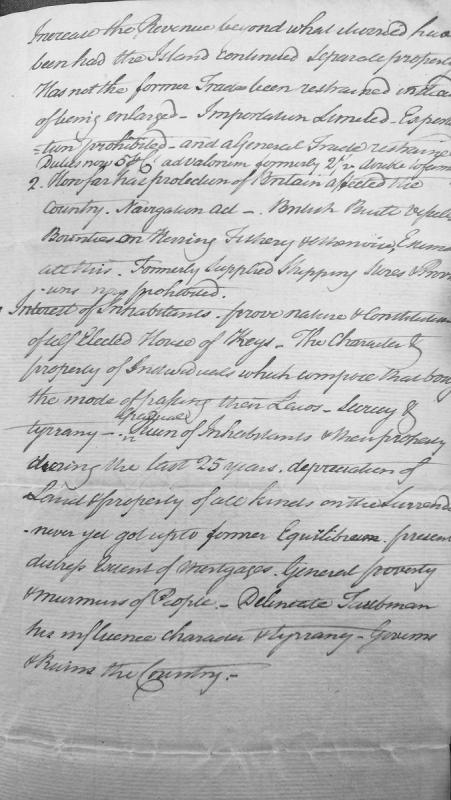
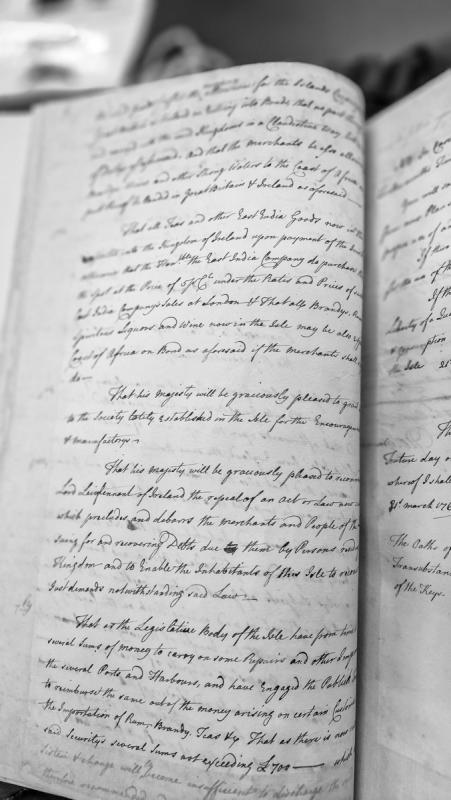
A series of numbered points (9-11) outlining arguments regarding revenue changes, trade restrictions under British protection, and criticisms of the House of Keys governance structure. The document appears to be draft notes or an outline for a petition or legal argument concerning the economic and political condition of the Isle of Man over the preceding 25 years.
A manuscript document containing notes or outline points concerning the economic impact of union with Britain on the Isle of Man, including analysis of trade restrictions, duties, and navigation acts. The document also addresses grievances regarding the House of Keys governance structure, land depreciation, and the alleged tyranny of an individual (Taubman) over the past 25 years.
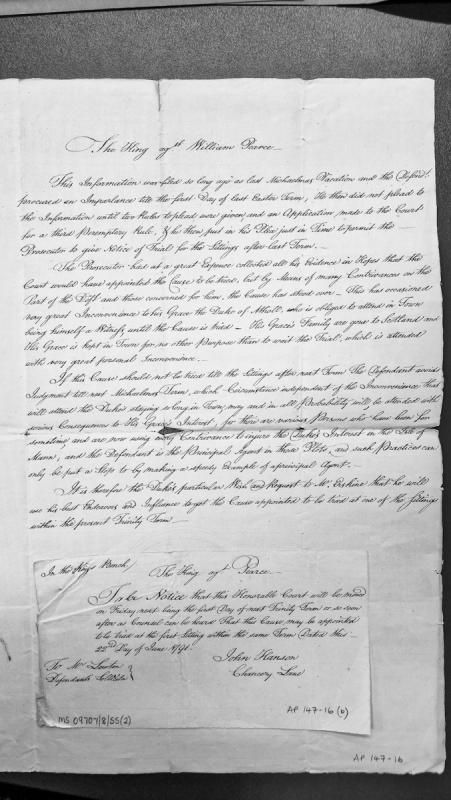
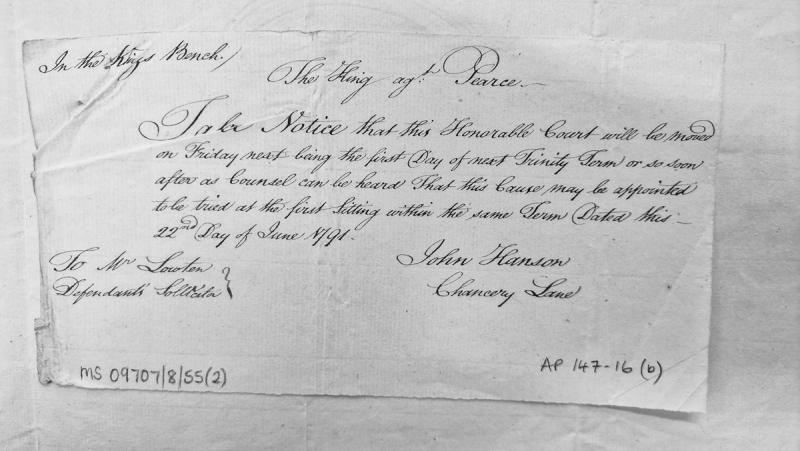
A notice of motion filed in the King's Bench court regarding a case between the King and Pearce. The motion requests that the court appoint the cause for trial at the first sitting of Trinity Term, with the hearing scheduled for Friday, the first day of Trinity Term 1791.
A notice to the defendant's solicitor informing that the King v. Pearce case will be moved before the King's Bench court on the first day of the next Trinity Term (or as soon after as counsel can be heard) for appointment of trial. The notice is dated 22 June 1791.
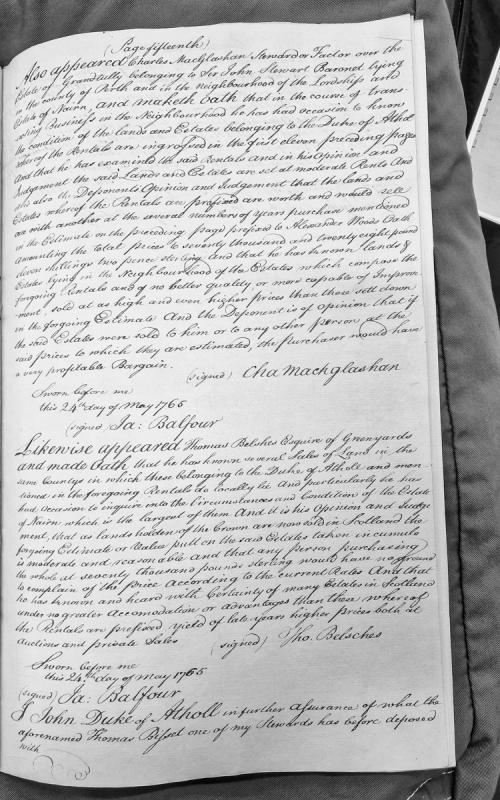
This document contains sworn testimonies from Charles MacGlashan (Steward of Grandtully Estate) and Thomas Belsches (Esquire of Greenyards) regarding the valuation and rental conditions of lands and estates belonging to the Duke of Atholl in Scottish counties. The document provides expert opinions on property values, comparable sales, and rental rates, estimating total estate value at £70,028 7s 2d sterling.
This document presents two versions of the oath administered to members of the House of Keys (Manx parliament): the pre-Revestment oath sworn to the Duke of Atholl, and the post-Revestment oath sworn after British Parliamentary sovereignty. The comparison illustrates the constitutional shift from ducal to Crown authority and the removal of feudal allegiance to the Atholl family.
Comparative text of the oath sworn by members of the House of Keys (Tynwald's lower house) before and after the 1765 Revestment. The pre-Revestment oath pledged allegiance to the Duke of Atholl as Lord of Man; the post-Revestment version transfers allegiance to the Crown. This document is part of a 1792 Commissioners' Inquiry report and directly illustrates the constitutional shift effected by the Revestment.
A partially legible document from March 1763 (or nearby year) relating to oaths, possibly transubstantiation oaths, associated with the House of Keys. The right-hand page is heavily obscured with multiple illegible sections.
Two versions of the oath of allegiance required of the Bishop of Man in 1608 (6 Jas. I). The first oath swears loyalty to the heirs of the Isle and the Captain/Governor; the second swears loyalty to Robert Cecil (Earl of Salisbury) and Thomas Howard (Earl of Suffolk) as representatives of the Crown's interest, and to William Stanley (Earl of Derby) as the hereditary lord. This document illustrates the constitutional and political relationships governing the Isle of Man under early Stuart rule and the division of authority between Crown interests and the Stanley lordship.
Two versions of the oath required of the Bishop of Man in 1608 under James I, showing the shift from allegiance to the heirs of the Isle to specific English nobles (Robert Cecil, Earl of Salisbury and Lord Treasurer; Thomas Howard, Earl of Suffolk; and William Stanley, Earl of Derby). Demonstrates the evolving constitutional relationship between the Isle of Man and English Crown interests, and the role of powerful English lords in governing the island.
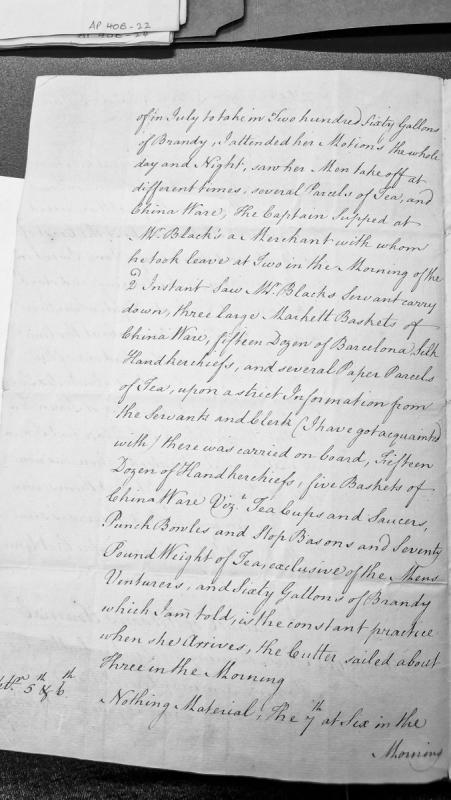
A witness account describing the observation of smuggled goods being loaded onto a ship in July, including brandy, tea, china ware, and silk handkerchiefs. The deponent details surveillance of the vessel's crew and cargo movements, with specific quantities recorded. This appears to be part of a larger court or revenue investigation document.
Official report by Commissioner Reid examining the Duke of Atholl's allegations concerning pre-Revestment (pre-1765) customs revenue collection and smuggling/illicit trade on the Isle of Man. Responds to arguments by the Attorney-General of the Isle regarding the legality and extent of revenue derived from contraband (tea, tobacco, East India goods). Central to disputes over compensation owed to the Duke following the 1765 Crown purchase of sovereignty.
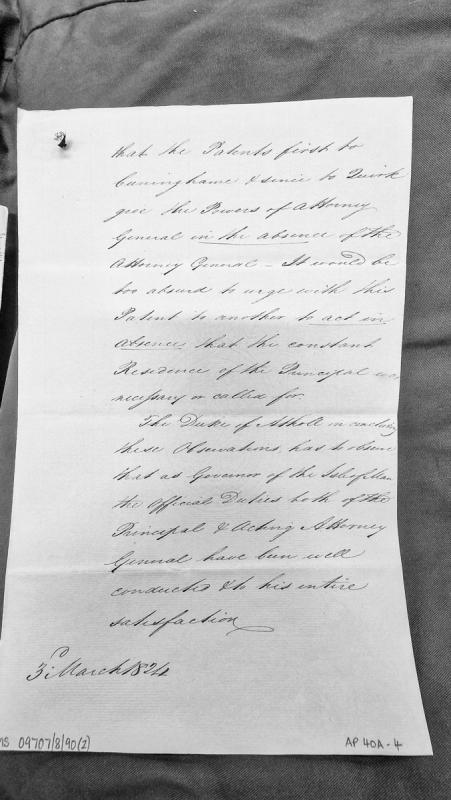
A legal opinion addressing the powers granted by Patents to act as Attorney General in the absence of the principal. The Duke of Atholl, as Governor of the Isle of Man, observes that the Official Duties of both Principal and Acting Attorney General have been well conducted to his satisfaction.
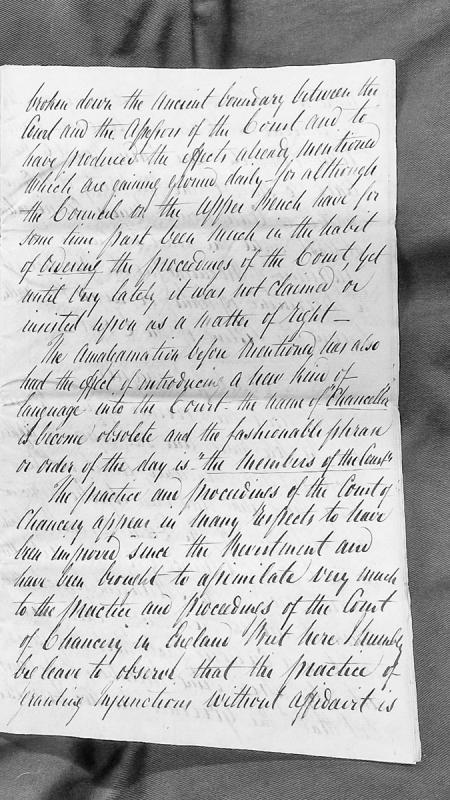
A fragment of a legal opinion discussing institutional changes to the Isle of Man Court following the Revestment, including the amalgamation of court and officers' roles, terminology shifts (obsolescence of 'Chancellor'), and procedural reforms aligning with English Chancery practice. The author raises concerns about the practice of granting injunctions without affidavit.
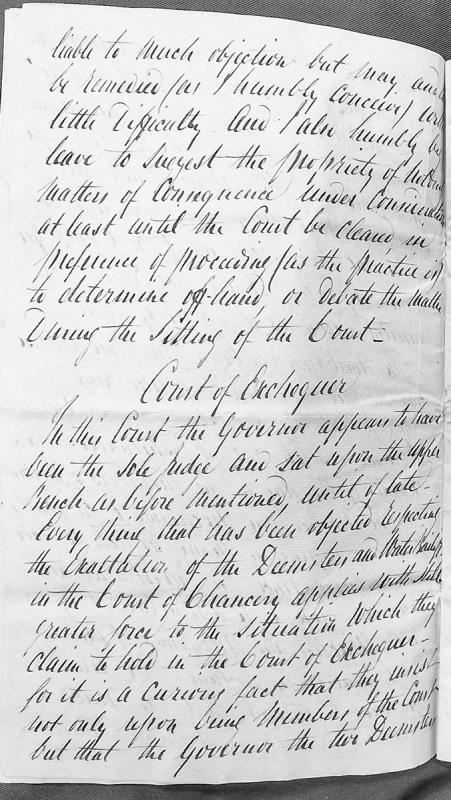
A fragment of a legal document discussing procedural improvements in court management, with particular focus on the role of the Governor and Deemsters in the Court of Exchequer. The author advocates for clearing the court before deliberating on matters of consequence and objects to the elevated status claimed by judicial officers.
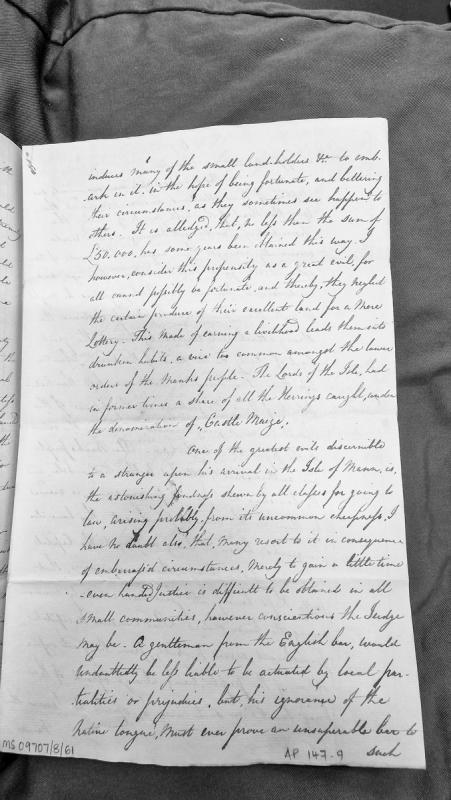
An analytical passage discussing the prevalence of herring fishing lotteries among small landholders in the Isle of Man, their negative social effects including drunkenness, and the unusual propensity for litigation among all social classes. The author critiques the lottery system as a distraction from productive land use and discusses challenges in administering justice.
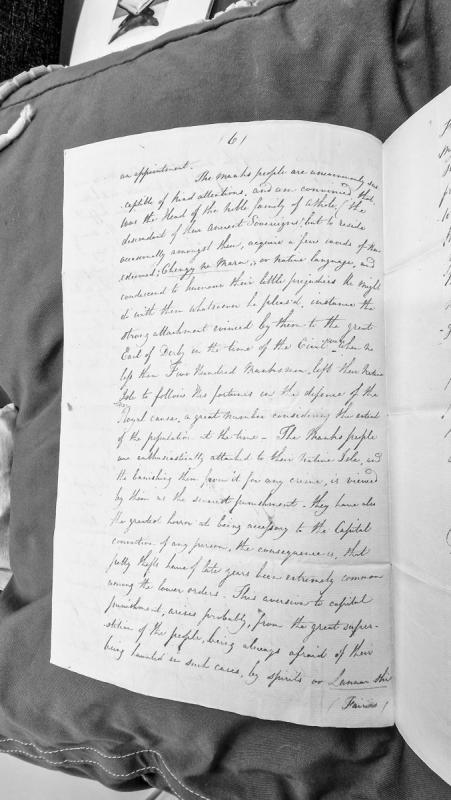
A fragment of text discussing the Manx people's susceptibility to kindness, their attachment to their native language (Chengey ny Mara), historical loyalty to the Earl of Derby during the Civil Wars, and their aversion to capital punishment which the author attributes to superstitious beliefs about spirits (Lannan shi/Fairies).
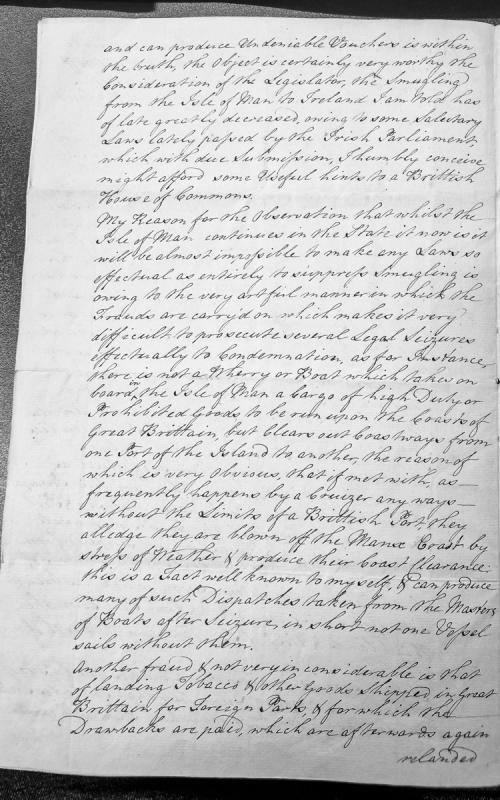
A legal or administrative opinion discussing the difficulties of suppressing smuggling from the Isle of Man to Great Britain and Ireland. The author argues that current laws are ineffectual due to fraudulent practices such as false coast clearances and misuse of export drawbacks, and suggests that Irish parliamentary legislation offers useful precedents.
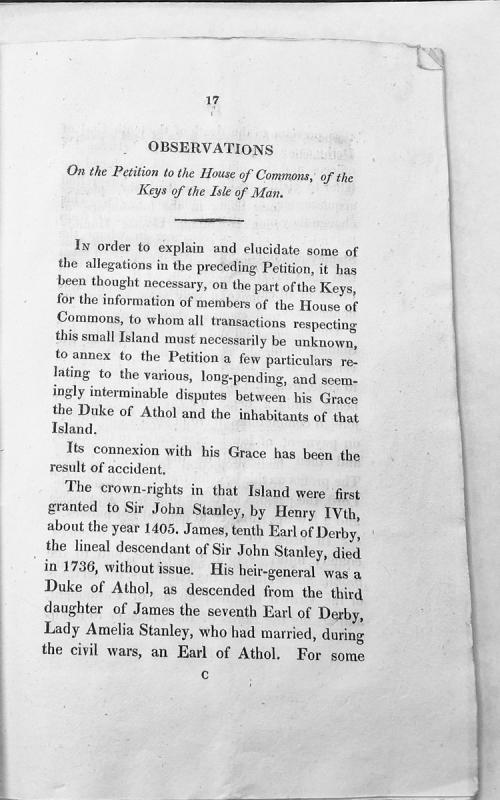
This is a printed pamphlet containing observations explanatory of a petition from the House of Keys to the House of Commons concerning long-standing disputes with the Duke of Athol over the Isle of Man. It provides historical context on the crown-rights granted to Sir John Stanley in 1405 and the succession through the Stanley and Athol families.
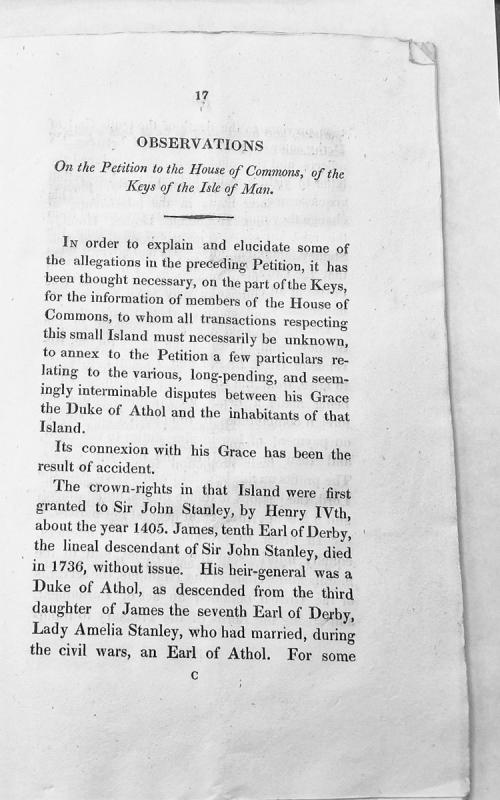
A printed pamphlet presenting observations and clarifications on a petition submitted to the House of Commons by the Keys of the Isle of Man. The document provides historical context on disputes between the Duke of Athol and the inhabitants of the Isle of Man, tracing the island's connection to the English crown through grants beginning in 1405.
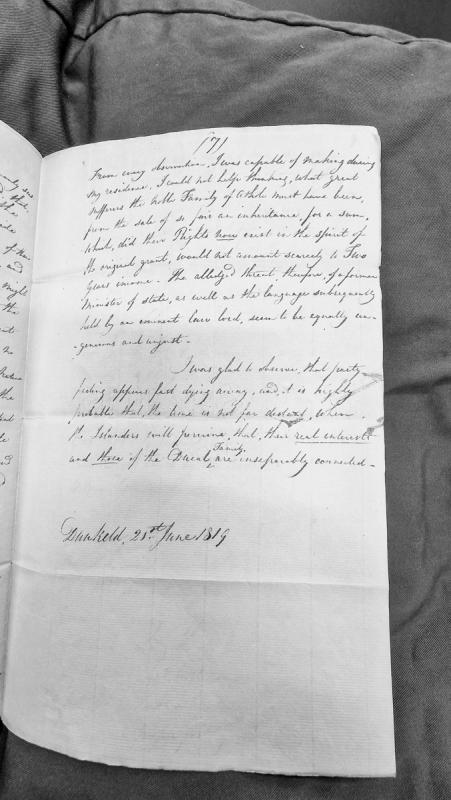
A reflective legal or political commentary discussing the sale of the Athol family's Isle of Man inheritance for an inadequate sum, criticizing threats made by a former Minister of State and a law lord. The author expresses optimism about declining party divisions and the interconnection of Islanders' interests with those of the Ducal family.
An undated administrative report (c.1764) analysing the illicit trade through the Isle of Man, detailing smuggling routes to Ireland, Wales, Scotland and the Solway Firth, the vessels employed, and estimated annual revenue losses to the British Crown (£200,000). The document provides quantitative data on goods flows, duties collected by the Duke of Atholl, and specific seizure records.