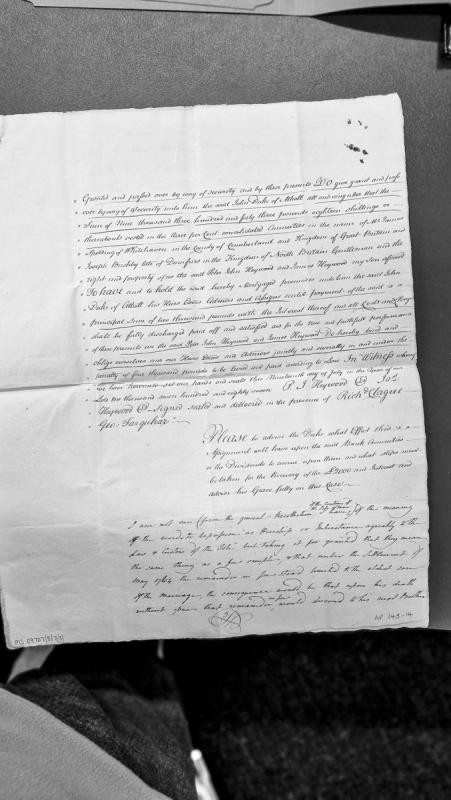
A mortgage deed dated 19 July 1787 wherein Peter John Heywood and James Heywood pledge £9,343 18s in three per cent consolidated annuities to John Duke of Atholl as security for a principal sum of £2000 with interest. The document includes a request for legal advice on the effect of the assignment on bank annuities and recovery procedures.
A legal opinion by Mr Humphreys concerning a proposed grant of annuity from Lord Glenlyon to the Norwich Insurance Company, dated 8 October 1824. The document appears to be a copy of the original opinion.
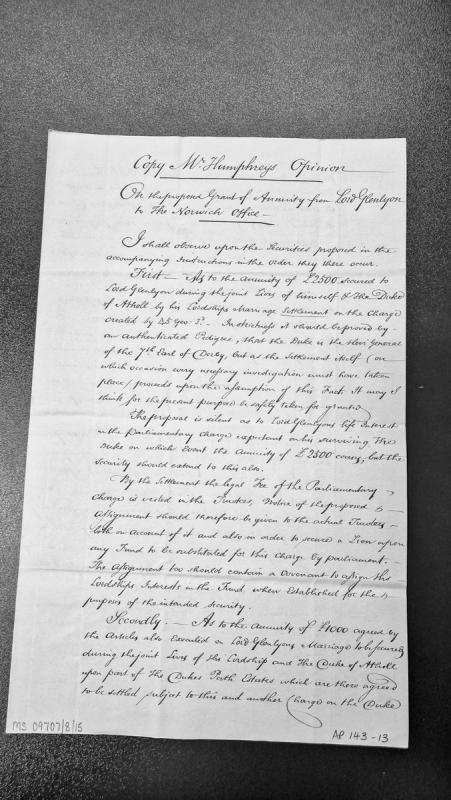
A legal opinion analysing the securities proposed for an annuity grant from Lord Glenlyon to the Norwich Office. The opinion examines the proposed annuities of £2500 and £1000 secured through Lord Glenlyon's marriage settlement and charges, with detailed commentary on required authentication and trustee notification.
Stood in the House of Keys in 1890 and said something that deserves to outlast the debate it was spoken in: 'We had a House of Keys ages before the House of Commons was in existence.' A statement of fact. A hundred and twenty-five years of Crown administration, and still the institutions persisted.
Charles Lutwidge reports to Treasury officials on the suppression of East India goods smuggling from the Isle of Man, noting the effectiveness of naval patrols and merchant fear. He details recent vessel movements and recommends making rum an enumerated commodity to combat brandy and rum smuggling from colonial plantations.
Charles Lutwidge reports to Treasury officials on suppression of East India goods smuggling and brandy/rum imports to the Isle of Man. He describes impacts of naval patrols by sloops of war and cutters, notes counter-orders preventing merchant vessels from delivering contraband, and recommends adding rum to enumerated commodities. This is a key intelligence document on the effectiveness of revenue enforcement measures in 1764.
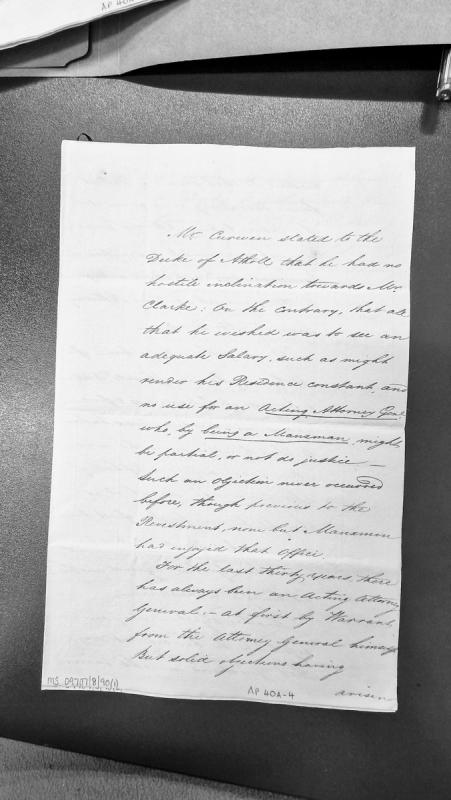
A record of Mr. Curwen's statement to the Duke of Atholl concerning the adequacy of the Attorney General's salary and his objection to appointing a Manxman to the position. The document discusses the history of acting Attorney General appointments over the preceding thirty years and notes that such objections to Manxmen holding the office had not previously occurred.
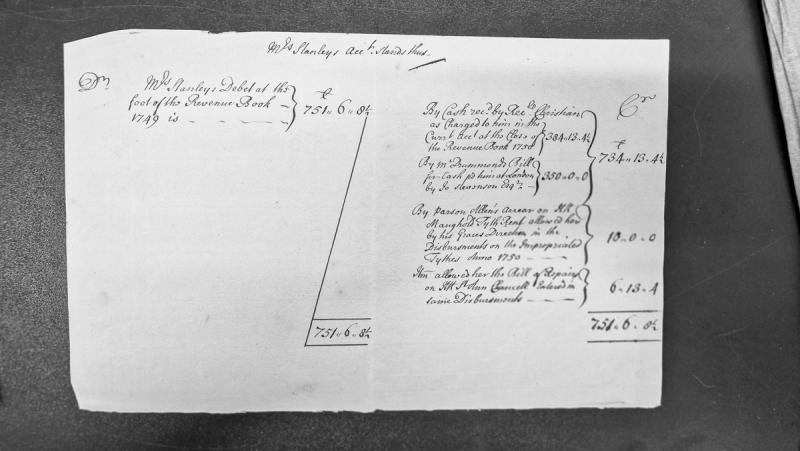
A financial account showing Mrs Stanley's debt and credits for the period 1749-1750. The account records her initial debt of £751 6s 8½d against the Revenue Book for 1749, balanced by receipts including cash from Revd Christian, Mr Drummond's bill, and allowances for various ecclesiastical expenses.
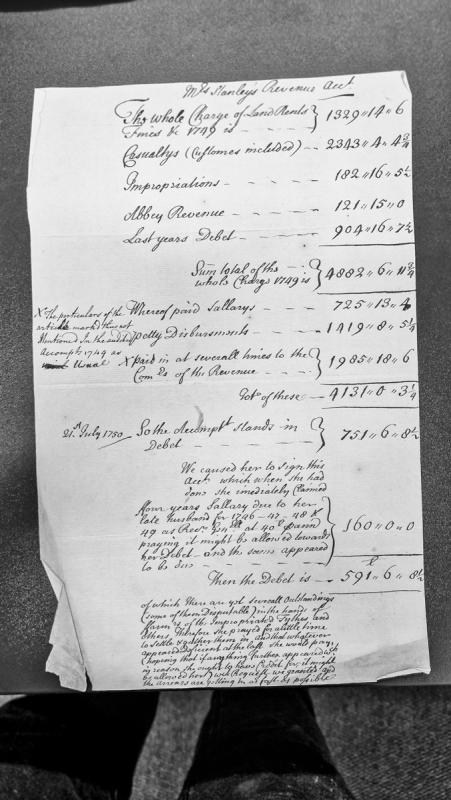
A revenue account for Mrs Stanley covering the year 1749, detailing charges from land rents, fines, casualties, impropriations, and abbey revenue, with disbursements and a final accounting as of 21 July 1750. The document records a debit balance and notes Mrs Stanley's claim for four years of salary due to her late husband as Receiver General.
Letter from James Murray, British Ambassador to Venice, to Earl of Halifax analysing the failure of the Order in Council to prevent smuggling at the Isle of Man. Murray argues that the Lord's extensive original grant powers make suppression impossible and recommends Crown purchase of the island as the only effective remedy. Includes revenue estimates and observations on the island's population and foreign smugglers.
Ambassador James Murray reports from Venice to the Earl of Halifax on the ineffectiveness of the Order in Council against smuggling at the Isle of Man. Murray argues that purchase of the island by the Crown is the only viable solution, given the extensive powers of the Lord Proprietor and the geography making enforcement impossible. He notes the island's revenue potential (£4,000–5,000 p.a.) and the political stability of its largely Anglican population.
Dan Mylrea, Isle of Man's chief revenue officer, confirms to Charles Lutwidge that import and export books for the past ten years can be made available upon proper authority. This correspondence evidences the transfer of commercial records to Westminster officials investigating the Island's trade and smuggling activity immediately after the Revestment.
Letter from Dan Mylrea (Collector of Customs, Isle of Man) to Charles Lutwidge, confirming that the Governor has approved production of ten years of import/export books (Ingates & Outgates) upon receipt of proper authority. Mylrea also confirms sending a copy of the Book of Rates and offers further assistance with revenue collection. This document is crucial evidence of Lutwidge's investigation into smuggling losses and the Treasury's interest in Manx trade records immediately before the Revestment Act.
Last native speaker of the Manx language. He had learned Manx as a child from an aunt who spoke no English. He died at ninety-seven in 1974. A language spoken on the Island since at least the fifth century — older than English, older than Parliament, older than the lordship that Parliament had purchased — and when he died, the thread of unbroken transmission that connected the Island to its own past was severed. UNESCO declared Manx extinct. But the recordings existed — made in 1948 when the Irish Taoiseach Eamon de Valera sent equipment across. The grammars existed. The Bible existed. Wilson's translations, Hildesley's completions. UNESCO revised its classification to 'critically endangered.' The language came back.
An extract from Nennius' 9th-century Historia Brittonum, Chapter II, describing Britain's geography, cities, and three principal islands—including Eubonia (Isle of Man). Provided in both English translation and original Latin. Relevant as early medieval context for Isle of Man's political and territorial status.
Excerpt from Nennius' 9th-century Historia Brittonum describing the geography and extent of Great Britain, including identification of three major islands: Inisgueith (Isle of Wight), Eubonia/Manau (Isle of Man), and Orkneys. Provides early medieval nomenclature and political context for the Isle of Man within British geography.
An excerpt from Nennius' 9th-century historical narrative, presented in both English translation and Latin original (Ex Nennio, Cap. II). This passage describes early post-Roman settlement of Britain and Ireland by peoples from Spain, including the settlement of Eubonia (the Isle of Man) by Builc. Included in Manx Society vol. IV (Monumenta de Insula Manniae), this is a foundational historical source for understanding pre-medieval Manx territorial identity and sovereignty.
A bilingual (English/Latin) extract from Nennius' 9th-century Historia Brittonum, republished in Manx Society vol. IV (Monumenta de Insula Manniae). The passage describes early settlements in Britain and Ireland, including the occupation of Eubonia (the Isle of Man) by Builc. Relevant as foundational historical context for understanding pre-medieval Manx history and the island's early political status.
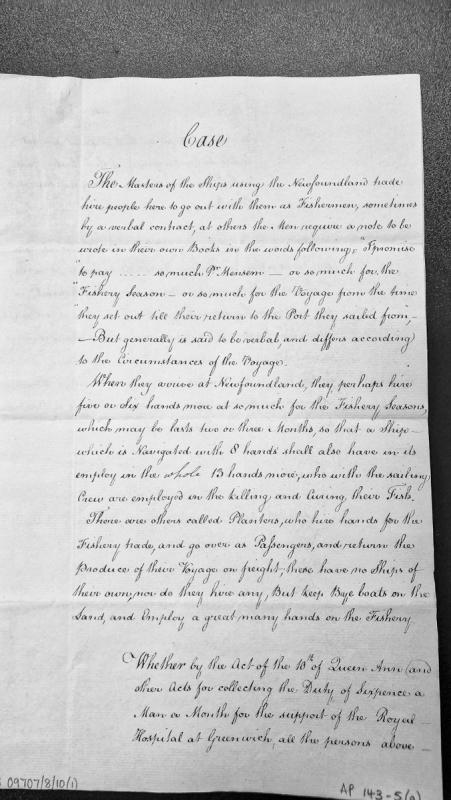
A legal analysis of hiring practices in the Newfoundland fishing trade, describing contractual arrangements for fishermen (both verbal and written), the employment structure aboard fishing vessels, and the distinction between ship masters and planters. The document discusses crew compositions and raises questions about applicability of duties under Queen Anne's Acts.
Site of the Iapetus Suture on the southwest coast — the geological fault line where Laurentia and Gondwana collided. The northern half of the Island was once part of Scotland, the southern half part of England. The Island's geology mirrors its political story.
Letter from Geo. Nicholson and John Cunningham to Mr. Bowes reporting on warnings issued to the Isle of Man regarding defensive preparations against unspecified threat. References correspondence sent via Kyrkowbray to the Captain of the Isle of Man. Document originates from the State Paper Office, Scotland and reflects 16th-century administrative communications concerning Manx governance and security.
High-Bailiff of Douglas who approached Lieutenant Hawkes directly and asked his intentions regarding impressment. Hawkes gave assurances he would not interfere with the fishery. When Hawkes broke his word, Moore led the meeting of principal inhabitants that produced the memorial to the Lieutenant-Governor.
The era of the sea kingdom. Godred Crovan's conquest at the Battle of Sky Hill in 1079 founded the dynasty that would rule for nearly two centuries. Tynwald formalised governance at a site the Manx people already considered sacred. The 32 Keys served a kingdom that stretched across the Hebrides. Norse and Celtic traditions intertwined — Thorwald's Cross at Kirk Andreas carries Odin on one face and Christ on the other. The diocese of Sodor answered to Trondheim, not Canterbury. Rushen Abbey kept the Chronicles of the Kings of Mann and the Isles. The Treaty of Perth in 1266 ended Norwegian suzerainty.
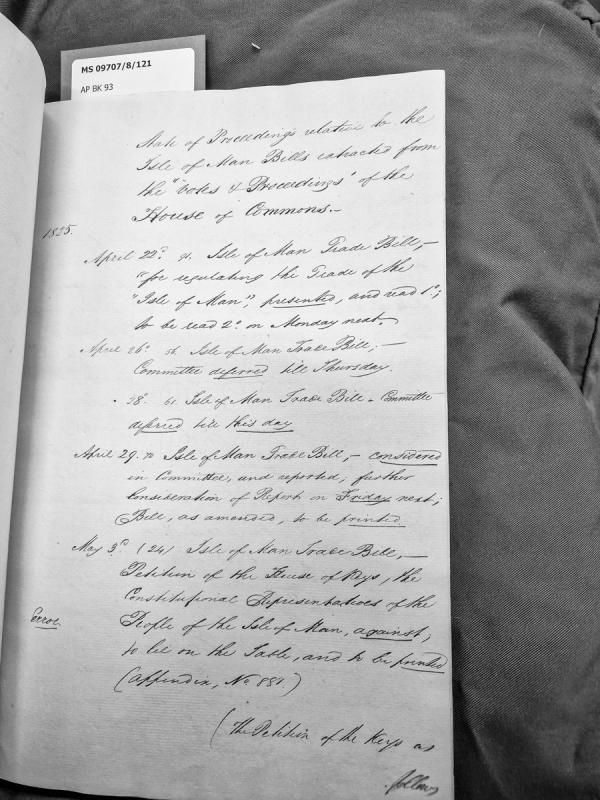
A chronological record of parliamentary proceedings regarding the Isle of Man Trade Bill during April-May 1825, extracted from House of Commons Votes and Proceedings. Documents the bill's progression through parliamentary stages including first reading, committee deferrals, and committee consideration, along with a petition from the House of Keys opposing the bill.