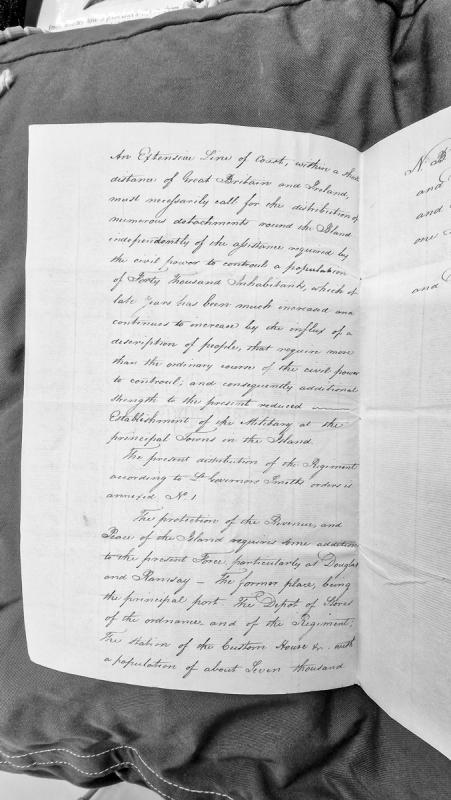
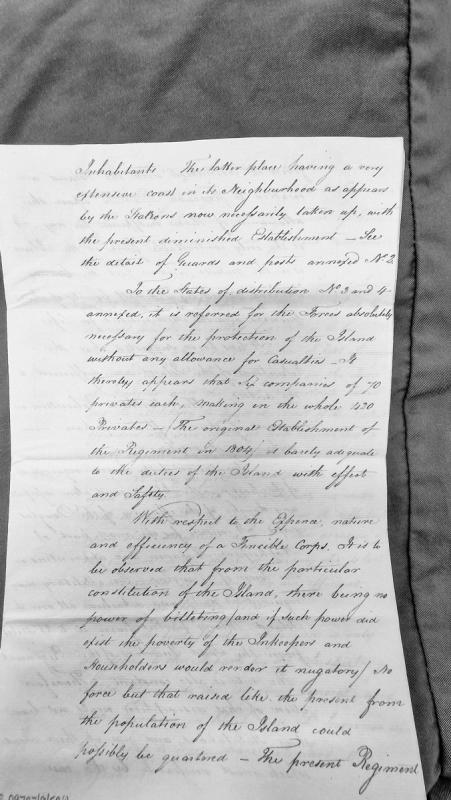
Administrative document discussing the distribution of military detachments around the Isle of Man, the need for additional military strength to control an increasing population, and specific garrison requirements at Douglas and Ramsay. References Lt Governor Smett's orders and notes Douglas as the principal port and regimental depot.
This document discusses the military garrison requirements for the Isle of Man, referencing the distribution of forces across coastal stations and the necessity of maintaining a regiment of six companies with 70 privates each (420 total). It examines the constitutional limitations of the island regarding billeting and the practical need for a Fencible Corps raised from the local population.
A comprehensive tabular and narrative history of the five military garrisons maintained by the Stanley lords on the Isle of Man from 1670 to 1765, based on examination of Disbursement Accounts. Provides details of garrison strengths, pay scales, organizational structure, and lists of soldiers and officers at Castle Rushen, Peel, Douglas Fort, Derby Fort, and Ramsey. Directly contextualizes the military and administrative infrastructure that the British Parliament acquired during the 1765 Revestment.
Comprehensive reference document extracting garrison organization, pay structures, and personnel records from Manx Disbursement Accounts (1670-1765, with gap 1674-1682). Details the composition, ranks, and salaries of military forces at Castle Rushen, Peel, Douglas, Derby Fort, and Ramsey, with indexed tables of soldiers' names, dates of service, and biographical notes. Essential context for understanding administrative structures and military personnel immediately preceding the 1765 Revestment.
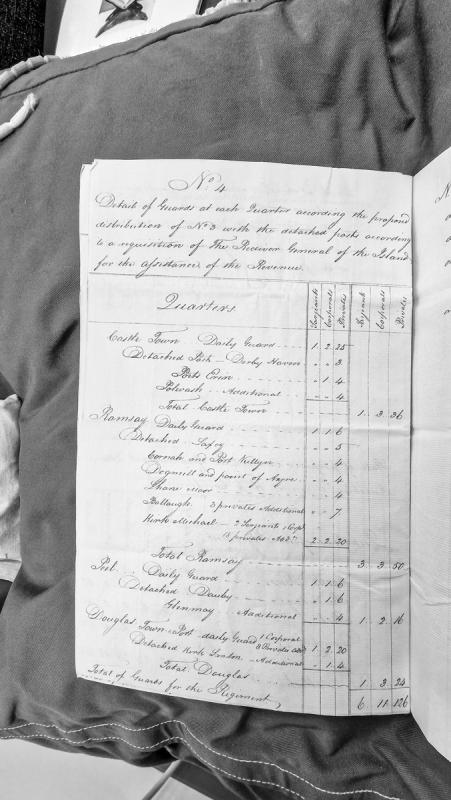
A tabular administrative document detailing the distribution of military guards across various fortified positions and towns on the Isle of Man, including Castle Town, Ramsay, Peel, and Douglas. The table specifies personnel allocations (Sergeants, Corporals, and Privates) for daily guards and detached posts at key locations such as Derby Haven, Port Erin, Laxey, and other strategic points.
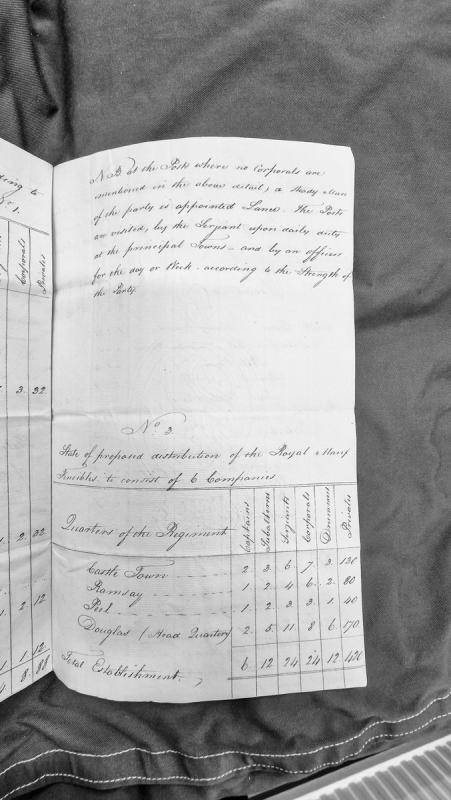
A tabular summary showing numerical distribution across four Manx towns (Castle Town, Ramsay, Peel, and Douglas) with columns representing different categories of establishment or personnel. The table includes totals for each category and a final aggregate column showing 420 as the total establishment figure.
A comprehensive historical survey of Manx military structures from pre-Norman times through the Napoleonic era, covering beacon systems, the Norse ship-levy (skeita-thing), parish militia organisation under the Stanleys, the 1651 rebellion, 18th-century militia decline post-Revestment, volunteer corps, and Fencible regiments. Directly relevant to understanding civil-military organisation before and after the 1765 Revestment, particularly regarding the cessation of militia musters after Crown acquisition.
A detailed historical chapter on Manx military forces following the 1765 Revestment Act, covering the decline of the foot militia, the Royal Manx Fencibles (1779–1810), volunteer corps during the Napoleonic Wars, and fortification history. Directly relevant to understanding post-Revestment governance, defence organization, and social mobilization on the island.
A scholarly chapter on Manx military history covering the period immediately following the 1765 Revestment Act. Traces the decline of the traditional foot militia, the rise and operations of volunteer corps during the Napoleonic Wars, the formation and service record of the Royal Manx Fencibles, and the state of coastal defences. Directly relevant to understanding post-Revestment governance, security arrangements, and social mobilization on the island.
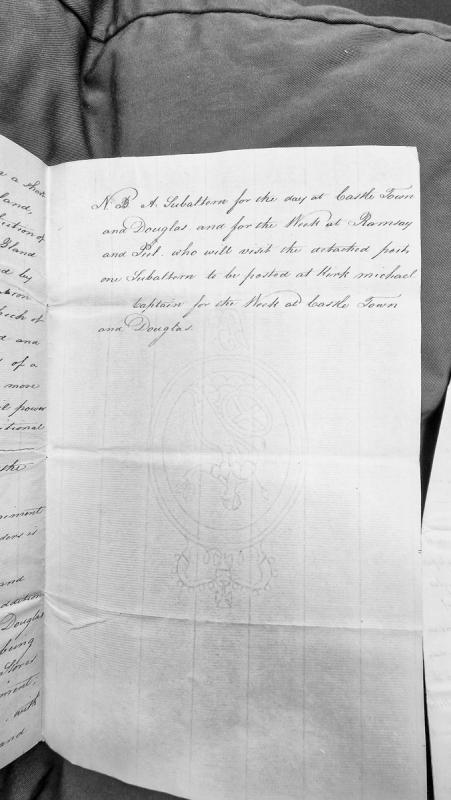
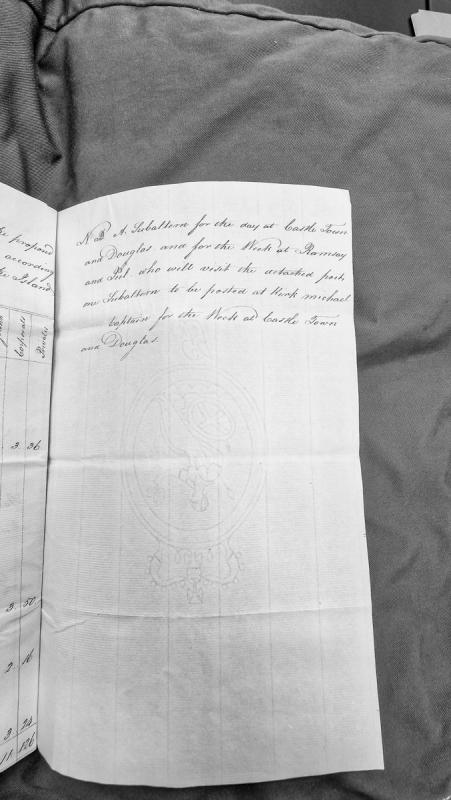
Administrative note detailing military personnel postings across Isle of Man locations, specifying weekly rotations for subalterns at Castle Town, Douglas, Ramsey, and Peel, with an additional post at Kirk Michael and captain assignments.
Administrative note detailing the posting assignments for military personnel (subalterns and captain) at various Castle Town, Douglas, Ramsey, Peel, and Kirk Michael locations. The document specifies daily rotations at Castle Town and Douglas, weekly rotations at Ramsey and Peel, with a permanent subaltern at Kirk Michael and a captain assigned weekly.
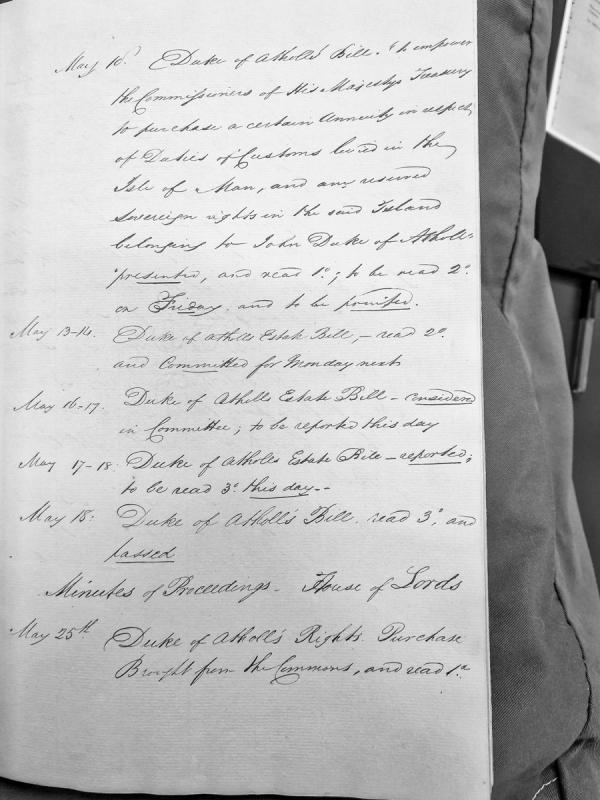
Parliamentary minutes recording the progression of the Duke of Atholl's Bill through the House of Lords in May 1765. The bill concerns purchasing an annuity from customs duties collected in the Isle of Man and reserved sovereign rights belonging to John Duke of Atholl. Documents multiple readings and committee consideration.
Companion legislation to the Purchase Act, extending British customs law to the Isle of Man and criminalising the trade that had been legal under Manx law. What had been commerce became contraband overnight. The Act imposed the full weight of the British customs establishment on an island whose entire commercial infrastructure was built on the trade Parliament had just abolished.
The language came back. Bunscoill Ghaelgagh opened in 2001 — a Manx-medium primary school teaching children in the language that was supposed to have died. Brian Stowell and Douglas Faragher led the revival. Tynwald still meets on the hill at St John's every July. The petitions of doleance are still heard. The survival of Manx identity is the people's achievement, not the Crown's. The indifference that caused the devastation also permitted the endurance. Crown dependence is not an administrative category. It is a living condition.
Chapter 16 from 'Land of Home Rule' (1893) examines the constitutional and financial settlement of the Isle of Man following the 1765 Revestment. It traces the key financial conflicts between Parliament and the Island (1837-1866), the reform of the House of Keys into a representative body in 1866, and concurrent disputes over the bishopric and church governance.
Chapter 16 of a published history covering the post-Revestment period (1829–1893), focusing on the constitutional and financial struggle between the Island and Parliament over taxation, customs duties, and Tynwald's powers. Examines the gradual evolution of fiscal and representative institutions, including the House of Keys reform, the bishopric controversy, and the relationship between Imperial and insular governance.
A table of contents page for Monumenta de Insula Manniae, a foundational collection of historical documents relating to the Isle of Man. This is a web-based index to a comprehensive documentary source that would cover medieval to early modern Manx history, likely including materials relevant to constitutional, administrative, and legal history of the island.
This is a web-based table of contents page for Monumenta de Insula Manniae, a collection of historical documents and records relating to the Isle of Man. The page appears to be from an early web implementation using HTML frames technology, indicating mid-1990s to early 2000s origin. It serves as a finding aid and navigation tool for accessing primary source materials relevant to Manx history.
This is a table of contents / index page from Manx Society Volume 7 (Monumenta de Insula Manniae Vol 2), cataloguing medieval documents from 1282 relating to Isle of Man, Scotland, and Norway. It lists charters, donations, and agreements involving King Magnus of Man, Scottish kings, Norwegian kings, and the monastery of Rushen. The documents cover territorial compositions, royal confirmations, and administrative records relevant to Manx sovereignty and ecclesiastical holdings.
Volume II of a published collection of historical documents relating to the Isle of Man, edited and translated by J. R. Oliver, M.D., and published by the Manx Society. Contains medieval charters, legal documents, and administrative records spanning from 1134 to the reign of Henry IV. Includes explanatory maps, an extensive table of Latin abbreviations used in ancient records, and detailed administrative and ecclesiastical documents relevant to Manx constitutional and legal history.
During the Second World War, the Mooragh Camp at Ramsey was one of several internment facilities on the Isle of Man. Douglas boarding houses along the promenade were also requisitioned for internment purposes. Once again, the island was being defined by someone else's needs — a convenient location to hold people the British mainland did not want. The pattern was familiar: Mann had been used by other people for other people's purposes for as long as it had existed in other people's awareness. The internment camps of two world wars defined Mann as a holding pen, just as the Revestment had defined it as a revenue line.
George Moore and others travelled to London repeatedly to petition for relief from the consequences of the Revestment. The deputations were received politely and achieved nothing. Moore's letters from London, preserved in the Bridge House Papers, document the experience of a Manx patriot confronting parliamentary indifference.
The historian A.W. Moore fixed 1824 as the date at which the Manx labourer reached his lowest depth of misery. The 1827 emigration ships sailed three years later. The timing was not coincidental. The people who packed their chests and walked behind the carts laden with luggage from the north of the island to the harbour at Douglas were leaving at the worst possible moment — which was also the only moment when leaving became easier to face than staying.