This is a metadata record for an automated transcription from the Manx Primary Source Archive, indicating an image file was processed but no document content is present in the provided transcription.
This is a metadata header from an automated transcription of a Manx Museum document. The actual document content is not present in the provided transcription file, which contains only the processing metadata indicating the source image file, transcription date, and method used.
This is a metadata header from an automated transcription process for a Manx Museum manuscript. The actual document content is not present in the provided transcription file—only the processing metadata is visible.
This is a metadata header for a transcribed Manx primary source document. It records the source image file, transcription date, and transcription method but contains no actual document content to analyze.
This is a metadata header from an automated transcription process, indicating a document from the Manx Primary Source Archive has been processed. The actual document content is not included in this transcription file.
This is a metadata record for a transcribed primary source from the Manx Museum archive, showing transcription details rather than the actual historical document content. The transcription was completed on 2026-02-25 using automated processing.
This is a metadata header record from the Manx Primary Source Archive indicating a transcribed document. The record provides source image reference, transcription date, and processing method but contains no actual document content for analysis.
This is a metadata record for a document transcription from the Manx Primary Source Archive. The actual document content is not provided in this transcription file, which only contains header information about the transcription process and file references.
This is a metadata record for a transcription workflow, not a historical document itself. It indicates an automated transcription was processed through the Claude Batch API on 2026-02-25, but the actual document content is not included in this file.
This is a metadata record for an automated transcription from the Manx Museum archive, indicating a source image file and transcription processing details. No actual document content is present.
On 21 October 1805, the combined fleets of France and Spain met the Royal Navy off Cape Trafalgar. Manx sailors were there — because the herring fleet had trained them, because the Irish Sea had hardened them, because the press gangs had taken them or because, impoverished with no work at home, they had volunteered for the only employer hiring. They carried Manx names — Quilliam, Cawle, Bainbridge, Christian, Crow — and served on Nelson's ships alongside men who had never heard of Tynwald Hill. The battle that would be remembered as the greatest moment in British naval history was fought, in part, by men from an island whose own parliament had been silenced and whose harbours had been left to rot.
A geographical and historical study of Manx emigration to America from the 17th century onward, with particular emphasis on the major settlement wave of the 1820s–1830s in Ohio. Examines the distribution of Manx-Americans, early pioneers, economic integration, and cultural preservation. Relevant to understanding the broader Atlantic diaspora and social conditions driving emigration from the Isle of Man during the pre-Revestment period.
A catalogue/index page from the Manx Society's scholarly publication of medieval documents relating to the Isle of Man, dating to 1282 (10 Edward I). The page lists Latin summaries of charters, letters patent, and agreements involving Norwegian and Scottish kings, the Monastery of Rushen, and Manx territorial holdings. Relevant to understanding pre-Revestment Manx sovereignty and ecclesiastical history.
At its height, the Kingdom of Mann and the Isles stretched from the Hebrides to Dublin. The parliament had 32 members — 16 from the island and 4 from each of four groups of Hebridean islands: Lewis, Skye, Mull, and Islay.
Representatives arrived at Tynwald by boat, crossing hundreds of miles of open water.
Mark the full extent of the sea kingdom on a large map. Mark each island group. Then calculate: how far did the Lewis representatives have to sail? What route would they take? How long in a Norse longship?
A parliament held together by ships and kinship and the authority of a king who ruled from Castle Rushen.
Mother of Henry Tudor. Her marriage to Thomas Stanley connected the Lord of Mann to the Lancastrian claim to the English throne. Through her, the Stanley lordship of Mann became entangled with the highest politics in England.
Remembered the way the language died in the domestic space: 'the old folks would talk Manx when they did not want the children to understand.' The image that captures what the Revestment ultimately cost — not revenue, not harbours, but the thread between generations. The grandmother who could not be understood by her grandchild.
Bishop of Sodor and Man, successor to Wilson. Completed the Manx Bible — the New Testament in 1767, the full Bible in 1772, seven years after Parliament seized the lordship. The translation had been Wilson's project from the beginning. A Manx Prayer Book was printed in 1765 — the year of the Revestment itself — assuming a Manx-speaking congregation would endure. Hildesley observed that of twenty thousand people on the Island, few knew English.
Imprisoned by Bishop Wilson for adultery in 1715. Her husband appealed to the Governor, and the resulting jurisdictional dispute between ecclesiastical and civil courts echoed for years. In 1718 the Governor fined Wilson ten pounds 'for disobedience and contempt of the prerogative of the lord of the Isle.' Wilson paid the fine and carried on.
A comprehensive finding aid and inventory of UK National Archives documents (SP 48/2 and HO 98/63-82) downloaded from Manx Notebook, covering Crown governance of the Isle of Man following the 1765 Revestment purchase. Lists 70 documents chronologically with file references, dates, senders, and brief summaries of content including correspondence on constitutional matters, civil administration, military affairs, and governance between the Duke of Atholl, Lieutenant Governors, and the Home Office.
A comprehensive index and cataloguing guide listing 70 UK National Archives documents (SP 48/2 and HO 98/63-82) covering Crown governance of the Isle of Man after the 1765 Revestment. Includes document references, dates, file names, and brief descriptions of content. Primary value is as a finding aid for locating original documents across the Home Office and State Papers collections.
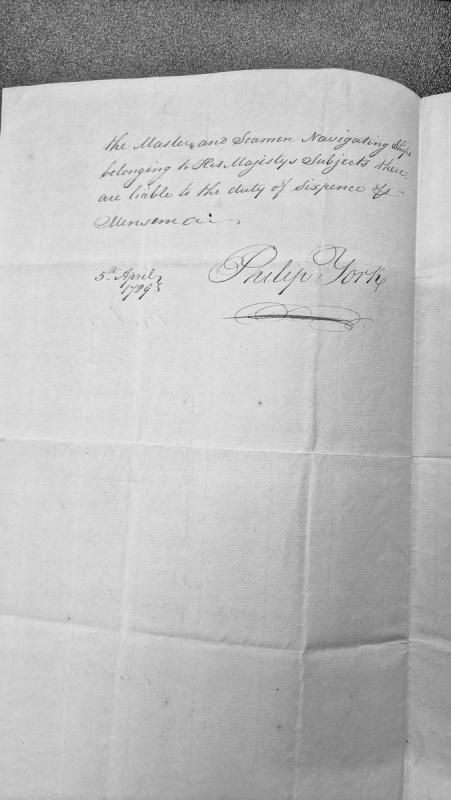
A brief administrative notice regarding the liability of masters and seamen navigating ships belonging to His Majesty's subjects to a duty of sixpence per month. The document is dated 5th April 1799 and signed by Philip York.
Letter from McCrone (likely a factor or estate manager) to the Duke of Atholl regarding the state of Lhen (Lhan Moar) Mill on the Isle of Man. McCrone requests approval for £200 in repairs (wheel, machinery, stones, walls, roof, floors) to restore the mill to profitability, citing a prospective tenant willing to pay £81 annual rent. The letter reflects post-Revestment estate management and revenue challenges on the island.
Letter from Castle Mona estate manager McCrone to the Duke of Atholl regarding the condition and financial viability of Lhen (Lhan Moar) mill on the Isle of Man. McCrone requests £200 for repairs to machinery, wheels, walls, roof and floors, proposing a prospective tenant willing to pay £81 annual rent. The letter reflects post-Revestment property management and estate operations under ducal ownership.
A memorandum documenting discussions between the Duke of Atholl and Governor Cochrane covering fortifications (Castle Rushen, Douglas, Ramsey, Peel, Derby forts), financial accounts, naturalization of six persons, taxation reforms, and pending legal appeals. Reflects the Duke's administrative oversight of the island and evolving governance structures in the 1750s.