The sea god said to protect the Isle of Man in Manx mythology. His cloak of mist concealed the Island from invaders, and his rent of rushes was paid annually at South Barrule and at Tynwald. Central to Manx identity and origin stories throughout Part I.
The old god of the sea who gave the island its name and protected it with his cloak of mist. Before the saints came, the Manx people paid rent to Manannan in rushes, carried to the summit of South Barrule each midsummer. The Metrical History records the tribute: a bundle of coarse meadow grass from every landholder, paid yearly. Some still climbed South Barrule in darkness with bundles of rushes, paying rent to the old god while the Christian island slept. A farm adjoining Tynwald grounds held its tenure tithe-free on condition of providing rushes for the ceremony. The roads to Tynwald carried his name: Bayr ny Managhan, Manannan's Road. The midsummer gathering, the constitutional ceremony, and the rent to the sea god all converged at the same sacred site.
Manannan wrapped his island in mist to hide it from invaders. The blue mist hung continually over the land and prevented mariners from suspecting there was an island so near at hand. Whether anyone still believed this by the eighteenth century is another question, but the old sense persisted that the Island was a place apart, sheltered, hidden, answerable to its own customs. The mist, if it ever existed, was a way of saying something true: that the island's best protection had always been its separateness, its smallness, the fact that it could be overlooked.
An ecclesiastical mandate from John Sharp, Archbishop of York, authorizing the induction, installation, and enthronement of Thomas Wilson as Bishop of Sodor and Man. The document confirms Wilson's nomination by the Earl of Derby (as patron), acceptance by King William III, and consecration by the Archbishop. It includes the form of installation ceremony performed on 11 April 1698 by Samuel Wattleworth, Archdeacon. The text is presented in both English and Latin versions.
An ecclesiastical mandate from John Sharp, Archbishop of York, dated 20 January 1697, formally installing Thomas Wilson as Bishop of Sodor and Man. The document includes the Latin original and English translation, with attestations of installation dated 11 April 1698. Relevant to understanding the Isle of Man's ecclesiastical governance and the formal procedures by which bishops were appointed and installed during the period leading up to the 1765 Revestment.
Collection of three previously published essays by David Craine on early modern Manx history: 'The Killing of William Mac a Faille' (1639), 'Sorcery and Witchcraft' (16th–18th centuries), and 'Church and Clergy, 1600–1800'. Edited and reprinted by Stephen Miller in 1994. Based on close-reading of Manx Museum manuscript holdings, these essays provide insights into Manx legal procedure, folk belief, ecclesiastical governance, agricultural practice, and social structures during the period preceding the Revestment.
Comparative table of customs duty rates on imports and exports in the Isle of Man across four centuries (1577, 1677, 1692), differentiated by native and foreign merchants. Covers staple commodities including agricultural products, alcohol, textiles, and colonial goods. Directly relevant to understanding the revenue base and trade patterns that made the Revestment fiscally significant.
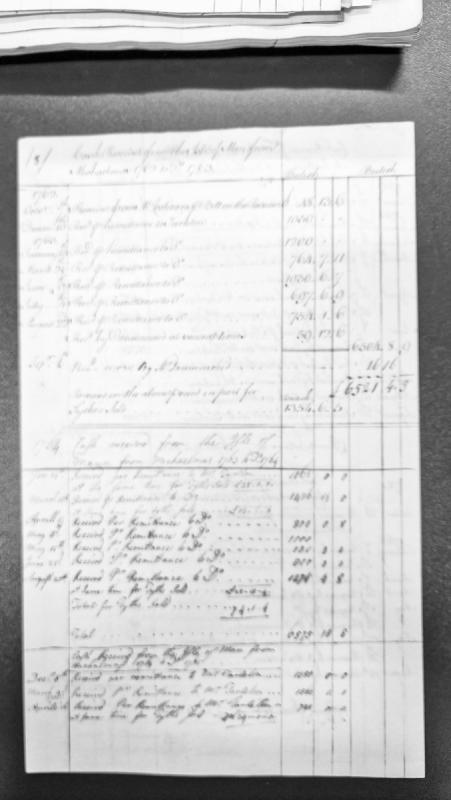
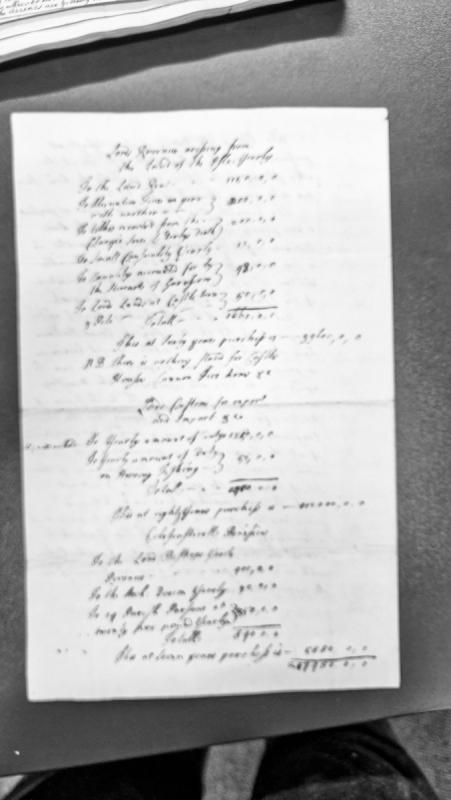
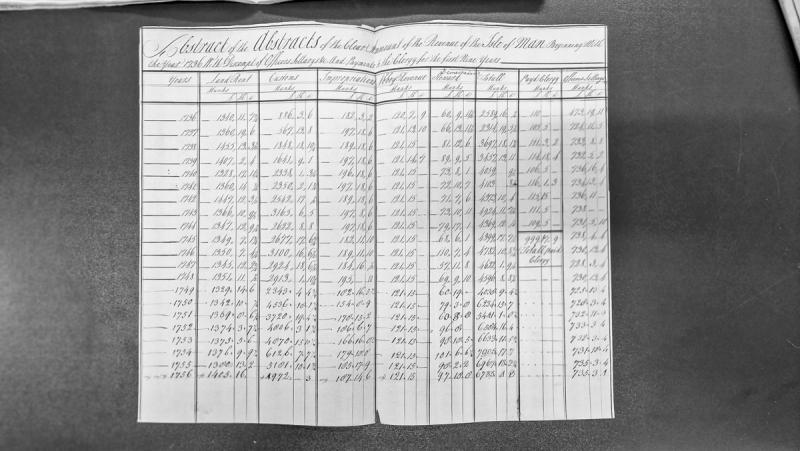
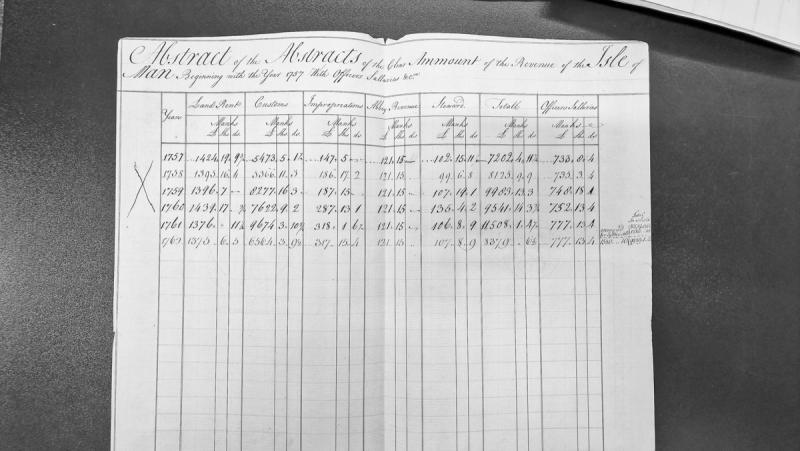
The Duke of Atholl's revenue collection system on the Isle of Man. The entire operation was managed by a handful of officers paid on a scale that invited accommodation. Paul Bridson, the principal revenue officer at Douglas, was paid three pounds Manx per year. The total salary bill for every revenue officer on the Island came to forty-nine pounds, thirteen shillings, and fourpence — for collecting six or seven thousand pounds annually. A significant portion of duties were charged ad valorem, assessed on the value declared by the importers themselves. The Duke observed: 'When I hear of people on such salaries as these, living splendidly, bringing up numerous families, or dying opulent, I cannot but doubt the fair collection.'
A popular historical essay tracing the Standish family's connections to the Isle of Man and arguing that Myles Standish and his wife Rose (and later her sister Barbara) were of Manx origin before emigrating aboard the Mayflower in 1620. The work examines family genealogy, Manx Church records, property entailments, and the Standish family's subsequent role in Manx political life, including House of Keys membership.
Defensive regiment raised on the Isle of Man in the 1790s during the Napoleonic Wars. Officered by Manx families, recruited from the parishes, trained on the Island's own ground. Not the British garrison — the Fencibles were Manx men serving in the Manx military tradition that predated the Revestment by centuries. Raised from an island that Parliament treated as a revenue line, from families living in the conditions the Revestment had created — collapsed economy, ruined harbours, sixpence-a-day wages. They volunteered anyway. Not out of loyalty to the Parliament that had done this to them, but out of something older: the habit of service woven into the Island's identity.
The native language of the Isle of Man, a Goidelic Celtic language closely related to Irish and Scottish Gaelic. Spoken on the Island since at least the fifth century. By the eighteenth century, the vast majority of the population spoke Manx: of 20,000 people, few knew English. The language was the medium through which the island knew itself. Without it, the identity survived but in diminished form, like a landscape seen through glass. The first printed book in Manx was Wilson's Coyrle Sodjeh in 1707. The complete Bible was finished in 1772, seven years after the Revestment. The language went from universal to extinct in two hundred years. Ned Maddrell, the last native speaker, died in 1974. But the revival began before he died, and by 2011, 1,823 people claimed some ability in Manx. UNESCO reclassified it from extinct to critically endangered.
The language lived longer in Ohio than it would live on the Isle of Man. Thomas Kelly's letter from Ohio in 1828 dropped into Manx twice. On the night the emigrants arrived, thirty-three Manx people gathered in one house and Manx was spoken in plenty. Pastor Cannell held services in Manx. George Borrow met a woman whose son lived in a place where Manx was spoken. But the arc was the same: Manx spoken freely by the first generation, used as a secret parents' language within a generation, then gone. The institutional supports were unnecessary in Ohio because the Manx had each other. But as the community dispersed, the language dispersed with it.
The language lived longer in Ohio than it would live on Mann. In the 1830s and 1840s, Manx was still a living tongue in Ohio — spoken in homes, in chapel, in the fields where they cleared the American forest. Pastor Cannell, the seventy-two-year-old Wesleyan who had crossed on the Ocean, held services in Manx in his own log house. No Governor could withdraw it. No bishop could declare it unnecessary. No school board could replace it with English, because there were no schools in the Ohio settlements that the Manx had not built themselves. The language died in Ohio too, eventually. Margaret Murray remembered the same pattern as on the island: the old folks would talk Manx when they did not want the children to understand. But for a time, the institutional supports that had sustained Manx on the island and been removed by the Revestment were unnecessary in Ohio — the Manx people had each other.
A copyright notice from the Manx Notebook website clarifying the terms of use for HTML editions of scanned historical texts. It asserts copyright over the digital edition while acknowledging that underlying source texts are out of copyright, and sets conditions for linking and reproduction.
Contact page for the Manx Notebook website, providing editor Frances Coakley's email and instructions for research inquiries. Notes her substantial Manx library (1500+ monographs, maps, prints) and research support capabilities. Indicates the site contains 15,000+ pages of Manx historical content and references availability of a CD-ROM archive.
An annotated bibliography and index page cataloguing full-text transcriptions of books, documents, and extracts relating to Isle of Man history, society, and culture. The collection spans from 1656 to 1950, including primary sources, travel accounts, historical studies, and genealogical works. Relevant to the Revestment project as it identifies key contemporary sources from the 1765 period and contextual historical materials.
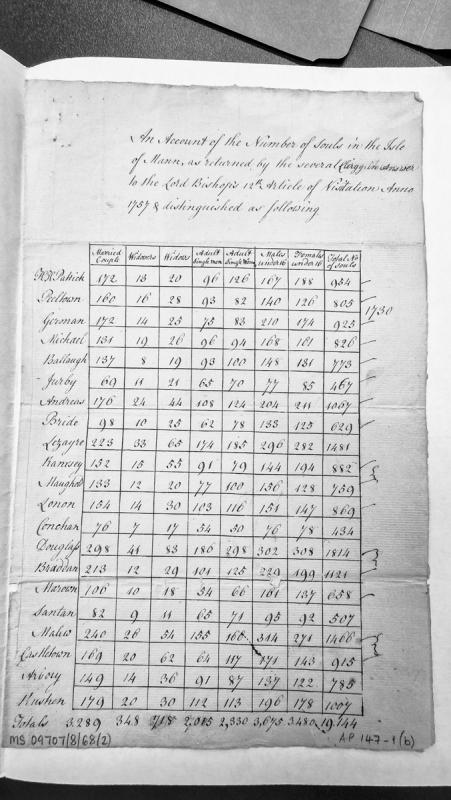
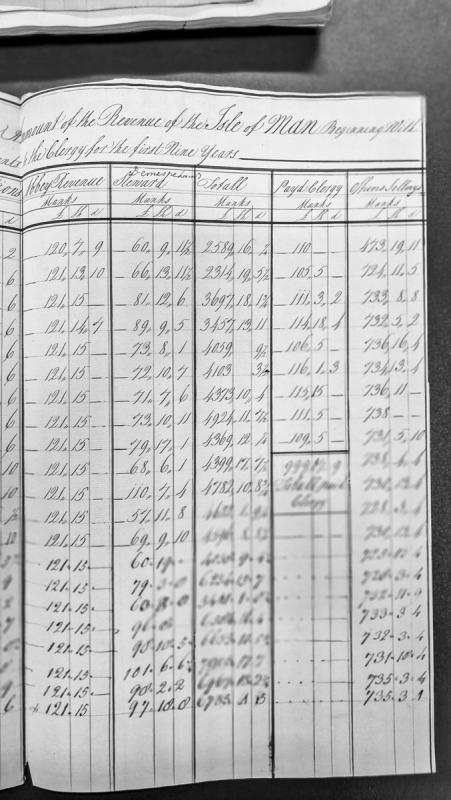
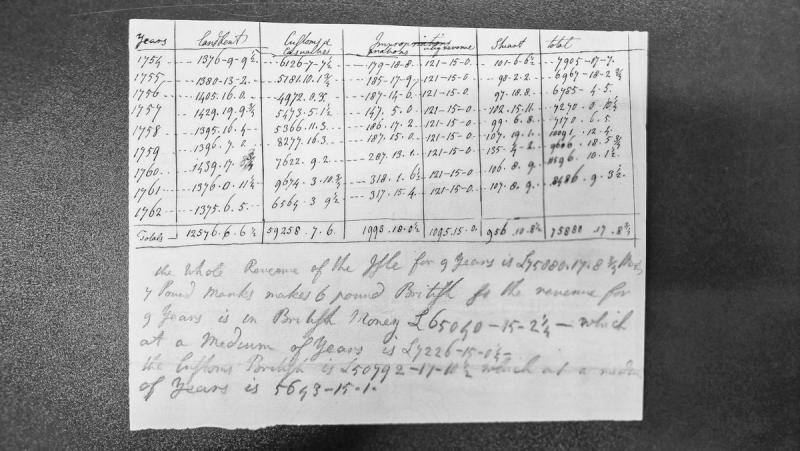
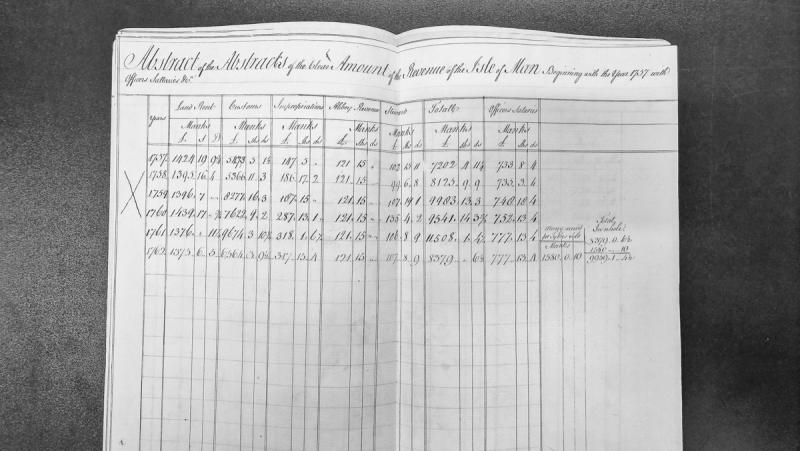
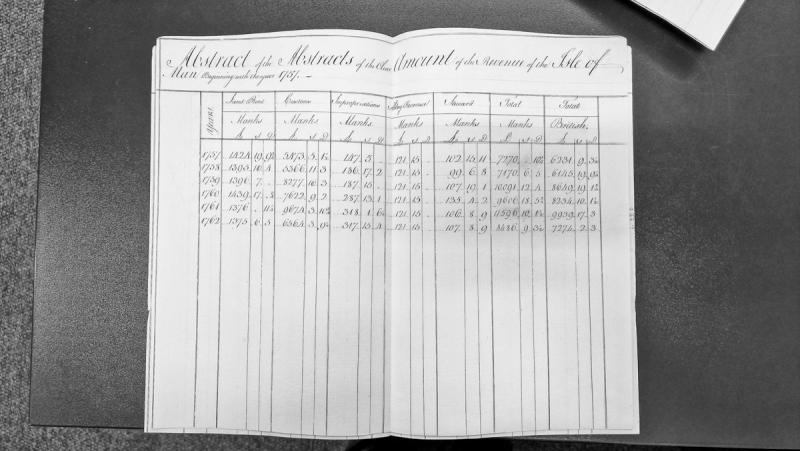
A tabular revenue abstract or statistical summary organized by Manx parishes and districts, with numerical data across eight columns totaling 19,144. The document appears to be administrative record-keeping, possibly relating to taxation, population, or property valuation by parish.
This is a metadata entry for a transcription project at the Manx Museum, indicating an automated transcription was generated on 2026-02-25. The source image reference is provided but the actual document content is not included in this file.
This is a metadata record for an automated transcription from the Manx Primary Source Archive. The actual document content is not present in the transcription file provided, only header information about the transcription process and source image reference.
This is a metadata record for a transcribed document from the Manx Primary Source Archive. The source image file is identified as 20260218_124832.jpg, with transcription completed on 2026-02-25 using automated processing via Claude Batch API.
This is a metadata header for an archived transcription, indicating automated processing of a Manx historical source. No substantive document content is present in the transcription provided.
This is a metadata record for an automated transcription from the Manx Primary Source Archive, indicating a source image file but containing no actual document content to analyse.
This is a metadata header for a transcription from the Manx Museum's archival collection, indicating an automated transcription was performed on 2026-02-25. The actual document content is not present in the provided text.
This is a metadata record for a transcription from the Manx Primary Source Archive, indicating an automated transcription was performed on 25 February 2026 using Claude Batch API. The actual document content is not present in the provided text.
Metadata record for a Manx Museum archival item. The transcription appears to be incomplete or consists only of header information without substantive document content.