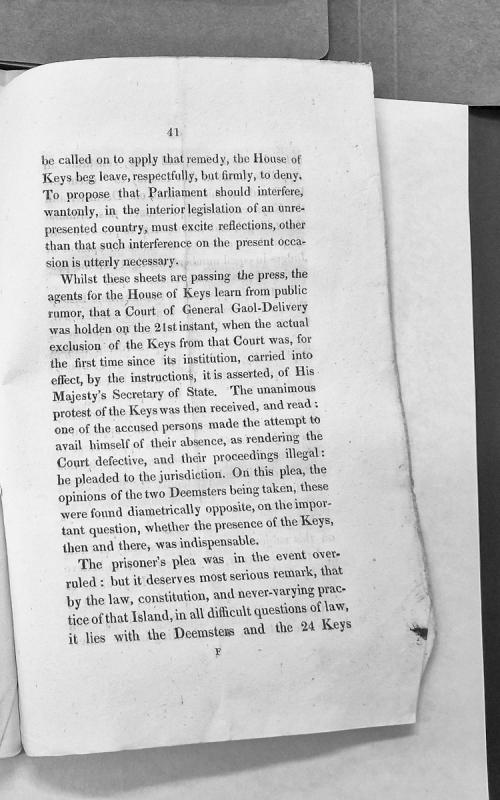
A printed pamphlet page presenting the House of Keys' formal objection to their exclusion from a Court of General Gaol-Delivery held on the 21st instant, allegedly by instruction of His Majesty's Secretary of State. The document discusses the constitutional and legal implications of this unprecedented exclusion and notes a disputed jurisdictional plea by an accused person regarding the absence of the Keys.
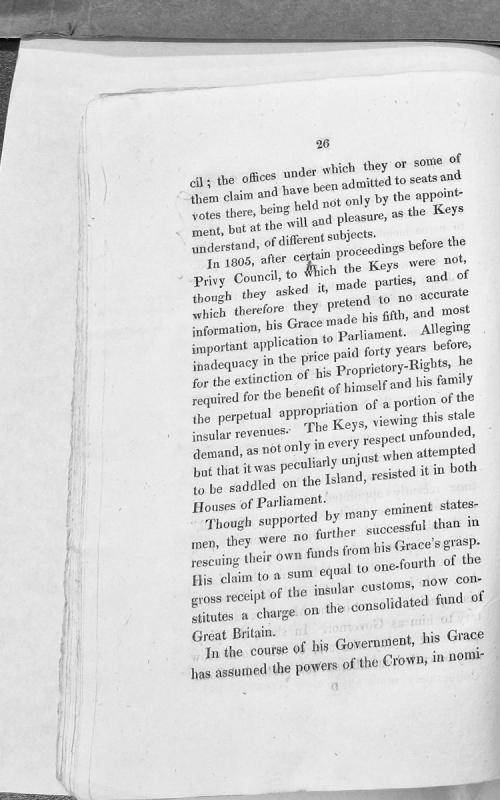
Extract from a legal or political document discussing the House of Keys' opposition to successive applications by a Duke (likely the Duke of Atholl) for financial compensation and appropriation of insular revenues. References proceedings from 1805 before the Privy Council and Parliament regarding inadequacy of compensation paid for extinction of proprietory rights.
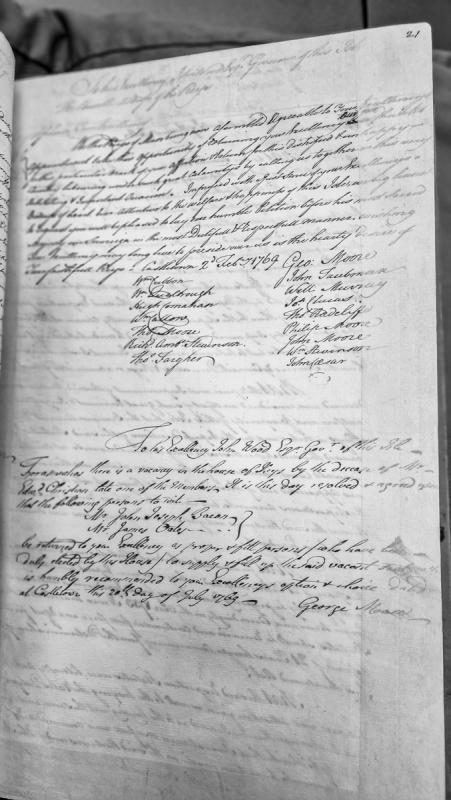
A formal resolution from the House of Keys to Governor John Wood Esq, dated 20 July 1769, recommending two candidates, John Joseph Bacon and James Oates, to fill a vacancy created by the death of Ewan Christian. The document requests the Governor's approval of the elected candidates.
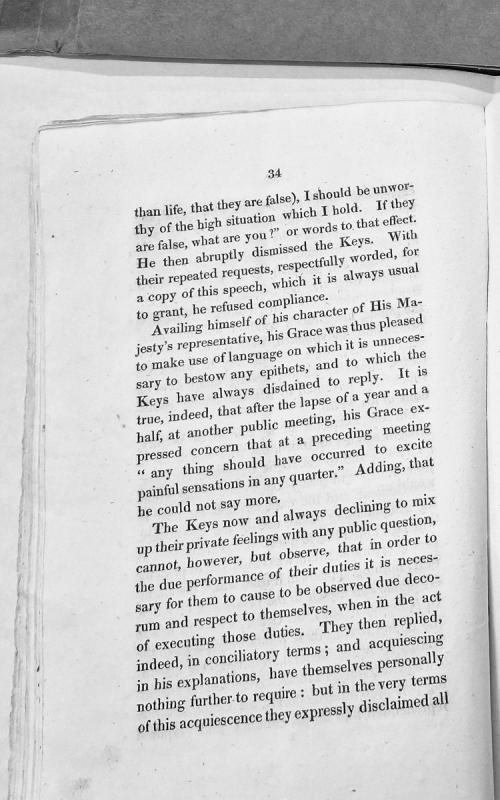
This document records a dispute between the House of Keys and the Governor (referred to as 'his Grace'), regarding the Governor's intemperate language during a meeting and his subsequent refusal to provide a copy of his speech. The Keys describe how the Governor dismissed them abruptly after making what they characterize as insulting remarks, and note that a year and a half later he only expressed vague concern about the incident. The Keys assert their need to maintain decorum and respect in their official duties.
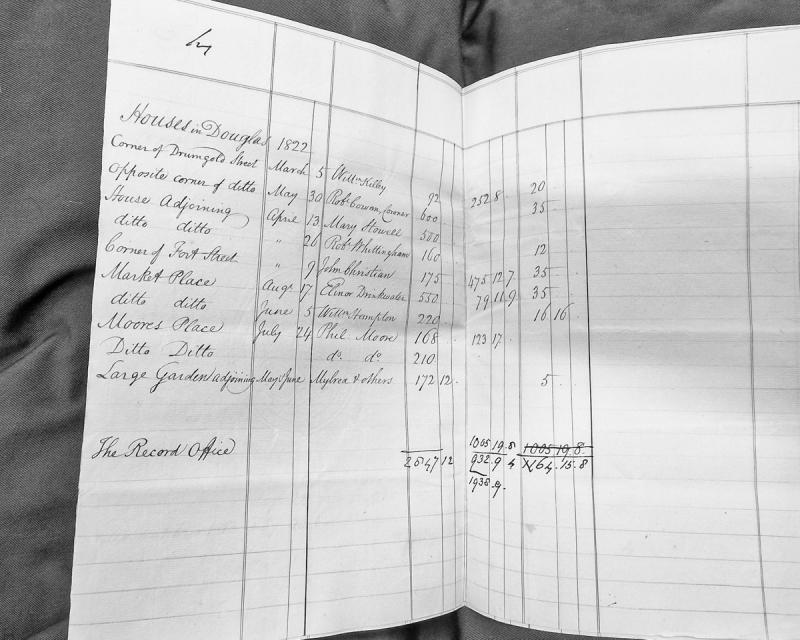
A revenue abstract listing properties in Douglas, Isle of Man during 1822, with owner names, dates of entry, and associated financial values. The document appears to be an official record maintained by The Record Office, detailing house valuations and tax assessments for various locations including street corners and market places.
Twenty-four years old. Lost his right arm at Trafalgar. The records do not say what he did afterward, or whether anyone compensated him for the arm the Navy took. Young men, fishermen's sons most of them, raised in the post-Revestment poverty, sent to fight at the far end of Europe, and sent home damaged to an island that had no means to care for them.
Castletown merchant, sent alongside George Moore to London in March 1765 carrying the Keys' resolution and their hopes. The choice to send him alongside Moore was deliberate — Moore was the constitutional man, Cosnahan the commercial man who understood what suppressing the trade would actually do. He told the Duke, face to face, that if the Duke had simply gone to Dunkeld and let the storm blow over, the Island might have been left in peace. The Duke's reply: 'as Matters then stood in the House of Commons, he should lose all his Revenues without any Compensation.' Cosnahan also testified under oath that the Keys and merchants would have voluntarily supported increased duties if anyone had asked. Nobody asked.
A midwinter tradition observed on 26 December, St Stephen's Day. Groups of men and boys would hunt a wren, carry it on a decorated pole, and process from house to house singing the Wren Song. The wren was the king of the birds, hunted at midwinter as part of the ritual turning of the year. Still practised on the Island today, making it one of the oldest continuously observed folk customs in the British Isles.
William Christian, known universally by his Manx name Illiam Dhone (Brown-haired William), was Receiver General of the Isle of Man. In 1651, faced with a Parliamentary fleet and an absent lord, he led the Manx militia in surrendering the island rather than see it destroyed in a war that was not theirs. He was tried and executed at Hango Hill in 1663 on the orders of the restored Countess, becoming the most resonant figure in Manx national memory.
A peer-reviewed economic history article examining smuggling in 1530s–1540s Bristol through merchant account books and customs records. Jones demonstrates that smugglers were regular merchants who recorded illicit transactions alongside legitimate trade in standard accounts, and uses record linkage to quantify smuggling in leather and grain exports. The study illustrates how high tariffs incentivised evasion and provides methodology applicable to other early modern smuggling analysis.
Extract from the Statutes of the Realm (5 Elizabeth I, 1562) permitting foreign-born merchants to import French wines into Manx ports in foreign-owned vessels, limited to 100 tonnes per year. This establishes early modern trade privileges and Manx commercial autonomy, relevant to understanding pre-Revestment trade frameworks and the Isle's special trading status.
A doctoral thesis examining the Dutch East India Company's decline in the late 18th century through the lens of the relationship between the Company and its servants. The work emphasizes informal institutions (private trade, corruption, networking) as functional mechanisms for adaptation to changing circumstances in Asia. While focused on the VOC, the thesis includes comparative analysis with the English East India Company, offering contextual insights relevant to understanding contemporary corporate and imperial structures during the period of the 1765 Revestment.
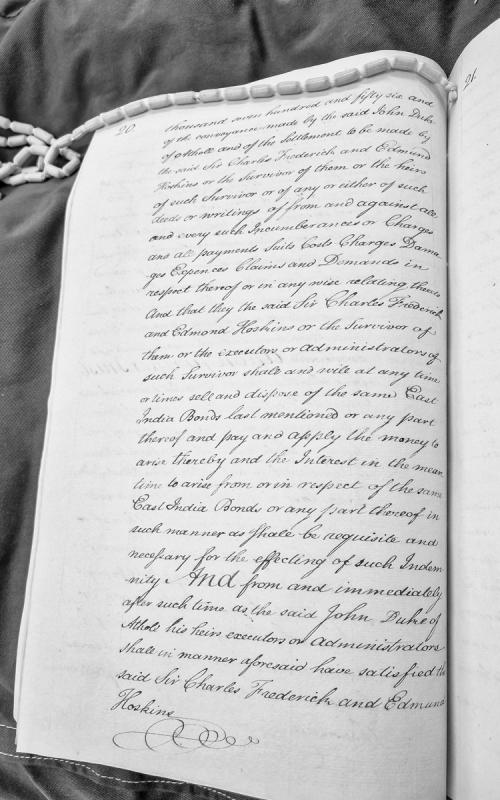
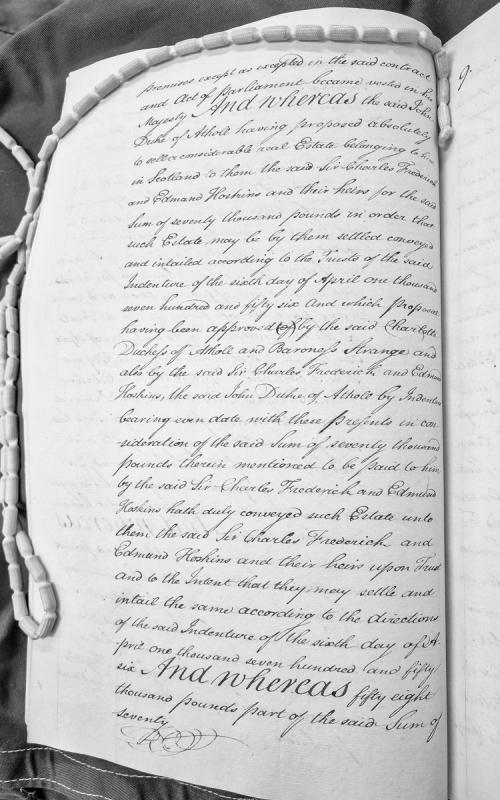
Fragment of a legal indemnity document from 1756 concerning East India Bonds and a conveyance by John Duke of Athol. The document outlines conditions for indemnification by Sir Charles Frederick and Edmund Hoskins, including provisions for the sale and disposition of East India Bonds and the management of arising interest and funds.
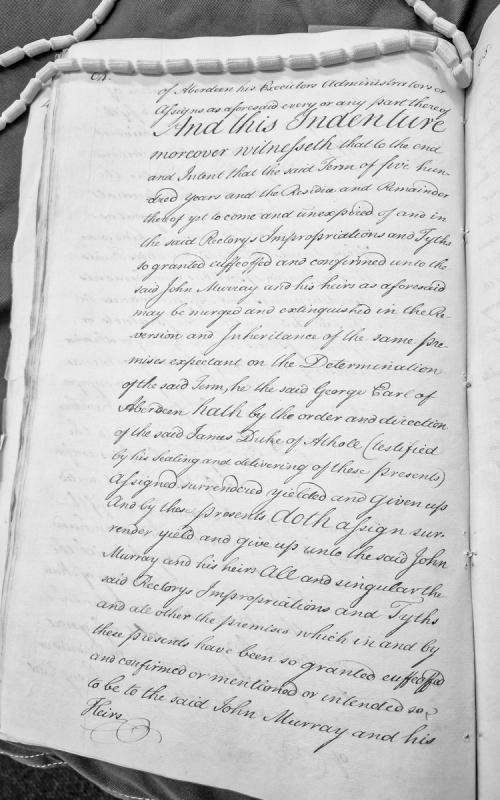
This is an excerpt from a legal indenture concerning the assignment and confirmation of rectory impropriations and tithes to John Murray and his heirs. The document involves George, Earl of Aberdeen, acting under the direction of James, Duke of Athole, and represents a formal legal transfer of ecclesiastical property rights and revenues.
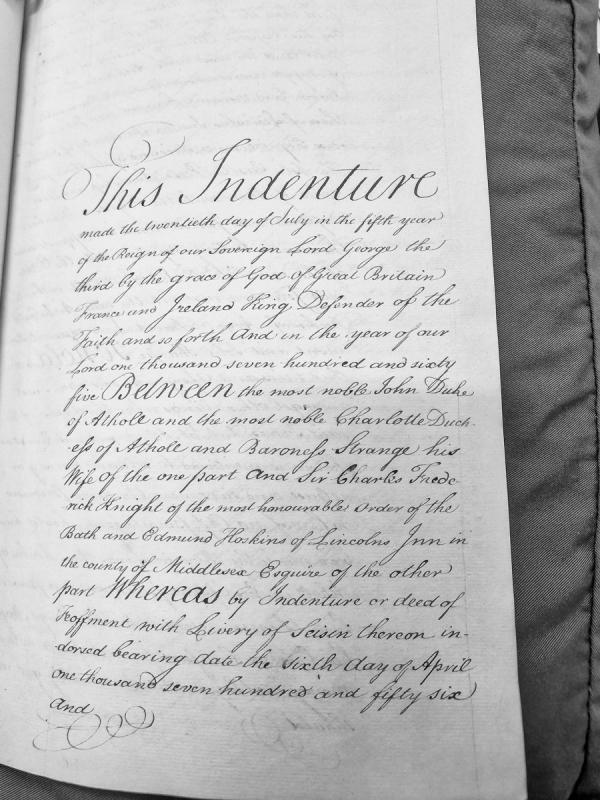
An indenture dated 20 July 1765 between John Duke of Athole and Charlotte Duchess of Athole on one part, and Sir Charles Frederick (Knight of the Bath) and Edmund Hoskins on the other part. The document references a prior deed of feoffment dated 6 April 1756 and appears to concern property matters.
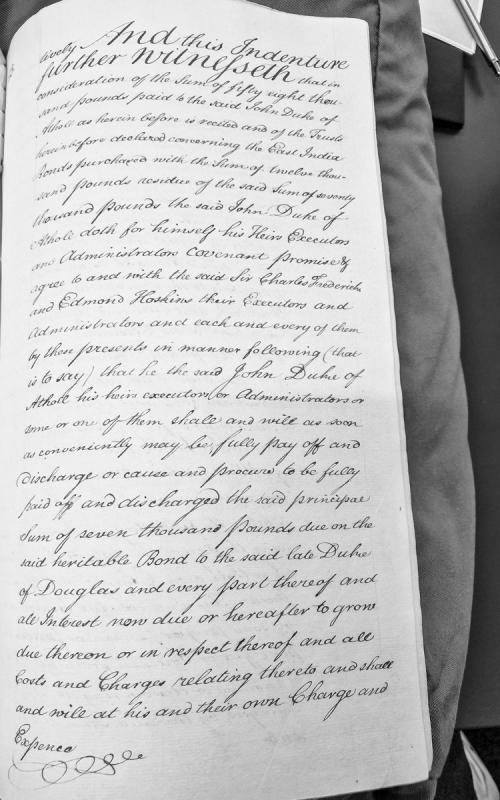
A legal indenture detailing covenants and agreements between John Duke of Athole and Sir Charles Frederick and Edmond Hoskins regarding financial obligations. The document specifies the payment of fifty-eight thousand pounds, trust arrangements for East India Bonds purchased with twelve thousand pounds, and the Duke's covenant to discharge a principal sum of seven thousand pounds due on a heritable bond to the late Duke of Douglas.
A 1503 apprenticeship indenture from the Harleian Manuscripts, documenting an agreement between William Park (master) and John Darse (apprentice) for a 6-year term of service in music instruction and teaching. The document specifies Park's obligations to teach singing, prickle-song, organ-playing, and manners, and Darse's duties of obedience and service. The Abbot of Rushen and other parties serve as sureties. This is a rare example of early Manx institutional and social documentation, providing context for pre-Revestment Isle of Man society and church administration.
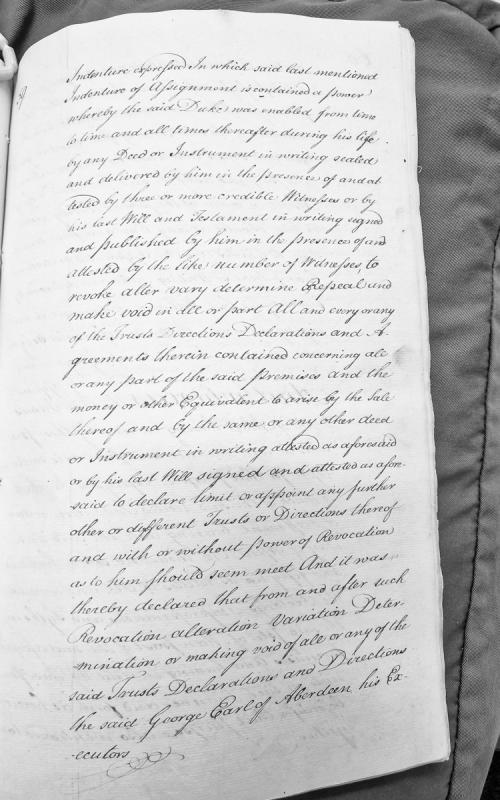
A legal document describing provisions in an indenture of assignment that granted a Duke powers to revoke, alter, vary, and determine trusts and directions concerning premises and proceeds from their sale. The document outlines procedures requiring sealed deeds or wills attested by witnesses, and the subsequent declarations regarding George Earl of Aberdeen and his executors.
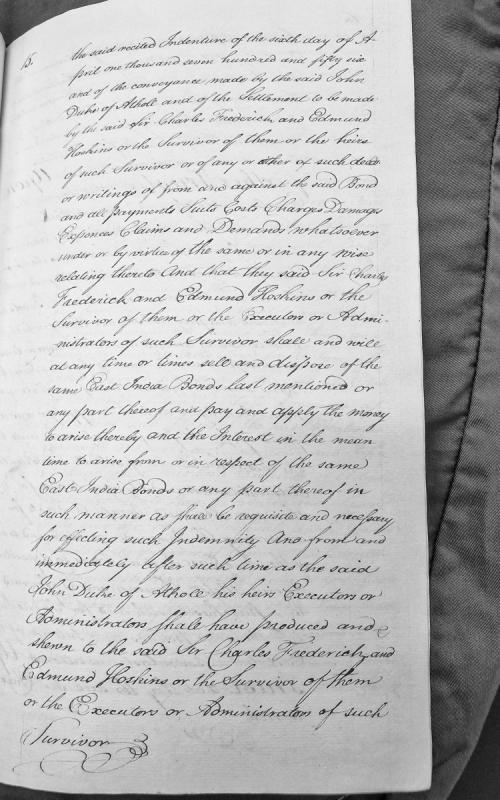
A legal document detailing obligations regarding East India Bonds and indemnification. The document references an indenture dated April 6, 1756, and outlines the duties of Sir Charles Frederick and Edmund Hoskins (or their survivors) to manage and dispose of East India Bonds to effect indemnity.
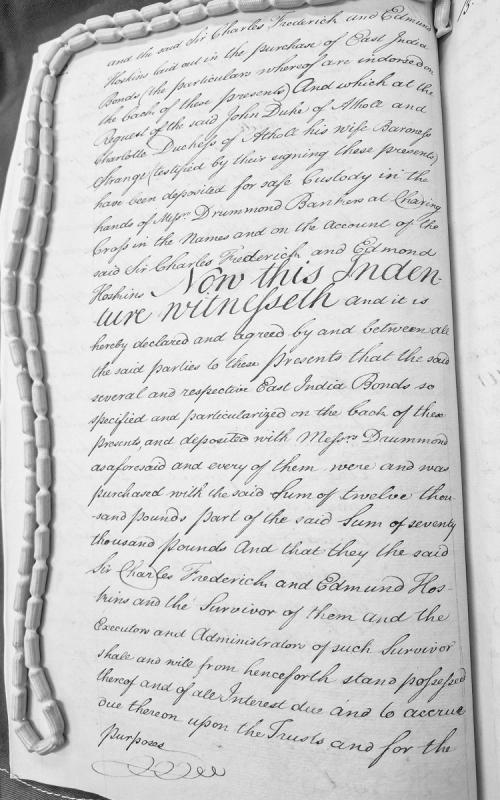
A legal indenture documenting the purchase and deposit of East India Bonds valued at twelve thousand pounds (part of a seventy thousand pound sum) with Messrs Drummond Bankers at Charing Cross. The document outlines the trust arrangements between Sir Charles Frederick, Edmund Hoskins, and John Duke of Athole and Charlotte Duchess of Athole (Baroness Strange), with provisions for succession through executors and administrators.
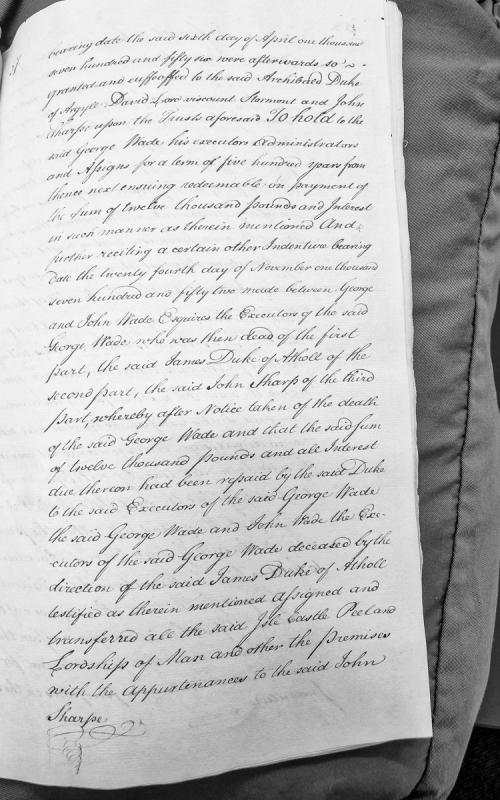
This document is an excerpt from a legal indenture detailing the conveyance and enfeoffment of the Isle of Man, Castle Peel, and associated lordships. It recites two key dates (April 6, 1756 and November 24, 1752) and describes the transfer of these properties from George Wade's executors to John Sharpe following repayment of a twelve thousand pound debt to the Duke of Atholl.
A legal document detailing the proposed sale of a Scottish estate by John, Duke of Athole, to Sir Charles Frederick and Edmund Hoskins for £70,000. The estate is to be settled and entailed according to the terms of an earlier indenture dated 6 April 1756, with approval from Charlotte, Duchess of Athole and Baroness Strange.
A 1417 indenture between commissioners of John de Stanley (Lord of Man and the Isles) and 24 keys of Mann (local magnates) establishing legal procedures for the extradition of felons who flee the lordship to baronial territories and penalties for baronial retention of such fugitives. Demonstrates early Manx constitutional structures and the tension between lordly and baronial authority.
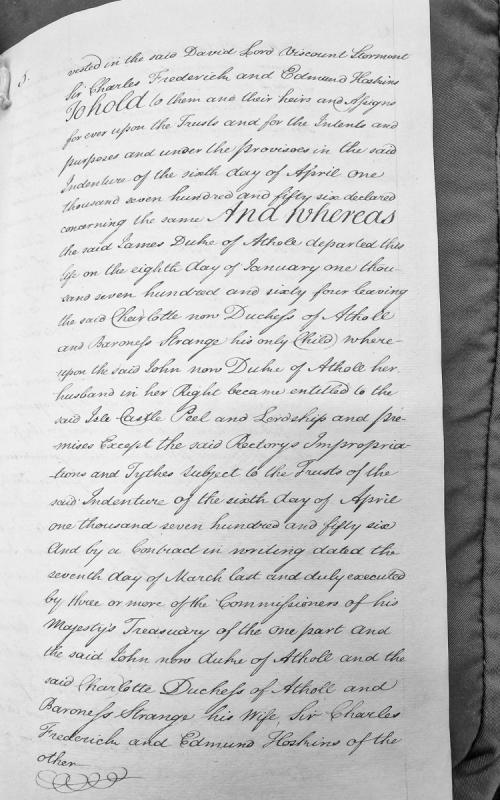
Fragment of a legal document detailing the vesting of Isle of Man properties (Isle, Castle, Peel, and Lordship) in trustees following the death of James Duke of Athole in 1764. The document references an original Indenture of April 6, 1756, and a subsequent contract dated March 7 involving Treasury Commissioners and the current Duke and Duchess of Atholl.