A report from Governor Wood to the Duke of Atholl covering administrative matters on the Isle of Man including tithe collection, legal expenses, court reforms, and revenue matters. Discusses Heywood's tithe arrears, Winchley's bill payment, new laws and court regulations, and £1200 remitted by Charles Lace. Illustrates the Duke's direct involvement in Manx governance two years before the Revestment.
Report from Governor Wood to the Duke of Atholl detailing quarterly trade conditions, the seizure of Dutch ships carrying tea, capture of smuggling vessels (wherrys), and financial remittances including tithe money. Demonstrates revenue collection challenges and enforcement tensions during the period immediately preceding the Revestment.
Report #12 from Governor John Wood to the Duke of Atholl, dated 8 October 1763, concerning the death of Deemster Taubman and Wood's interim appointment of Taubman's nephew to the position. The letter addresses administrative procedures, the authority of the Governor, and succession in Manx judicial offices under the feudal proprietorship of the Duke of Atholl.
Report from Governor John Wood to the Duke of Atholl concerning the death of Deemster Taubman and recommending Taubman's nephew as successor. Wood praises the nephew's abilities, uprightness, and attachment to the Duke's interest, while noting his merchant status. Demonstrates the patronage system and revenue interests governing Manx administrative appointments in the pre-Revestment period.
Governor John Wood reports to the Duke of Atholl on the death of Deemster Taubman and recommends Taubman's nephew as his successor. Wood praises the nephew's abilities, uprightness, and attachment to the Duke's interests, while noting that his continued involvement in merchant trade could add £500 annually to revenues. This document illuminates the patronage system governing Manx office-holding under Atholl's sovereignty and the intertwining of commerce with administration.
Administrative report from Governor Wood to the Duke of Atholl concerning remittance of £2000 from Isle of Man revenue (in cash and bill of exchange), and discussion of the sale of tithes at 35 years' purchase. Addresses practical difficulties with tithe conveyancing and concerns about buyers who purchased on the assurance of incumbrance-free titles. Dated June 1763, during the period leading to the 1765 Revestment.
Report from Governor Wood to the Duke of Atholl detailing revenue collections, cash flow difficulties, merchant credit issues following the failure of Douglas traders Thompson and Janson, and tithe conveyances. Provides insights into early 1760s economic conditions on the Isle of Man and administrative arrangements between the Governor and the Duke.
Report from Governor Wood to the Duke of Atholl detailing financial remittances (£1,300), tythe (tithe) purchase money collections (£535 12s 1.5d), and auction results for glebe and tythe sales across Manx parishes including Michael, Lezayre, Maughold, Lonan, and Marown. Reflects Atholl's ecclesiastical and financial administration of the Isle of Man before the 1765 Revestment.
Report from Governor Wood to the Duke of Atholl covering financial remittances, tithe sales, mining operations under Mr Griffith's lease, legal costs, and Governor's House repairs. Dated February 1763 with postscript of March 1763. Provides insight into Atholl's income sources from the Island before the 1765 Revestment.
Official report from Governor John Wood to the Duke of Atholl covering financial remittances (£1200), tithe collection, castle repairs at Rushen, industrial operations (paper mill, iron forge, snuff mill), and trade conditions. Provides snapshot of Manx economy and infrastructure two years before the Revestment, noting cash scarcity and trade dullness partly attributed to post-war circumstances and customs enforcement.
A report from Governor Wood to the Duke of Atholl detailing the passage of laws by the Isle of Man Legislative Body, requesting the Duke's assent to a consolidated Act, and noting expected financial returns and tithe deeds from Scotland. The letter reflects the administrative relationship between the Atholl proprietor and the island's governance in the decade before the Revestment.
Report from Governor John Wood to the Duke of Atholl covering multiple administrative matters including a criminal execution, customs enforcement by revenue cutters (particularly the Lurcher and Easter), merchant resistance to boarding and seizure operations, and financial accounts (boon money, court dinner allowances). Directly addresses tensions between revenue enforcement and merchant interests on the eve of the Revestment.
Report from Governor John Wood to the Duke of Atholl concerning governance of the Isle of Man, including matters of crime and punishment, customs enforcement by naval cutters, merchant petitions regarding seizures, court expenses, and boon money accounts. Directly relevant to pre-Revestment administrative procedures and tensions between revenue enforcement and merchant interests.
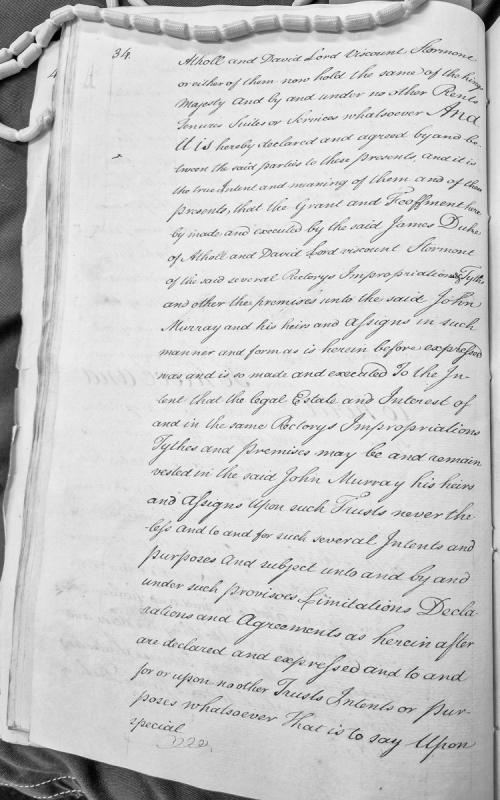
A legal document concerning the transfer of ecclesiastical properties (rectorys, impropriations, tythes) from James Duke of Atholl and David Lord Viscount Stormont to John Murray and his heirs. The document declares the intent and terms of the grant, establishing that the legal estate shall be vested in Murray subject to various trusts, provisoes, limitations and agreements to be subsequently detailed.
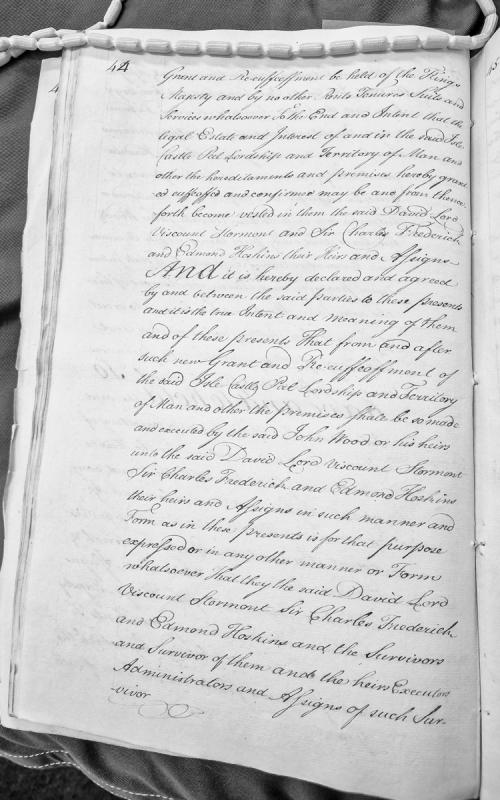
A legal document concerning the grant and re-enfeoffment of the Isle of Man, Castle Peel, and associated territories. The document outlines the terms by which these hereditaments are to be vested in David Lord Viscount Stormont, Sir Charles Frederick, and Edmond Hoskins, their heirs and assigns, held of the King's Majesty.
A charter issued by William de Montagu, Earl of Salisbury and Lord of Man, granting a yearly rent of forty pounds to William de Faryndon for life, payable from the issues of the Isle of Man. The document demonstrates feudal land tenure, revenue administration, and the Earl's authority over Man in the late 14th century. It is presented in both English and Anglo-Norman French versions.
A formal grant document issued by William de Montagu, Earl of Salisbury and Lord of Man, granting a yearly rent of 40 pounds to William de Faryndon for life, payable from the issues of the Isle of Man. The document is presented in both English and Norman French versions, with witness signatures and heraldic seal description. It illustrates feudal administrative practice and revenue structures on the island in the 14th century.
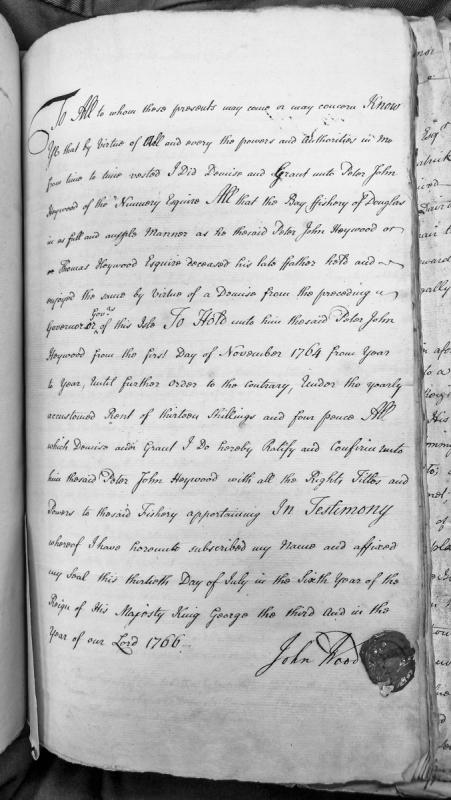
A formal grant document by which the Governor of the Isle of Man demises and grants the Bay Fishery of Douglas to Peter John Heywood, Esquire, from 1 November 1764 onwards at an annual rent of 13 shillings and 4 pence. The document ratifies and confirms the fishery rights previously held by Thomas Heywood (the grantee's deceased father) under a prior governor.
A legal obligation document from 1587 recording a grant by Henry, Earl of Derby (Lord of Mann) to Robert Salusburye of Denbigh of tithes, glebe lands, and church properties belonging to Kirkchriste and Kirkmarron churches in the Isle of Mann. The document establishes conditions for the lease, involving the Salusburye and Wright families, and provides evidence of early modern ecclesiastical property administration and lordship rights over Mann.
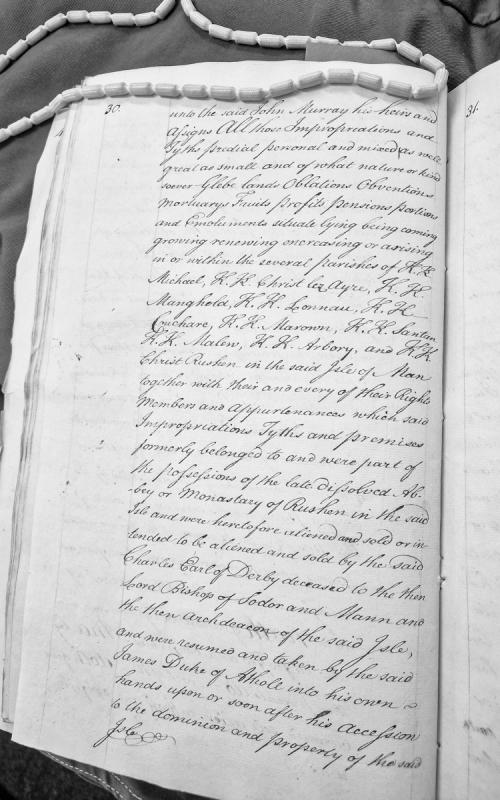
A legal document detailing the transfer of ecclesiastical impropriations, tithes, glebe lands, and associated revenues from multiple Isle of Man parishes (including Michael, Ayre, Maughold, Lonan, Cuchare, Marown, Santan, Malew, Arbory, and Rushen) to John Murray. The document traces the property's history through the dissolved Abbey of Rushen and its subsequent ownership by the Earls of Derby and Dukes of Atholl.
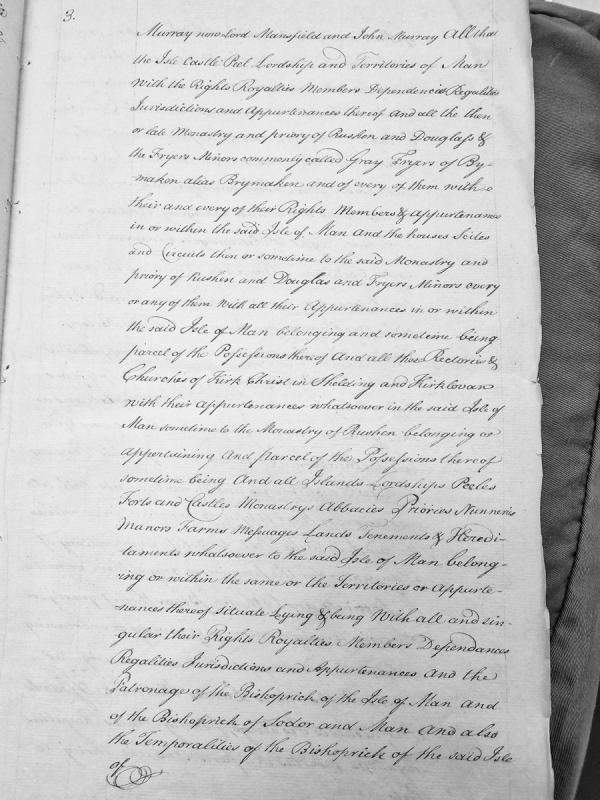
A formal legal document detailing the conveyance of the Isle of Man and its associated properties, rights, and jurisdictions to Murray (later Lord Mansfield) and John Murray. The document enumerates extensive holdings including castles, monasteries, priories, churches, islands, manors, and ecclesiastical patronage rights, suggesting a major land transfer or charter confirming territorial possession.
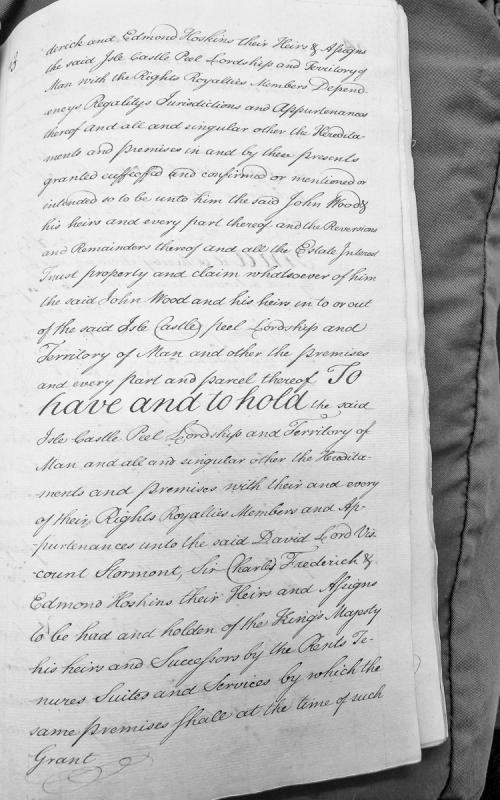
A legal conveyance document transferring the Isle of Man, Castle Peel, and associated lordship, territory, rights, royalties, and appurtenances from John Wood to David Lord Viscount Stormont, Sir Charles Frederick, and Edmond Hoskins. The document details the hereditary estates, jurisdictions, and claims being granted and their conditions of tenure.
Royal writ from King Henry III to the Justice of Ireland, confirming annual grants (wine and corn) to Reginald, King of Man, as a knight's fee, following his homage in London. This document establishes early feudal relationships between the Crown and the Manx kingdom, foundational to understanding the constitutional status of Man and the chain of title that preceded the 1765 Revestment.
A royal charter from King Henry III to the Justice of Ireland, granting Reginald, King of Man, an annual fee of two hogsheads of wine and 120 crannocks of corn as a knight's fee, as previously held under King John. This document establishes the feudal relationship between the English Crown and the Kings of Man in the early 13th century, providing constitutional and economic context for later Isle of Man sovereignty questions.
Royal charter issued by King John granting Reginald, King of Mann, a knight's fee in Ireland (Carlingford, Ulster) and annual corn payments in recognition of homage and service. This document exemplifies the feudal relationship between the English Crown and the medieval Kings of Mann, and their position within the broader Norman-Angevin realm.