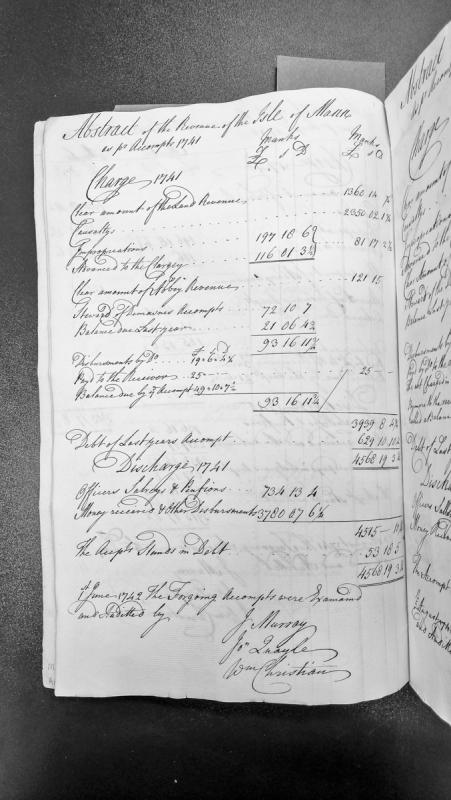
A financial accounting document detailing debts, discharges, officer salaries and disbursements for 1741, with a balance calculation. The account was examined and audited on 1 June 1742 by three auditors.
Settlement in Virginia associated with Colonel William Christian, descendant of the same family as Illiam Dhone. The Fincastle Resolutions of 1775 — drafted by Manx-descended Virginians — preceded the Declaration of Independence. The constitutional instinct the Christians carried from the Isle of Man expressed itself in American revolutionary politics.
A resolution and address adopted by the freeholders of Fincastle County, Virginia on 20 January 1775, endorsing the Continental Congress association and expressing loyalty to King George III while asserting constitutional rights against Parliamentary overreach. The document reflects colonial grievances on the eve of the American Revolution and demonstrates the intersection of colonial constitutional thought with British sovereignty claims.
Born in 1764, the same year the old Duke of Atholl died. Of the Christians of Milntown — the family seated in Lezayre who had provided Deemsters since 1408. Captain Taubman recommended the young midshipman to Bligh in 1784. The Christians also farmed at Ronaldsway near Castletown — close enough that Illiam Dhone could see Hango Hill from his door. The farmhouse stood into the 1930s before demolition for the Island's airport. Travellers arriving at the Island today land on Christian land without knowing it.
Bilingual (Latin/English) transcription of passages from the Chronicle of Florence of Worcester covering early medieval and Norman-era references to the Isle of Man (Mevania). Includes accounts of Welsh rebellion (1094), Norwegian King Magnus's expedition (1098), and the island's political status. Relevant as historical background on pre-Revestment Manx sovereignty and the transition from Norse to Norman influence.
A formal indenture establishing truces between English and Scottish forces, dated 8 May 1357 and made at London. The document lists territories under English and Scottish sovereignty, explicitly naming the Isle of Man as subject to English faith and fealty. Presented in both English and Anglo-Norman French. Relevant as early constitutional evidence of Manx status within English sphere during medieval period.
A formal indenture recording a truce agreement made in London between England and Scotland, dated 8 May 1357. The document explicitly names the Isle of Man among territories under English royal faith and allegiance, alongside England, Scotland, Ireland, Gascony, Brittany, and Wales. This is significant for establishing the Isle of Man's constitutional status within the English realm in the 14th century.
A published collection of official correspondence between the East India Company's Court of Directors in London and the Company's government in Fort William, Bengal, covering 1796-1800. Includes public letters, separate revenue letters on salt and opium monopolies, and law letters. Contains an introduction covering Company trade, monopolies (salt, opium), and administrative matters during the governorships of Sir John Shore and Lord Wellesley.
The Manx Language Society — Yn Cheshaght Ghailckagh — was founded to preserve and promote the Manx language. A.W. Moore and others recognised that the language was dying and that its loss would mean the loss of the Island's cultural identity. The Society's work would eventually feed the revival that produced Bunscoill Ghaelgagh a century later.
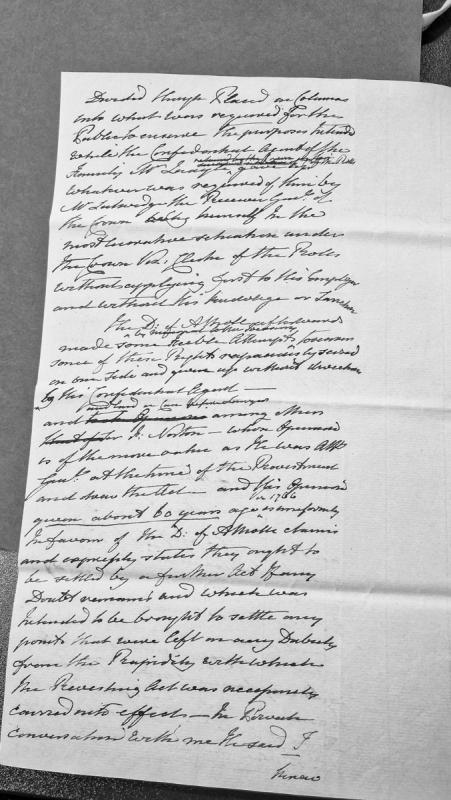
A fragmentary legal document discussing disputes over public revenue and the Duke of Atholl's rights following the Revestment Act. References opinions from R. Norton, the Attorney General at the time of Revestment who drafted the Act, regarding claims that should be settled by further legislation. Mentions various officials including the Receiver General and Clerk of the Rolls.
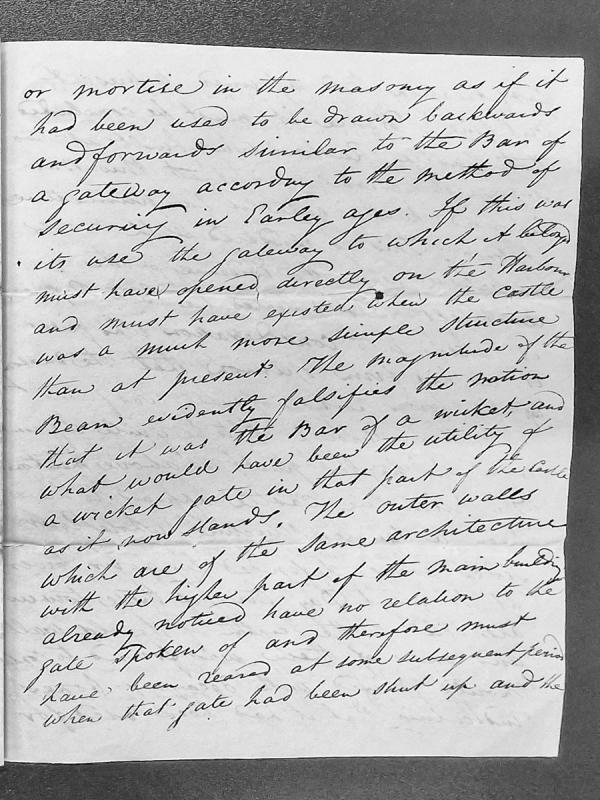
A fragmentary text discussing the architectural history of a castle structure, specifically analyzing the purpose and design of a large beam or bar that may have functioned as a gateway mechanism. The author considers whether it served as a sliding bar for security purposes in early construction phases.
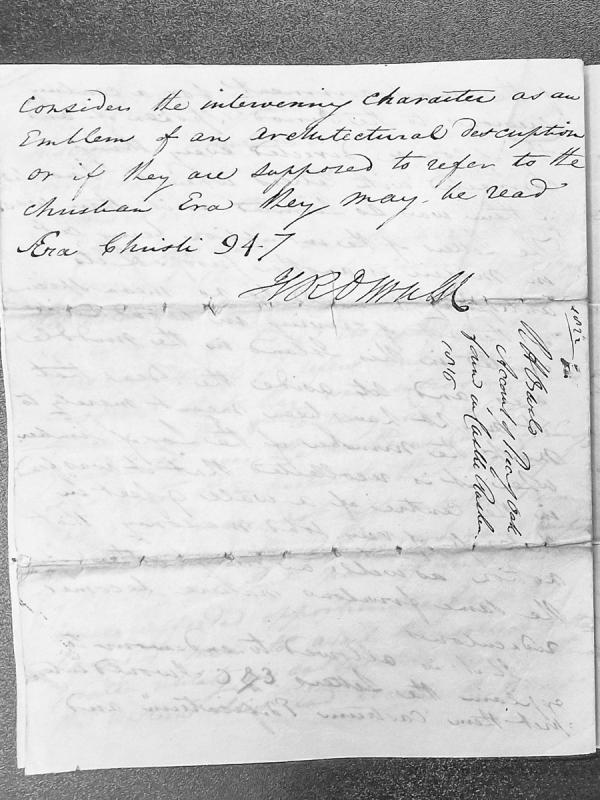
A fragmentary manuscript discussing the interpretation of intervening characters as architectural emblems or Christian Era references (94.7). The verso contains an endorsement referencing an account of a rock found in Castle Rushen, with dates 1012 and 1016 marked.
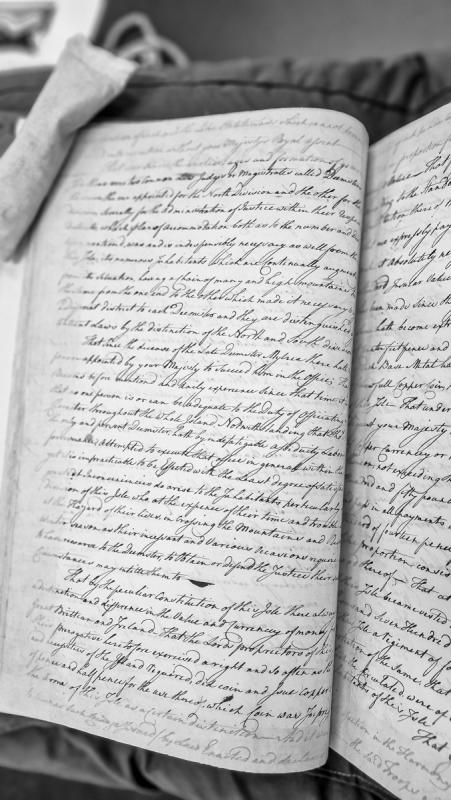
A heavily obscured right-hand page fragment discussing monetary standards, copper coin, currency regulations, and references to royal authority and Isle governance. The document appears to concern coinage valuation and legal tender specifications, mentioning amounts in pounds and pence.
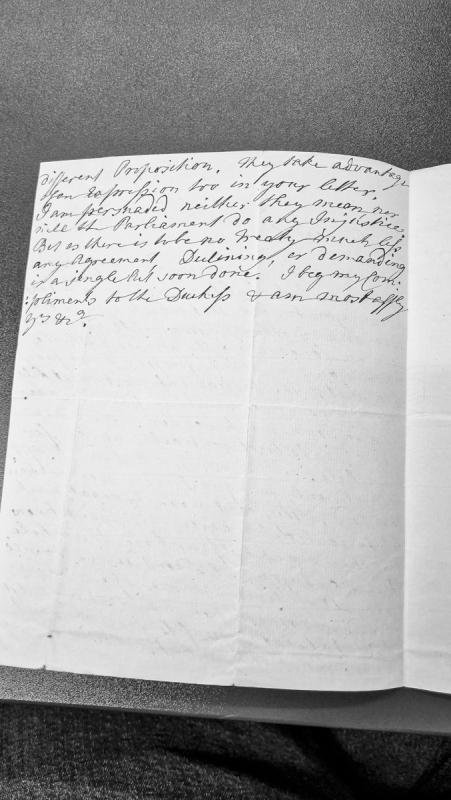
This is a fragmentary letter discussing a proposition and concerns about potential injustice. The writer expresses confidence that neither the addressee nor Parliament intends injustice, and notes that in the absence of a treaty, any agreement or demand can be quickly resolved. The letter closes with compliments to a Duchess.
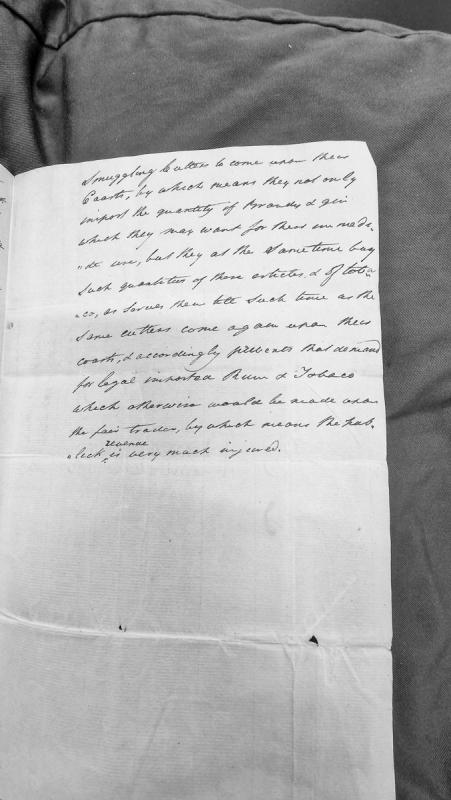
This is a fragmentary passage discussing the impact of smuggling cutters on coastal trade, particularly how they supply brandy, gin, and tobacco to local populations, thereby reducing demand for legally imported rum and tobacco and injuring public revenue.
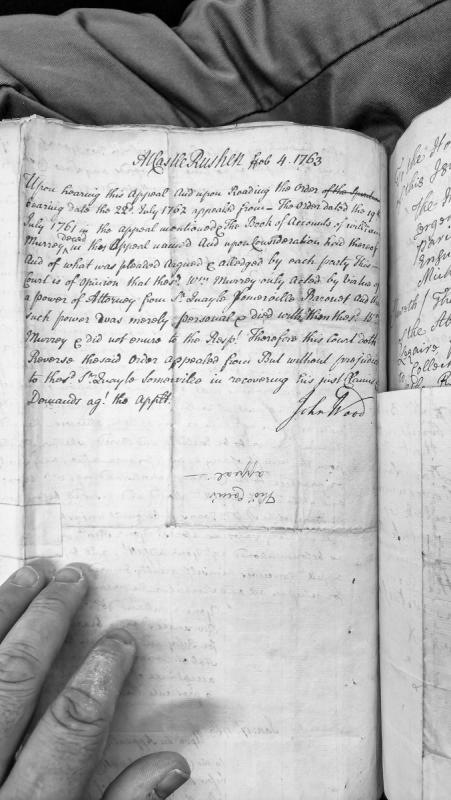
A fragmentary document containing only inverted text at the bottom of a page. The legible text includes 'ex parte' (Latin legal terminology) and what appears to be 'eMurry' or similar, suggesting this may be part of a legal document or court matter.
A heavily damaged or partially visible text fragment showing only the right edge of an adjacent page. The content is largely obscured, with only disconnected words and partial phrases visible, making it impossible to determine the document's purpose or full content.
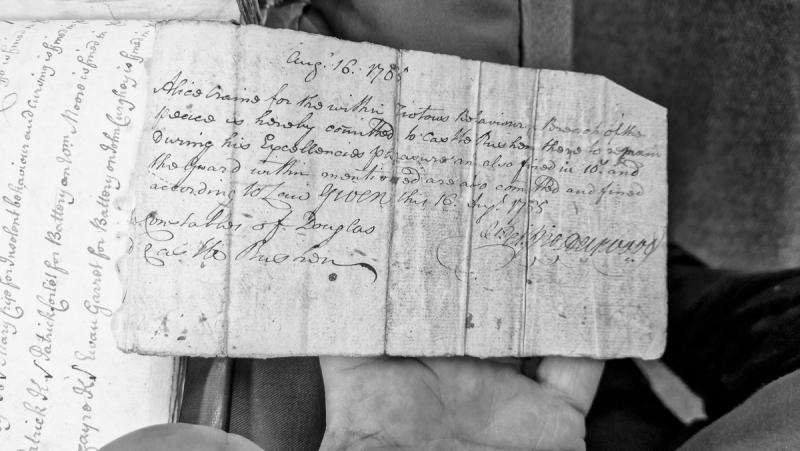
A partially visible and rotated court document recording presentments or charges against multiple individuals. Legible names include Mary Cla[?], Patrick Corlet, and Susan Garret, with charges involving insolent behaviour, cursing, and battery. The document is severely fragmented with substantial text loss.
Argued Scottish naturalisation before Parliament in 1606, using the Isle of Man's settled position as an example. His citation confirms that Mann's distinct constitutional status was recognised at the highest levels of English law.
Letter from Massachusetts Governor Francis Bernard to Benjamin Franklin requesting assistance in arranging his son's passage from Alexandria, Virginia to Philadelphia and onwards to Boston. The letter references earlier correspondence and indicates a logistics issue with the young Bernard's travel arrangements. Contextually relevant to understanding transatlantic colonial communications and the networks of prominent American colonial figures during the pre-Revolutionary period.
A detailed letter from the Attorney General of the Isle of Man defending his non-residence on the island against criticism from the Duke of Atholl. Frankland argues that his services are more effective when based in England, citing precedent, Treasury warrants, constitutional law, and support from island authorities. The letter addresses the tension between the Duke's proprietary interests and the Crown's control over Manx offices.
Attorney General Frankland defends his non-residency on the Isle of Man against criticism from the Duke of Atholl, arguing that his legal services are more effective when based in England. The letter addresses constitutional questions about the Attorney General's duties, the legitimacy of absence under the 1696 Act of Tynwald, and the Treasury Warrant of 1808 governing salary conditions. It provides insight into tensions between the Manx ducal interest and the Westminster establishment.