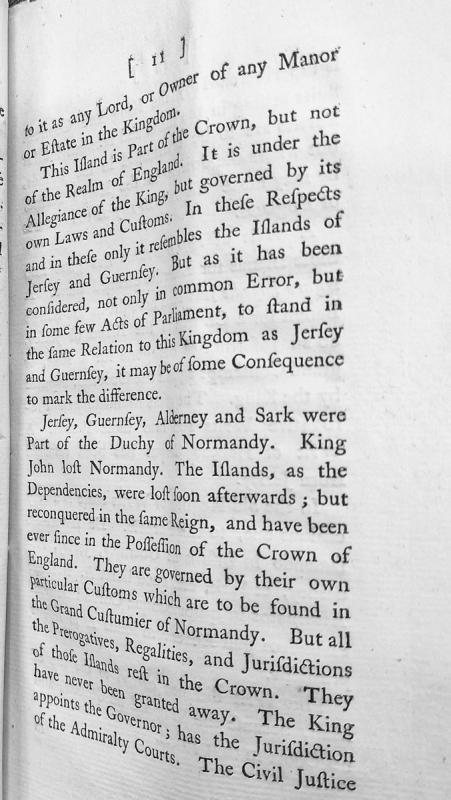
A legal treatise explaining the Isle of Man's unique constitutional position as part of the Crown but not the Realm of England, governed by its own laws and customs. The document clarifies distinctions between Man and Jersey/Guernsey regarding their historical origins and relationship to Crown jurisdiction, discussing prerogatives, regalities, and jurisdictions.
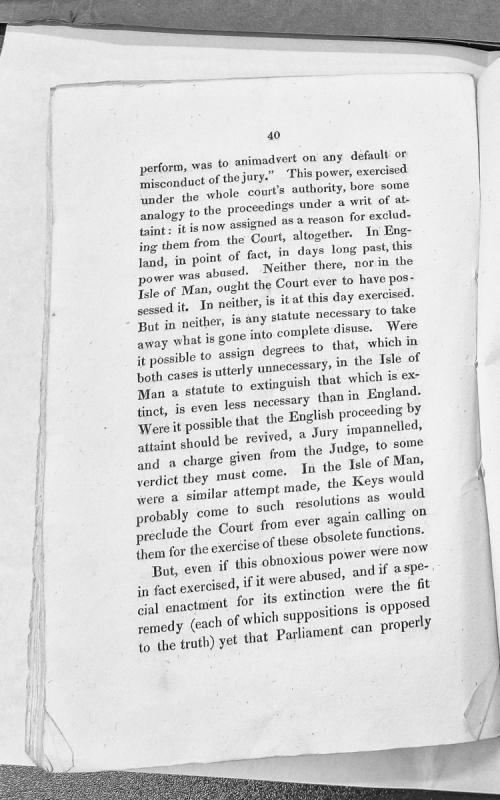
A legal opinion or treatise discussing the historical powers of courts over juries, comparing English and Manx legal procedures. The text examines whether statutory intervention is necessary to extinguish obsolete judicial powers regarding jury oversight, and argues that such powers are already in disuse in both England and the Isle of Man.
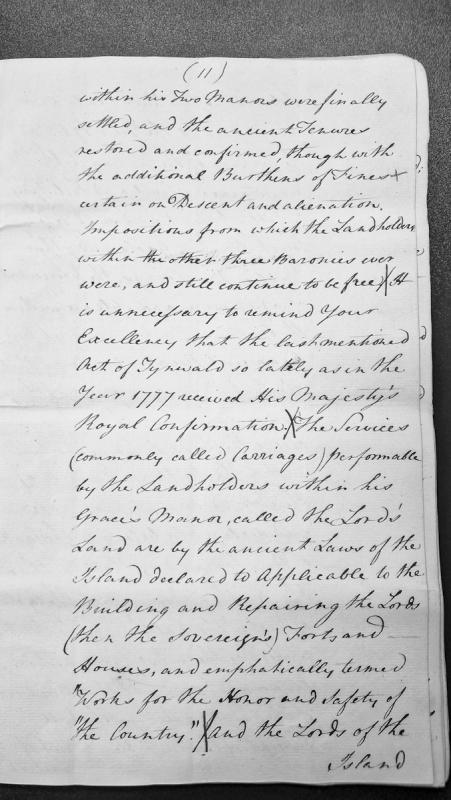
A fragment of a legal document discussing the settlement of tenures within manors on the Isle of Man, the restoration of ancient tenures with additional fines on descent and alienation, and the distinction between burdens imposed on the Lord's Manor versus other baronies. References a 1777 Act of Tynwald confirmed by His Majesty and describes services (carriages) performable by landholders.
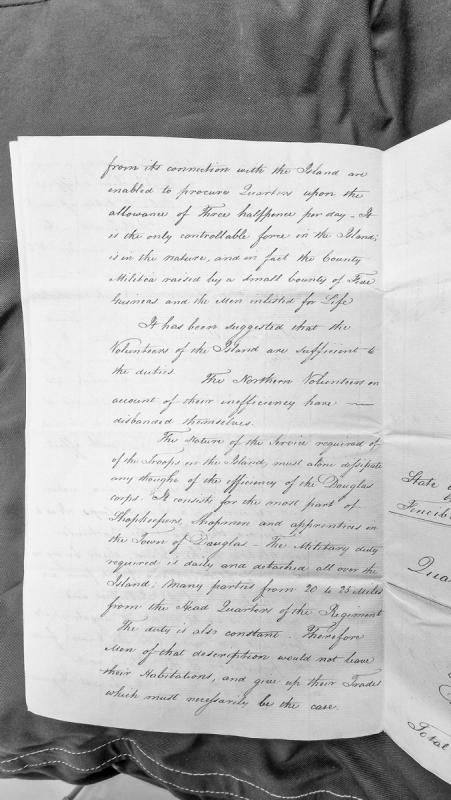
A fragment of administrative correspondence discussing the nature and efficiency of military forces on the Isle of Man, including commentary on militia, volunteers, and the composition of the Douglas corps. The document addresses the impracticality of using local shopkeepers and tradesmen for military duties requiring travel across the island.
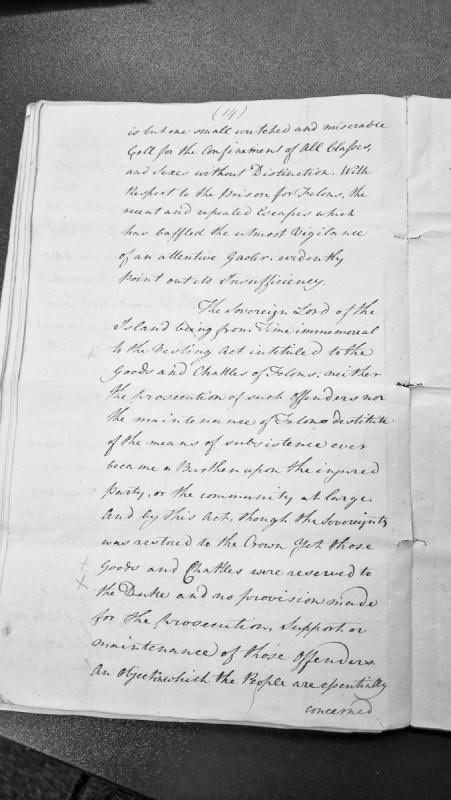
This document discusses the inadequate state of prison facilities on the Isle of Man, particularly regarding confinement of felons and the problems of escapes. It examines the legal and financial implications of the Vesting Act regarding the Crown's sovereignty, the Duke's retained rights to felons' goods, and the unresolved question of who bears responsibility for prosecuting and maintaining offenders.
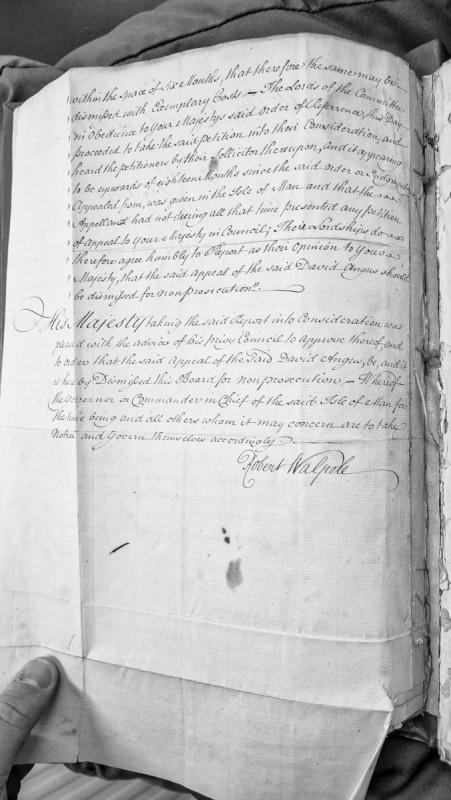
A Privy Council order dismissing the appeal of David Angus for lack of prosecution. The document reports that over eighteen months had elapsed since the original judgment in the Isle of Man without the appellant presenting a petition of appeal, leading the Lords of the Committee to recommend dismissal with exemplary costs, which His Majesty approved.
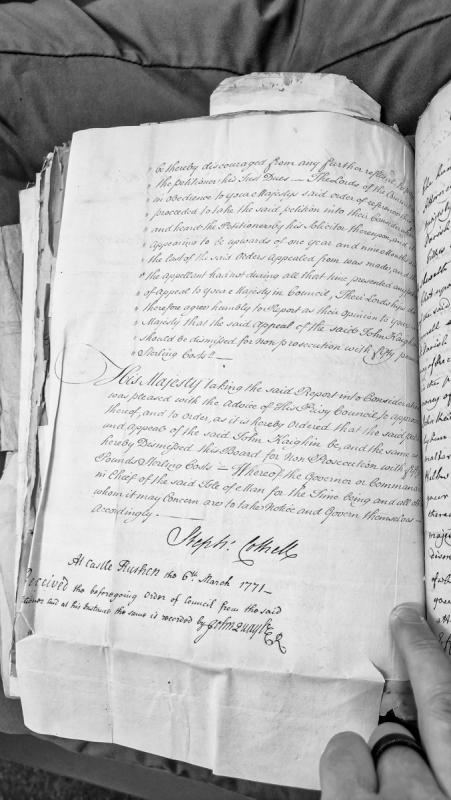
A formal order from His Majesty's Privy Council dismissing the appeal of John Kaighin for non-prosecution. The Lords of the Committee reviewed the petition and found that over a year and nine months had elapsed since the original orders without the appellant presenting an appeal to the Majesty in Council, leading to dismissal with fifty pounds Sterling costs imposed.
A parliamentary decree (5 Ed. II) from 1312 ordering the removal of Sir Henry de Beaumont from the King's Council and the forfeiture of lands including the Kingdom of Man, due to his procurement of grants contrary to royal ordinance and bad counsel to the King. The document is presented in both English translation and original Anglo-Norman French from the Rotuli Parliamentorum.
A parliamentary decree (Rotuli Parliamentorum, 5 Ed. II) ordering the removal of Sir Henry de Beaumont from the King's Council and the forfeiture of the Kingdom of Man and other lands due to his taking of the island contrary to royal ordinance and giving bad counsel to the King. The decree also addresses the role of Lady de Vescy in procuring these grants and orders forfeiture of Bamburgh Castle. The text is presented in both English and Anglo-Norman French, providing insight into early 14th-century constitutional constraints on feudal grants.
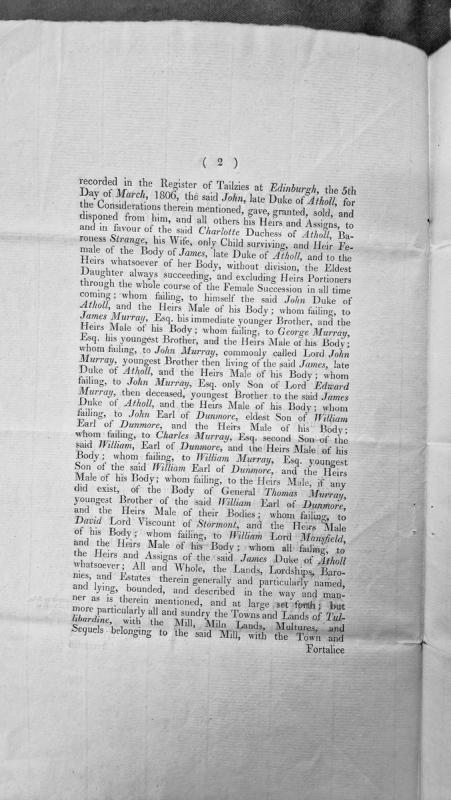
This is a legal document recording a disposition (transfer) of Scottish lands and estates registered on 5th March 1806. The Duke of Atholl transferred extensive properties to his wife Charlotte with detailed succession provisions favoring female heirs followed by male line succession through various branches of the Murray family.
A medieval narrative account, dated to the era of Edward I (c.1272), describing a legendary dispute between the Irish and Scottish kings over sovereignty of the Isle of Man. The story recounts how a wise man proposed that the island's freedom from venomous reptiles should determine its rightful overlord, resulting in the island being adjudged to Scotland. The text includes allegorical Christian interpretation relating the dispute to the contest between Christ and the devil for the human soul.
A medieval narrative account (c.1272, from MS in Edward I's era) describing a legendary dispute over sovereignty of the Isle of Mann between the kings of Ireland and Scotland, resolved through a wisdom-based test involving the presence or absence of venomous reptiles. The document includes allegorical Christian interpretation and demonstrates medieval Manx historiographical traditions.
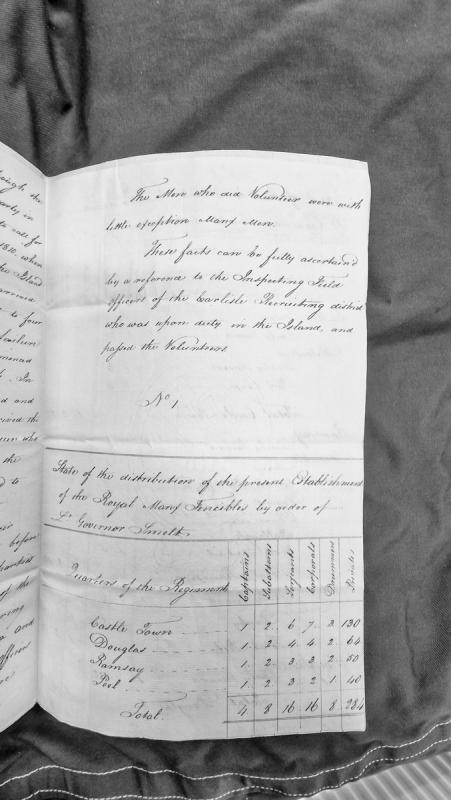
Administrative document detailing the organizational structure and deployment of the Royal Manx Fencibles regiment across four quarters of the Isle of Man. Provides a comprehensive breakdown of personnel by rank and garrison location, showing a total establishment of 4 captains, 8 subalterns, 16 sergeants, 16 corporals, 8 drummers, and 284 privates.
A historical document from the Isle of Man dated to the year 1767. Limited textual content is visible in the transcription, providing minimal information about the document's specific purpose or subject matter.
A comprehensive collection of primary documents relating to Rev. William Smith's 1758 petition to the King in Council against his imprisonment by the Pennsylvania Assembly. Includes Smith's petition (dated 6 February 1758), Benjamin Franklin's detailed notes refuting the petition point-by-point, observations on attacks on the Quakers, and procedural notes for counsel. These documents were presented at hearings before the Attorney General and Solicitor General on 20 and 27 April 1758, and provide crucial evidence of early American colonial constitutional disputes and Assembly claims to parliamentary privilege.
George Moore's Irish estate, near Dublin. His wife Catherine was the daughter of Mr Callan, a Dublin merchant. Moore managed both his Manx trading operation and his Irish property from Bridge House, Castletown.
The Island's principal town and commercial centre on the east coast. Douglas harbour was critical to the trading networks and suffered devastating neglect under Crown administration. The 1787 storm destroyed harbour infrastructure. Impressment gangs operated here in 1811. In the manuscript, Douglas is where the commercial world and the consequences of the Revestment are most visible.
His English-Manx dictionary, published in the 1970s, introduced twentieth-century vocabulary to a language that had been frozen in the nineteenth, giving speakers the words they needed to live in Manx, not merely to pray in it.
Press gangs operated in Douglas, seizing Manx men for the Royal Navy. The Island that had lost its merchant fleet to Crown seizure now lost its men to Crown impressment. The fishermen and sailors who had worked the Irish Sea routes were taken for service in wars that had nothing to do with them.
A storm destroyed Douglas harbour, killing fishermen. The harbour had been neglected under Crown administration — the infrastructure that the Manx people depended on for their livelihoods left to rot because the Crown had no interest in maintaining what it had purchased.
Draft letter from the Duke of Atholl to George Grenville (First Lord of the Treasury) dated 20 August 1764, responding to Treasury correspondence from 25 July regarding potential Government purchase of the Isle of Man. The Duke expresses confidence in Grenville's character and willingness to negotiate the sale on terms of frankness and confidence, comparing the approach to prior dealings with Walpole, Pelham, and Newcastle.
Draft correspondence from the Duke of Atholl to George Grenville (First Lord of the Treasury) dated 20 August 1764, responding to a Treasury letter of 25 July regarding negotiations for the Government's purchase of sovereignty over the Isle of Man. The Duke expresses confidence in Grenville's character and willingness to negotiate on terms of 'frankness & confidence' similar to those his predecessor maintained with Walpole, Pelham, and Newcastle.
A proposed but unsent letter from John Murray, Duke of Atholl, to the Treasury Lords dated 20 September 1764, responding to their request for detailed revenue accounts of the Isle of Man in preparation for sale negotiations. The Duke claims insufficient possession time and knowledge to provide accurate valuations and revenue details, and requests a delay of several months. This document reveals the early stages of negotiations leading to the 1765 Revestment and the Crown's difficulty in assessing the island's financial worth.
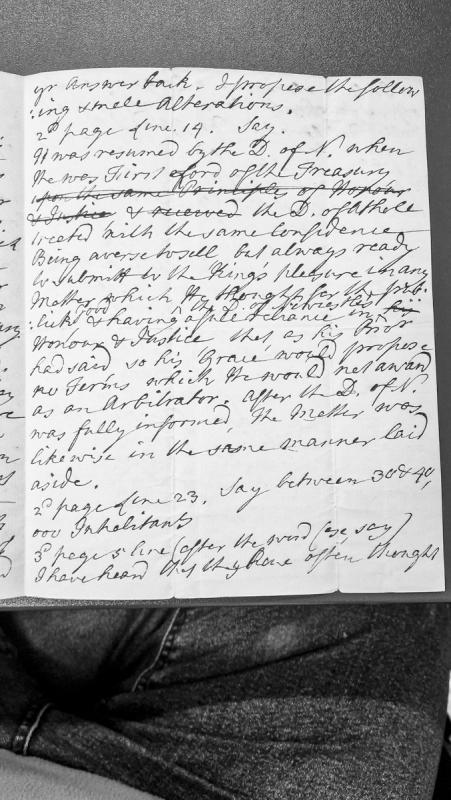
This document contains proposed textual alterations to what appears to be a legal or formal response. It discusses the resumption of a matter by the Duke of Newcastle when he was First Lord of the Treasury, and addresses principles of honor and justice, submission to the King's Pleasure, and the Duke of Athole's treatment.
Extensive historical narrative from William Draper's 1864 work on the House of Stanley, focusing on James, seventh Earl of Derby's execution (15 October 1651) and the subsequent Parliamentarian seizure of the Isle of Man under the Countess of Derby. Includes the Earl's dying speech, character analysis, letters of instruction to his son, and details of the island's capture by Duckinfield and Birch. Highly relevant to understanding the political and personal context of the Stanley lordship immediately preceding the 1765 Revestment.