The codification of Manx law at Tynwald in 1417 preserved the Island's legal tradition in written form. The breast law — customary law carried in the memory of the Deemsters — was recorded. This was not an imposition of new law but the writing down of what the Deemsters already knew and applied.
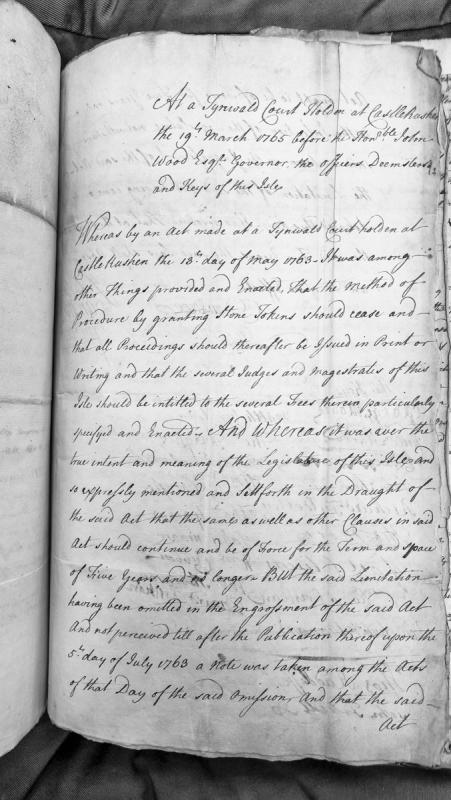
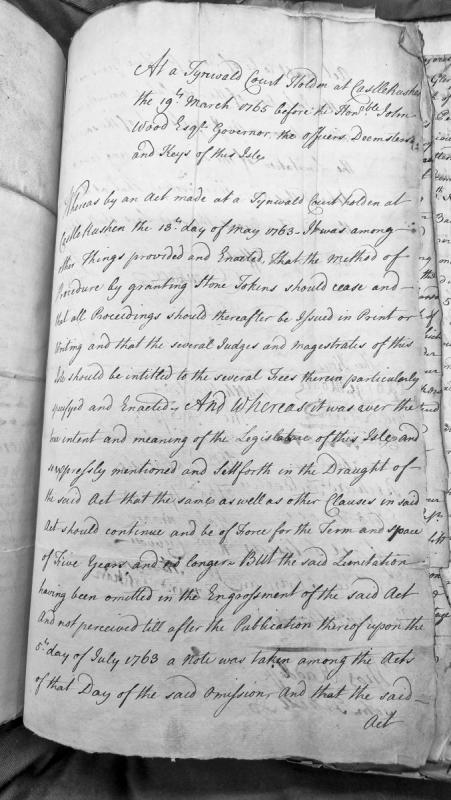
A Tynwald Court proceeding from Castle Rushen addressing an omission in an Act passed on 13 May 1763 concerning the cessation of Stone Tokens as a legal procedure and the establishment of fees for judges and magistrates. The court clarifies that the Act was intended to have a five-year limitation period, which was omitted from the engrossment and discovered after publication on 5 July 1763.
A Tynwald Court judgment from 1765 addressing an Act passed in 1763 concerning the cessation of stone token procedures and the establishment of fees for judges and magistrates. The judgment discusses an omission in the original Act regarding its five-year limitation period, which was discovered after publication.
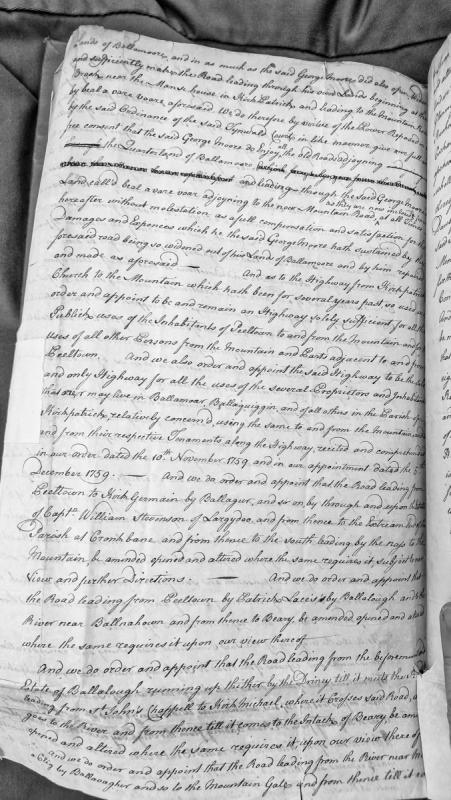
A Tynwald Court directive addressing road maintenance and usage rights in the Kirkpatrick parish area of the Isle of Man. The document grants George Moore of Ballamoore compensation and road rights in exchange for road improvements made on his lands, and specifies multiple public highways for use by inhabitants of Peeltown and surrounding parishes.
The open-air parliamentary ceremony held at Tynwald Hill on 5 July (originally 24 June, Midsummer Day, shifted when the Gregorian Calendar was adopted in 1753). Laws are proclaimed from the hill in Manx and English. The Deemsters fence the court and declare that no one shall quarrel or make disturbance. Rushes are laid along the procession way from the chapel to the hill. The ceremony is not a museum piece. It is a working constitutional act, the formal proclamation of legislation on a hill where legislation has been proclaimed since before the Norman Conquest. The forms survived because the forms are the substance. There is no Tynwald ceremony separate from Tynwald itself.
The heart of Manx governance. Four tiers rising in concentric circles, twelve feet high, eighty across at its base. The grass has never been replanted. According to tradition, soil was carried from every churchyard on the Island — earth from all seventeen parishes, mingled together so the hill embodies the unity of the Manx people. The Manx name Cronk-y-Keeillown uses 'keeill' not 'kirk,' proving the site predates the Norse. The Norse built their assembly at a site the Manx people already considered sacred. Tynwald still meets here every July.
Not a hill in the geographic sense, no chance feature of the earth's creation. A constructed mound, built deliberately at the centre of the Island, at a site where Manannan's roads converge, where a keeill dedicated to St John stood before the Norse arrived, and where the midsummer gathering had taken place since before written record. The Norse established their thing-vollr at an already-sacred site. The Manx name Cronk-y-Keeillown preserves the pre-Norse chapel. The name Tynwald preserves the Norse assembly. The roads preserve Manannan. Three layers of meaning in one constructed mound.
Tynwald formally ratified Stanley rule — not as automatic acceptance of an English king's grant, but as the Manx constitutional body exercising its own authority to confirm a new lord. The distinction is important: the grant came from Henry IV, but the legitimacy came from Tynwald.
For over a decade after the Revestment, Tynwald was effectively silenced. No petitions heard in the old way. No laws promulgated as the constitution required. The ancient ceremony continued in form but the substance — the living governance the Prologue describes — was hollowed out. The silence is the book's recurring structural motif: told, acknowledged, ignored.
Complete text of the Declaration of Independence (July 4, 1776) and U.S. Constitution with amendments, published by U.S. Citizenship and Immigration Services as educational material. Includes index and scholarly quotations on constitutional principles. Relevant to the Revestment project as a comparative document illustrating colonial grievances against Parliamentary sovereignty and principles of constitutional reform that provide context for understanding contemporary 1765 debates on Manx governance.
Official USCIS publication containing the full text of the Declaration of Independence (4 July 1776) and U.S. Constitution with amendments, plus editorial quotes from Hamilton, Washington, Jefferson, Mason, Marshall, and Madison. Includes index and reference to National Constitution Center. Relevant to Revestment project as comparative constitutional/parliamentary context for understanding 1765 Isle of Man debates on sovereignty, representation, and taxation.
The transcription file contains only header metadata and archive information with no actual document content to analyze. The source image reference and transcription method are noted, but the primary source text is absent.
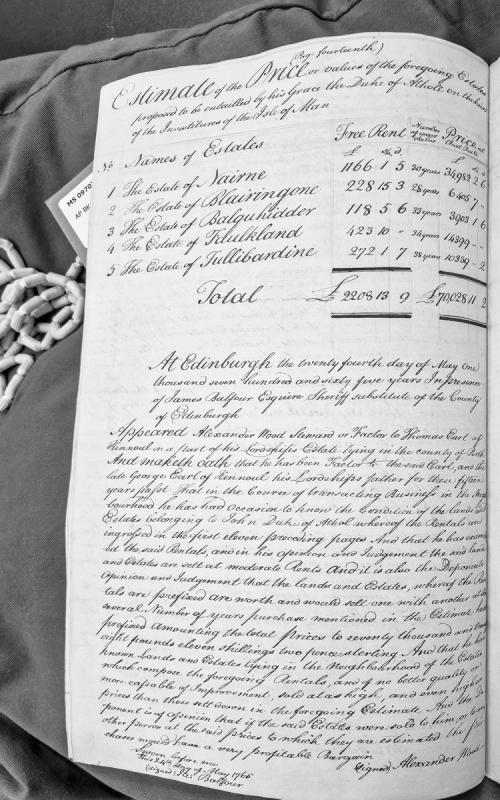
A sworn affidavit by Alexander Wood, factor to the Earl of Kinnoul, attesting to the moderate valuation of lands and estates belonging to John Duke of Athol. Wood provides expert opinion on rental assessments and estimated sale prices totaling £70,028 11s 2d, based on 15 years of experience managing neighboring estates.
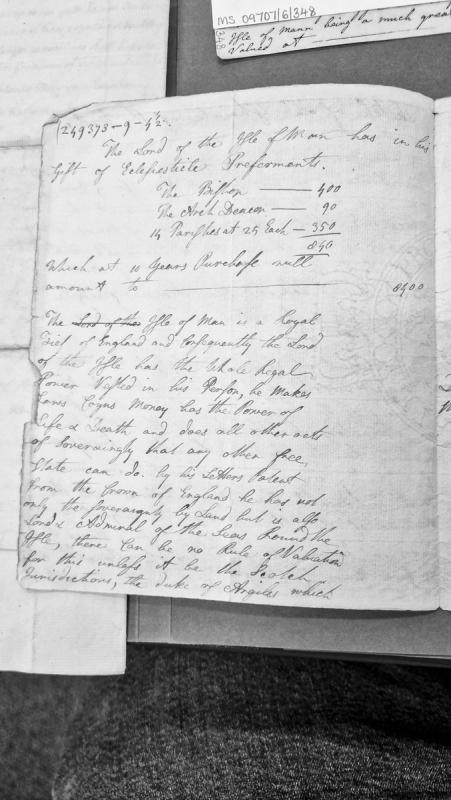
A document describing the ecclesiastical patronage held by the Lord of the Isle of Man, listing the Bishop, Arch Deacon, and 14 parishes with their valuations, totalling 8,400 at 10 years purchase. It also outlines the sovereign and regal powers vested in the Lord of the Isle, including legislative authority, coinage, and judicial powers, comparing the jurisdiction to Scottish precedents.
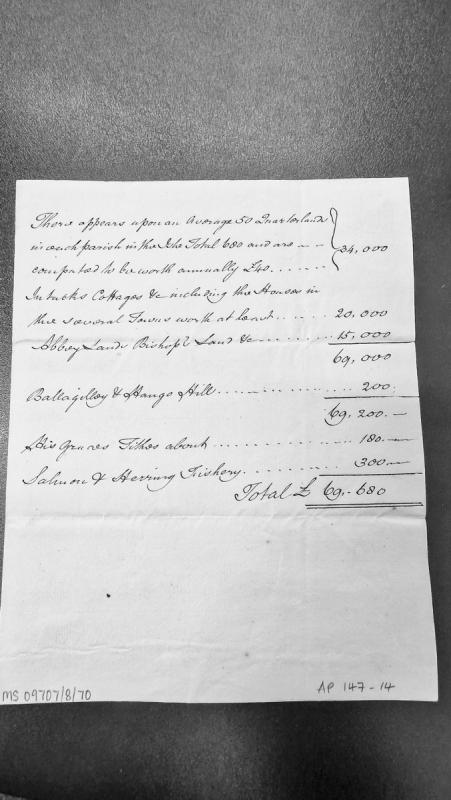
A revenue abstract estimating the annual value of various categories of property and resources on the Isle of Man, including quarterlands, intacks, cottages, abbey lands, bishop's lands, tithes, and fisheries. The total valuation reaches £69,680.
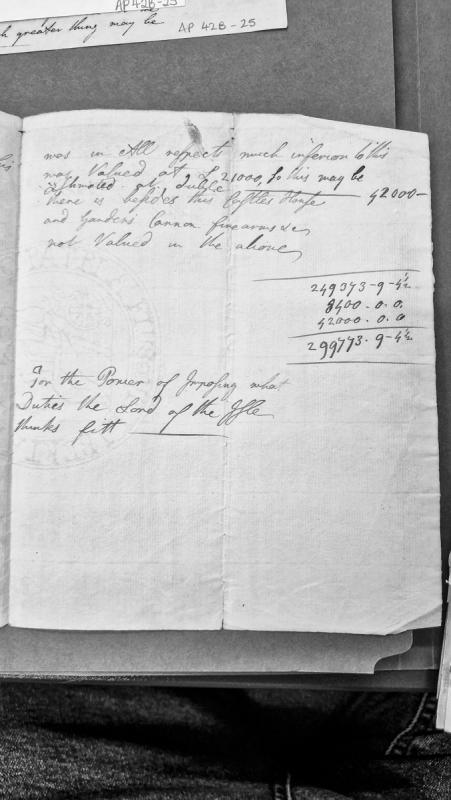
A revenue abstract calculating property valuations, including a castle, house, gardens, and military equipment. The document shows comparative valuation methodology and totals approximately £299,773, with a note regarding the Lord of the Isle's power to impose duties as seen fit.
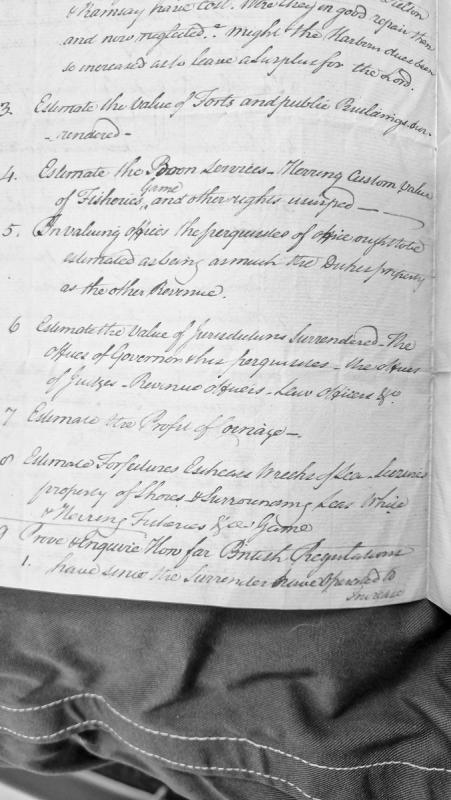
A numbered list of items to be valued and evaluated regarding Manx properties, offices, and rights that were surrendered, likely related to compensation claims or accounting following the transfer of governance. Includes estimates for forts, harbours, fisheries, offices, and jurisdictions.
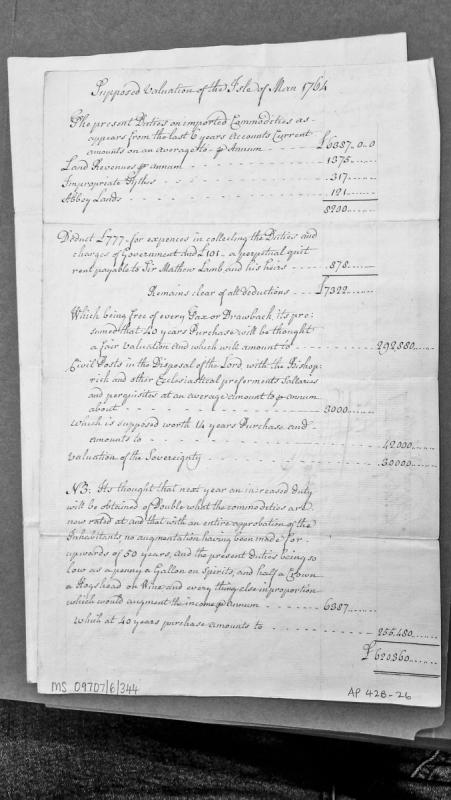
A financial assessment of the Isle of Man's revenue sources and property valuations dated 1764. The document calculates annual revenues from duties, land, tythes and abbey lands, deducts administrative costs, and applies multiplier factors (40 and 14 years purchase) to estimate total valuation of approximately £620,360. It includes a note on anticipated duty increases.
Destination for Moore's fish cargo. He recorded a 90% profit on one shipment — evidence of just how profitable the legitimate Manx trading economy was.
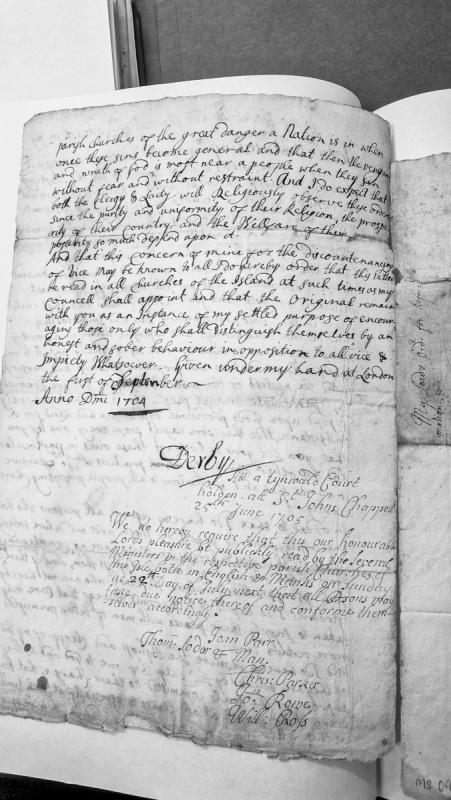
A letter from the Earl of Derby (dated 1 September 1704) addressing the dangers of vice and immorality becoming widespread in society, ordering clergy and laity to observe strict moral standards. The letter was subsequently ordered to be read publicly in all parish churches by the Tynwald Court on 25 June 1705, with instructions for dissemination in both English and Manx.