Wrote home from Ohio in 1827. His letter, published in the Manx Sun on 18 March 1828, was both an invitation and an indictment. 'A laboring man can earn as much in 2 days that will keep a family of 7 or 8 persons a week.' 'The girls here do not work in dunghills like slaves as they do on the Island.' 'No Mc Crone, Sandy or Lambie.' 'You do not want to put your hand in your hat and humble yourself to the dust when you spake to a gentleman here like you do on the Island.' He dropped into Manx twice in the letter. He reported: 'This first night we were here there were 33 Manx people in our house at a time. Manx is spoken here in plenty.'
In 1827, Thomas Kelly wrote home from Ohio. His letter, published in the Manx Sun on 18 March 1828, was both an invitation and an indictment. He reported that a labouring man could earn in two days enough to keep a family of seven or eight for a week, and that the girls did not work in dunghills like slaves as they did on the Island. He named names — McCrone, the Duke of Atholl's chief tithe proctor. Every comparison between Ohio and Mann was a silent accusation of what Mann had become. Kelly dropped into Manx twice in the letter, the habits of a bilingual mind writing to people who would understand both languages. He recorded that on the first night thirty-three Manx people were in his house, and that Manx was spoken in plenty. The letter was read aloud, as such letters always were, and published in the newspaper — read again in homes and chapels across the northern parishes.
Whitehaven merchant who co-signed the merchants' memorial to the Treasury alongside Walter Lutwidge, calling for the purchase of Mann's sovereignty. The memorial was signed by thirty-two traders and represented the Whitehaven commercial interest that competed against the Manx running trade. The same family would provide the Receiver-General who administered the consequences of the seizure they had lobbied for.
One of three men sent to London in late 1765 or early 1766 as the first post-Revestment deputation — alongside Hugh Cosnahan and John Christian. They arrived too late to influence the Mischief Act but achieved one thing: duty-free entry into Britain and Ireland for Manx produce and manufacture. It was not nothing. But it was not what they had gone for.
Prime Minister 1754–1756 and 1757–1762. Central figure in the parliamentary politics that led to the Revestment. His administration first pursued the acquisition of the Isle of Man.
The vicar who married William Bligh and Elizabeth Betham at St Catherine's Church, Onchan, on 4 February 1781. The marriage is recorded in the parish register.
Brought six tons of coal from Liverpool to Douglas in September 1748, because the Island needed fuel as much as it needed profit. The coal boats came and went alongside the brandy ships without anyone finding the juxtaposition remarkable.
The most consequential political operator in fifteenth-century England. Survived every king of the Wars of the Roses. Married Margaret Beaufort, Henry Tudor's mother. At Bosworth on 22 August 1485, he positioned six thousand men between the two armies and waited. When Richard III charged at Henry, Sir William Stanley intervened. Thomas — who had committed no troops to the fighting — picked up Richard's crown, found under a hawthorn bush, and placed it on Henry Tudor's head. The man who had fought for nobody crowned the new king. Created Earl of Derby 27 October 1485.
The first Lord of Mann to adopt the lesser title, replacing King with Lord. Two explanations: political prudence after the Wars of the Roses, or a gesture of submission — 'it is not fit for a King to be subject to any but the KING of KINGS.' The title change was not made on the Island, not ratified by the estates, not discussed at the hill. It was made in England, for English reasons. The kingly title lingered despite the change — as late as 1532, the 3rd Earl still styled himself 'Soveraigne and liege Lord.'
Manx advocate who captured the Island's constitutional position in a legal treatise published in 1792. Every word precise: 'The Isle of Man, or, as it was anciently called, The Kingdom of Man, though generally tributary to, or feudally pendant on, one or other of the British Crowns, was never annexed to either, nor to any other Realm; and has, from Time immemorial, enjoyed otherwise, and within itself, a Free Constitution.' Tributary — feudally pendant — but never annexed. The distinction between custodianship and ownership in legal language.
Coroner of Rushen Sheading who discovered George Wilks's counterfeit pennies in a house search. Reported the matter because he was 'sworn to my Lord' and 'obliged to make a discovery.' Note the family name — Tubman/Taubman — which would appear in the Island's affairs for generations.
Letter from Philadelphia merchant Thomas Wharton to Benjamin Franklin discussing multiple versions of Patrick Henry's Virginia House of Burgesses resolves against the Stamp Act (May 1765), with detailed editorial analysis of textual variants and manuscript copies in Franklin Papers. Also reports on Cumberland County's violent opposition to supplying Fort Pitt, including the seizure and burning of Joseph Spear's goods.
Chief Constable of Douglas who testified to the 1792 Commissioners that the prison was 'in a very ruinous condition, and insufficient for the purpose of confining offenders, without having a guard set over them.' Twenty-six years the Crown had been responsible for this building.
Bishop of Sodor and Man from 1698 to 1755, the longest episcopate in the history of the diocese. Wilson built schools, translated the Bible into Manx, enforced ecclesiastical discipline with a rigour that earned him both admiration and enemies, and became inseparable from the island's identity. His fifty-seven year episcopate shaped Manx society more profoundly than any lord.
Norse carver whose cross-slab at Kirk Andreas depicts Odin devoured by Fenrir at Ragnarok on one side and Christ triumphant on the other. The most famous visual evidence of the Norse-Christian transition on the Isle of Man.
The tavern in Milk Street, London, where George Christian sent coded letters during the appeal against Illiam Dhone's execution, and where Derby sent his spy Roper to infiltrate the Christian family's network.
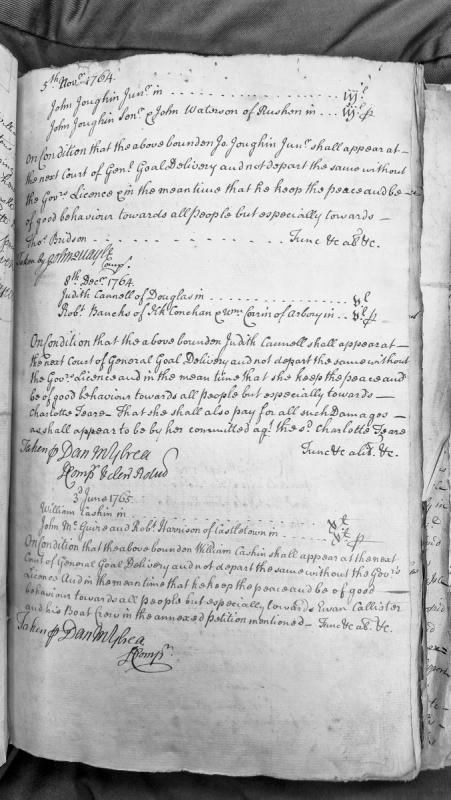
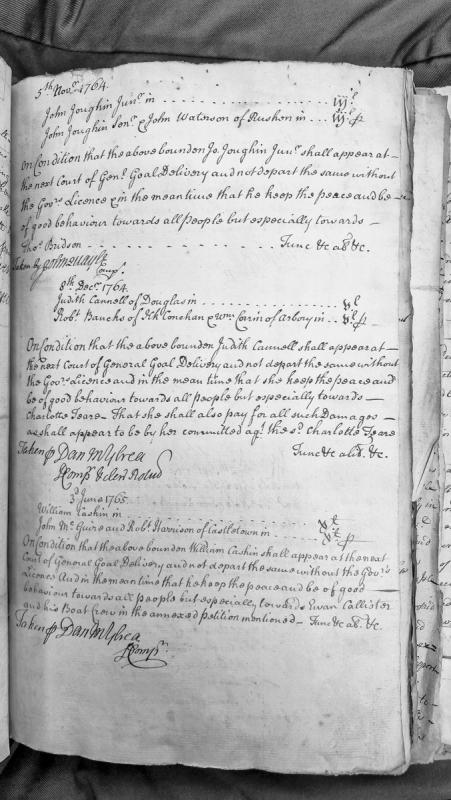
A record of three recognisance bonds requiring individuals to appear before the Court of General Gaol Delivery and maintain good behaviour. The bonds cover John Joughin Jr. (November 1764), Judith Cannell of Douglas (December 1764), and William Cashin (June 1765), each with named sureties and specific conditions regarding peace-keeping and reparations.
A record of three separate recognisance bonds taken before the Manx courts between November 1764 and June 1765. Each bond requires the named party to appear at the next Court of General Goal Delivery, keep the peace, and maintain good behaviour, with named sureties. The bonds relate to disputes involving Thomas Bridson, Charlotte Tears, and Ewan Callister and his boat crew.
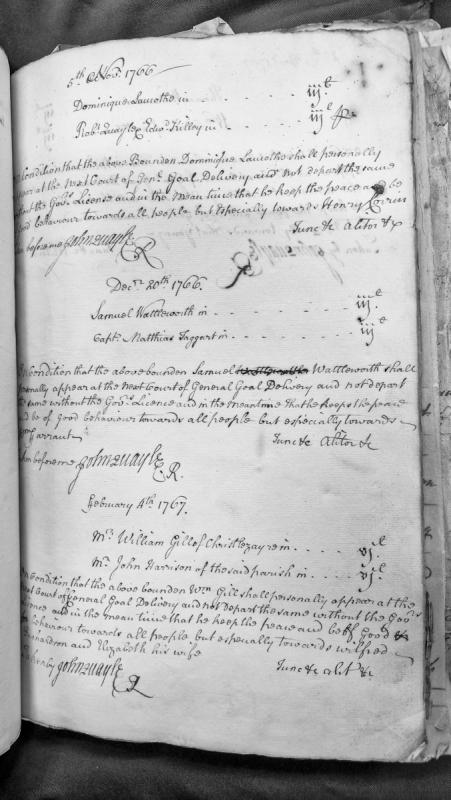
A series of three recognisances (bonds) taken before John Quayle, Coroner and Jurat, requiring individuals to appear at the next Court of General Gaol Delivery and keep the peace. Each recognisance names two sureties bound in £3 or £6 amounts and specifies particular individuals toward whom peaceful behaviour must be maintained.
The TT motorcycle race, held on the Isle of Man since 1907. The most famous sporting event on the Island and a defining element of modern Manx identity. Run on public roads over a 37.73-mile mountain course.
Chapter 22 from Train's 1844 History and Account of the Isle of Man, covering the rise and suppression of the contraband trade from circa 1670 to the 1830s. Details the smuggling operations, the role of Manx islanders and adventurers like Commodore Thuròt, revenue losses to Britain, and government attempts at regulation culminating in the 1765 Revestment Act and subsequent fiscal reforms.
The formal transfer of sovereignty from the Duke of Atholl to the Crown. Crown officers took possession of Castle Rushen. The Duke's administration ended. The ceremony marked the moment when the custodianship — held by the Stanleys and then the Atholls for three and a half centuries — passed to a Crown that had no interest in the Island beyond stopping the trade.
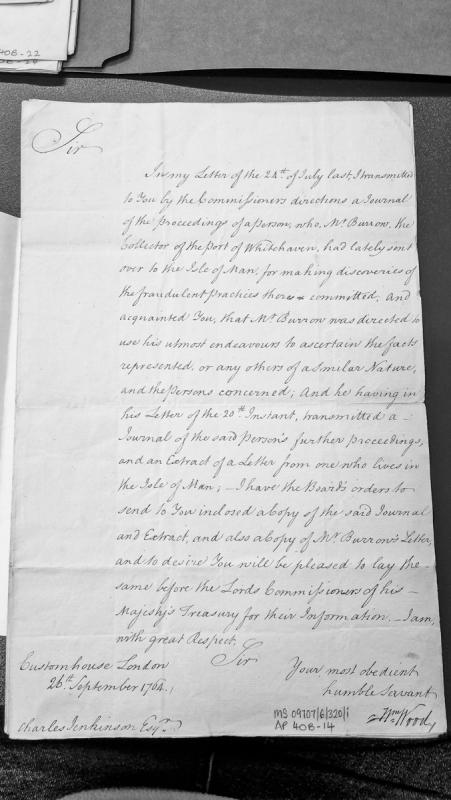
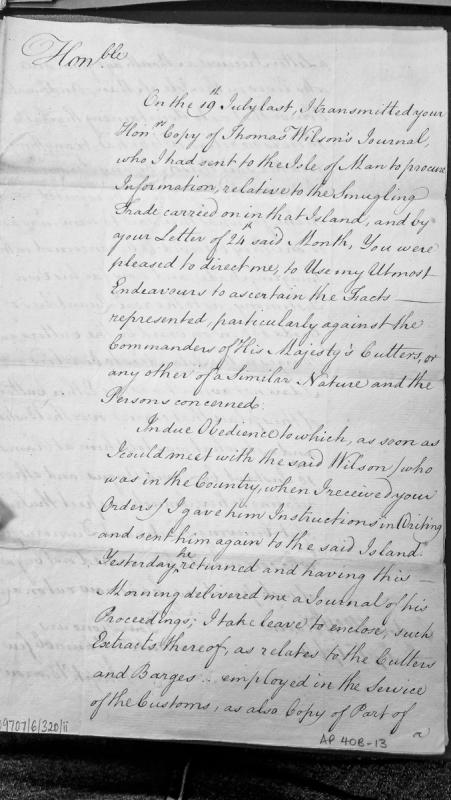
Official letter from William Wood at the Customhouse, London, to Charles Jenkinson Esq., transmitting copies of a journal documenting investigations into fraudulent customs practices on the Isle of Man, along with related correspondence from Mr. Burrow, Collector of the Port of Whitehaven, for submission to the Lords Commissioners of the Treasury.
Administrative letter enclosing extracts from Thomas Wilson's investigative journal concerning smuggling activities in the Isle of Man and the conduct of His Majesty's Customs cutters and barges. The sender reports having received instructions on 24th July to investigate facts represented against commanders of royal vessels and persons involved in smuggling operations.