Over twelve hundred wells and springs were recorded on the first Ordnance Survey maps in the 1860s, a century after the Revestment. The holy wells among them were still visited. The practice was consistent: walk three times sunwise around the well, drop a pin or pebble into the water, make your prayer, drink, and tie a rag to the tree that overhung the pool. The rags accumulated, fading in sun and rain, testimony to generations of hopes and griefs that no parish record preserved. Chibbyr Lansh, St Maughold's Well, still drew pilgrims from across the Island. The wells survived because the people who visited them did not need permission.
Forget Halloween — Hop-tu-Naa is older.
The last night of October was the Manx New Year’s Eve, the night when the old year died and the dead walked abroad. Bonfires burned on the hills. Children carried turnip lanterns from house to house, singing the Hop-tu-Naa song.
Not pumpkins — turnips. Carving a turnip is harder work than a pumpkin, which is part of the point.
This activity guides you through making a traditional Hop-tu-Naa lantern from a turnip (or a swede if you can’t find a big enough turnip), with the words of the song to learn.
Best done in late October, obviously — but there’s nothing stopping you practising in July.
The song sung by children on Hop-tu-Naa (31 October) as they carry carved turnips door to door. One of the oldest surviving calendar songs in the Celtic tradition, marking the last night of the old Manx year.
An excerpt from Draper's 1864 historical work on the House of Stanley, focusing on James, Tenth Earl of Derby (d. 1735-6) and tracing the descent of Isle of Man sovereignty through the Stanley and Athol families. Includes detailed account of the 1765 Parliamentary purchase of the island by the Crown from the Duke of Athol for £70,000, with reserved land rights and annual payments, and subsequent sales in 1806 and 1826.
Benjamin Franklin's 1760 pamphlet arguing for retention of Canada and Guadeloupe in peace negotiations following the Seven Years' War. Addresses colonial security, frontier defence against French-backed Indians, and long-term strategic interests in North America. Includes observations on population growth and governance of colonies.
Benjamin Franklin's major pamphlet on British imperial policy following the Seven Years' War, arguing for retention of Canada over Guadeloupe based on mercantilist economic theory and the value of North American colonies as markets for British manufactures. Includes comparative trade data, population statistics, and discussion of colonial governance and the risk of independence. Part of broader 1759–1763 pamphlet debate over peace settlement terms.
Benjamin Franklin's influential pamphlet arguing for British retention of Canada rather than Guadeloupe in the forthcoming Treaty of Paris, addressing mercantile theory, colonial markets, and imperial economic interests. Originally published April 1760, this is a transcription from Founders Online (National Archives). The document engages with contemporary debates on colonial value and prefigures later tensions between mother country and colonies.
Benjamin Franklin's major 1760 pamphlet arguing for British retention of Canada over Guadeloupe in peace negotiations following the Seven Years' War. Engages mercantilist economics, colonial growth potential, and the role of North American colonies as markets for British manufactures. Includes comparative trade statistics and reprints Franklin's 1751 'Observations concerning the Increase of Mankind.'
Benjamin Franklin's influential pamphlet arguing for British retention of Canada over Guadeloupe in peace negotiations following the Seven Years' War. Addresses mercantilist economic theory, colonial population growth, trade expansion with North America, and the strategic importance of continental colonies as markets for British manufactures. Includes statistical evidence on exports and population growth in the colonies.
Benjamin Franklin's 1760 pamphlet engaging in public debate over post-war colonial policy, particularly the retention of Canada versus Guadeloupe. Franklin argues for Canadian possession on grounds of American security, frontier stability, and prevention of future costly conflicts. The work addresses imperial strategy, colonial defense, Indigenous relations, and the economics of empire during the Seven Years' War aftermath.
The sea is the thing. It always was. An islander might go a lifetime without climbing Snaefell, but nobody could ignore the water. It was visible from almost anywhere on the island, audible from everywhere on a windy night, and it shaped every aspect of Manx life. The Irish Sea can be millpond-smooth in the morning and dangerous by afternoon, and the fishermen who made their living from it learned its moods through generations of accumulated experience. Every coastal parish had its stories of boats that did not come back. Somewhere out in that water, if the old stories can be believed, lies the Kingdom of Manannan mac Lir.
Chapter 10 from an 1893 history of the Isle of Man, drawing on primary accounts by William Blundell, Thomas Chaloner, William Sacheverell, and Bishop Wilson to describe Manx life during the Civil War period and Restoration. Covers agriculture, herring fishery, social structure, laws, and governance under the Derby dynasty, providing context for pre-Revestment island conditions.
Chapter 10 from "Land of Home Rule" (1893) provides a detailed portrait of Isle of Man society in the 17th century following the English Civil War, drawing on primary sources by William Blundell, Chaloner, Sacheverell, and Bishop Wilson. It covers agriculture, herring fishery, social structure, laws, mineral resources, and governance under the Derby dynasty, offering crucial context for understanding pre-Revestment Manx conditions.
A bilingual (English/Latin) historical record from the Manx Society vol. 7 documenting the 1393 purchase of the Isle of Man by William Scrope from Montague, Earl of Salisbury. The entry also notes the transfer of the King's Bench and Chancery from London to York in the same year. This provides crucial context for understanding pre-1765 sovereignty claims over Man and the history of feudal ownership prior to the Revestment.
A bilingual (English/Latin) chronicle entry from Monumenta de Insula Manniae recording the 1393 purchase of the Isle of Man by William Scrope, Lord Chamberlain, from Montague, Earl of Salisbury. The entry also notes the temporary transfer of the King's Bench and Chancery from London to York. This is an early medieval precedent document relevant to understanding Manx sovereignty transfers.
174 keeill sites have been identified by archaeological survey. Many are on private land or hard to find, but dozens are accessible — marked on Ordnance Survey maps, visible as low stone foundations in fields and on hillsides.
This summer project challenges you to find and photograph as many keeills as you can. Each keeill entry in your field notebook should include: location (grid reference), condition, whether there’s water nearby (there almost always is), what you can see of the walls, and a sketch.
How many can you find in a summer? Nobody’s counted yet. You could be the first.
The communities remembered what happened to anyone who interfered with the keeills. A windmill built from keeill stones went with tremendous fury and had to be taken down. A farmhouse roofed with stone from a keeill produced such unearthly noises that the stone was returned to the site. Bishop Wilson knew the formula for the worst curse a Manx person could utter: Clogh ny killagh ayns corneil dty hie mooar, may a stone of the church be found in the corner of thy dwelling-house. The stories protected what the buildings could not. The holiness was understood to be permanent, deposited in the ground, infused into the stones. A ruined keeill was not a dead church. It was a sleeping one.
Over two hundred tiny chapels once scattered across the Island, roughly one for every treen. Built by the culdees, servants of God, who chose to live among the people and serve the families nearest to them. Typical dimensions: five metres by three, walls of stone described as unnecessarily massive for such small enclosures. One window. One door. Altar against the eastern wall. Almost invariably a spring or stream nearby. One keeill per treen was the general pattern. By the eighteenth century most were ruins, but the memory of holiness clung to them. A windmill built from keeill stones went with tremendous fury and had to be taken down. Wilson knew the curse: may a stone of the church be found in the corner of thy dwelling-house. The 2007 archaeological survey identified 174 sites. They survived because they were beneath notice.
The spirits that haunted churchyard stiles in Manx tradition. The boundary between consecrated and unconsecrated ground was a charged threshold in Manx belief. The keimagh inhabited that boundary, occupying the liminal space where the sacred met the everyday. Part of Moore's comprehensive taxonomy of the Manx supernatural world.
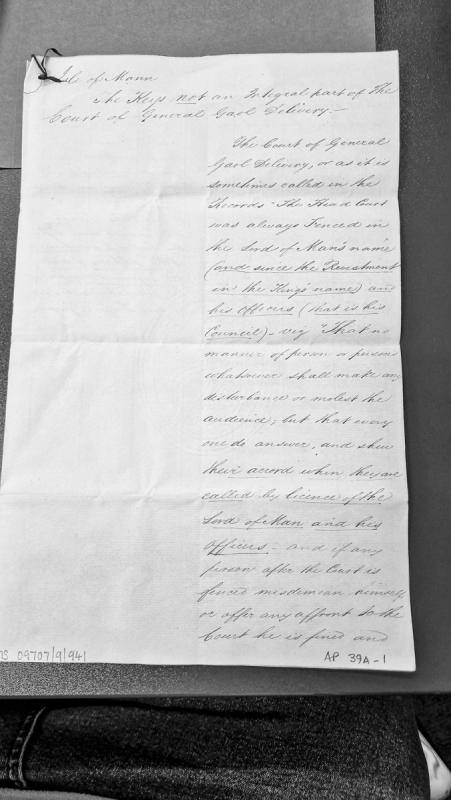
A legal document discussing the constitutional status of the Court of General Gaol Delivery (also called the Head Court) in the Isle of Man, describing its procedures for fencing the court in the Lord of Man's (later the King's) name and regulations for conduct during proceedings.
The census numbers tell the story. In 1874, 16,200 people spoke Manx, roughly thirty per cent of the population. By 1901, 4,598. By 1911, 2,382. By 1921, 896. By 1931, 529. By 1946, perhaps twenty native speakers remained. The mechanism was domestic, not dramatic: English-language schooling produced children who spoke English at school and Manx at home, then children who spoke English everywhere because their parents wanted them to get on. Margaret Murray remembered the old folks talking Manx when they did not want the children to understand. There were stories of Manx speakers getting stones thrown at them in the towns. The Revestment did not kill the language, but it removed every institutional support that had sustained it.
The revival began before the last native speaker died. Brian Stowell, who learned Manx from the last speakers, began teaching in the 1960s. In 1899, A.W. Moore had helped found Yn Cheshaght Ghailckagh, the Manx Language Society, whose motto was Gyn chengey, gyn cheer: without language, without country. In 1948, the Irish Taoiseach Eamon de Valera sent recording equipment to capture the voices of the last speakers, because the Manx government at that time would not. In 1985, Tynwald adopted Manx as an official language. In 1992, classes began in schools. In 2001, Bunscoill Ghaelgagh opened, the first primary school teaching entirely through Manx. By the 2011 census, 1,823 people claimed some ability. The first new generation of native speakers had appeared: children raised bilingually.
Chapter 15 from 'Land of Home Rule' (1893) examines the impact of the 1765 Revestment on Manx society, focusing on labour law reform post-1777, the island's transformation into a debt refuge under the 1737 Protection Act, suppression of smuggling, and the final purchase of the Duke of Atholl's remaining interests by the Crown in 1825. The chapter traces economic consequences from the loss of illicit trade through tourism and literary discovery, and evaluates the Stanley and Atholl dynasties' stewardship.
The final years before Parliament acted. George Moore's Letter Books recorded a cosmopolitan trading world operating from Bridge House in Castletown. The family networks — Moore, Quayle, Taubman, Christian — wove together commerce, governance, and community. The Keys passed their resolution. Hugh Cosnahan carried the deputation to London. The Whitehaven merchants petitioned Westminster. Parliament moved to protect East India Company revenues. The Isle of Man Purchase Act received Royal Assent on 10 May 1765.