The genius of the Manx church: each arriving culture adapted to what was already there rather than replacing it. Christianity settled beside the holy wells. The Norse built their parliament on sacred ground. The ritual year wove both traditions together so tightly that by the eighteenth century nobody could have said where Christianity ended and the older religion began. The early missionaries did not suppress the older world. Moore explained the mechanism: the early teachers of Christianity encouraged belief in charms against fairies and witches as a means of diverting their converts from the worship of nature. The clergy knew that to preach against the existence of fairies would make the people refractory. So they did not try. The accommodation was not a compromise. It was a way of being in the landscape.
The ancient militia was one of the Lord of Mann's prerogatives — Manx men, armed and trained, defending their own island under the Lord's authority. The garrison tradesmen whose names fill the disbursement accounts — the Brews and Killeys and Quayleys — had combined military service with their ordinary occupations for generations. A man might be a carpenter six days a week and a soldier on the seventh, and his father and grandfather had done the same. The Lord took responsibility for defence, but the community contributed. The garrison was raised from the people, not imposed upon them. That distinction — between a force that belongs to a community and a force that occupies it — is the distinction the Revestment destroyed.
In 1779, the Archbishop of York asked Manx people to contribute to the relief of Anglican clergy displaced by the American Revolution — the revolution provoked, in part, by the same fiscal overreach that had impoverished the Manx. The Bishop of Sodor and Man replied that his clergy's preferments and his congregations' circumstances could not afford such generosity. Forty-eight years later, Manx people were emigrating to the very republic the revolution had created, because the island the Archbishop had asked them to subsidise was no longer able to sustain them. The chapel that could not afford to help the displaced clergy was now itself being displaced.
Lords of Mann from 1736 to 1765, inheriting through the female Stanley line. James Murray, 2nd Duke of Atholl, appeared at his first Tynwald 'with a state and magnificence far exceeding any thing of the kind previously witnessed' — the last Lord to preside on Tynwald Hill until George VI in 1945. He died in 1764. His granddaughter Charlotte Murray inherited the Barony of Strange and with it the sovereignty. Her husband John, the 3rd Duke — whose father Lord George Murray had fought for the Jacobites and been attainted — held the lordship for less than a year before accepting £70,000 under duress. He never visited the Island. Charlotte's name is on the Purchase Act; no letter survives recording her views. The 4th Duke spent thirty years petitioning for additional compensation, was appointed Governor in 1793, and told the Keys in 1822 they were 'no more Representatives of the people of Man, than of the people of Peru.' The final settlement in 1829 cost Parliament approximately £487,144 in total. The Manx people received nothing.
The Manx mermaid. Part of Moore's full taxonomy of the supernatural beings that inhabited the Manx landscape alongside the human population. The ben-varrey belonged to the coastal waters in the same way the buggane belonged to specific inland sites. Each creature had its territory, its character, and its rules of engagement with the human world.
The bollan bane — mugwort — was gathered at midsummer and worn as a chaplet to protect against enchantment. It grows wild across the island.
This summer project is a nature journal: find and identify the plants that appear in Manx tradition. Mugwort for midsummer. Mountain ash (rowan) for May Day. Rushes for Tynwald. Elder, which the fairies favoured. Gorse, which the Manx people burned to clear land.
Press specimens, draw them, photograph them. Note where you found them and when.
By midsummer, gather your own bollan bane and make a chaplet. You’re doing something Manx people have done for longer than anyone can remember.
A melody the Manx people said had been learned from the fairies themselves. A farmer wearing mugwort for protection went into the hills and heard the fair folk playing music. He went back three times to memorise the tune, each time returning home later until finally arriving at sunrise to be met by an angry wife. But he had the tune, and it passed into the tradition of the island. Fairy music made safe by the protective herb, captured and carried back to the world of men.
When the British regulars replaced the Lord's garrison in 1765, the character of military presence on the island changed entirely. The 2nd Queen's Royal Regiment of Foot and Hale's Light Dragoons arrived from Ireland. The Black Watch followed. For sixty-three years, British regiments rotated through Castle Rushen — foreign soldiers billeted to enforce Parliament's revenue policy. By 1783, the barracks were in bad repair, the bedding very bad and defective. No Parliamentary money was allocated for repairs. The soldiers who occupied the island were housed as poorly as the islanders they occupied. Parliament sent the same kind of force to the Isle of Man that it sent to the Scottish Highlands, because Parliament understood both places the same way — as territories to be brought to heel.
The most famous of the bugganes, the malevolent site-specific spirits of Manx folklore. This buggane tore the roof off St Trinian's church every time it was built. Timothy the tailor took on the challenge, stitching a pair of breeches while the buggane rose from the ground before him. It demanded he look at its great head, large eyes, and long teeth. Timothy kept stitching. He finished the last stitch and leapt to consecrated ground just in time. The buggane, unable to follow him onto holy earth, tore off its own head and hurled it after him. Timothy was unscathed. The church remains roofless to this day. The story captures the accommodation at work: Christianity protected against the buggane, but it did not deny the buggane's existence.
An extract from Draper's 1864 'House of Stanley' detailing the burial places of the Earls of Derby, focusing on Burscough Priory (founded c.1186, dissolved c.1536) and the subsequent removal of bodies to Ormskirk Parish Church. Includes architectural descriptions, founding history, and references to the Stanley family vault, relevant to understanding the institutional and dynastic context of the Revestment-era Derby family.
A major scholarly monograph analysing the domestic impact of British imperial expansion through the lens of the East India Company's transformation from trading organisation to imperial power in South Asia. Bowen examines the Company's stockholders, directors, administrative structures, financial operations, and interactions with the British economy and society during the late eighteenth and early nineteenth centuries, drawing extensively on Company records held in the British Library.
A UCL History PhD thesis (2024) by Stephen Mallet analysing smuggling as a commercial business in Britain and France during the 18th century. The thesis examines smuggling supply chains, legal frameworks, organisation, financing, and risk management, with particular emphasis on the Isle of Man as a smuggling entrepôt until 1765. It adopts a comparative Anglo-French approach to understand smuggling economics and its impact on trade, revenue, and society.
The water-horse of Manx folklore. A shape-shifting creature who could appear as an ordinary horse grazing by a lake or river. Anyone who mounted it would find themselves unable to dismount as the creature plunged into deep water. In 1859 it was reported that such an animal was to be seen in a field near Ballure Glen, and hundreds of people left Ramsey to catch sight of it. Campbell, writing of the same tradition in Scotland, concluded that the old Celts must have had a destroying water-god to whom the horse was sacred. The Manx water-horse was sometimes identified with the Glashtyn.
The small island off the southern tip of the Isle of Man, sheltering the Sound from the southwest gales. A bird observatory and nature reserve. The Calf appears in the landscape as a constant companion to the southern parishes, visible from Port Erin and Port St Mary, separated by the treacherous Sound where the tidal race runs.
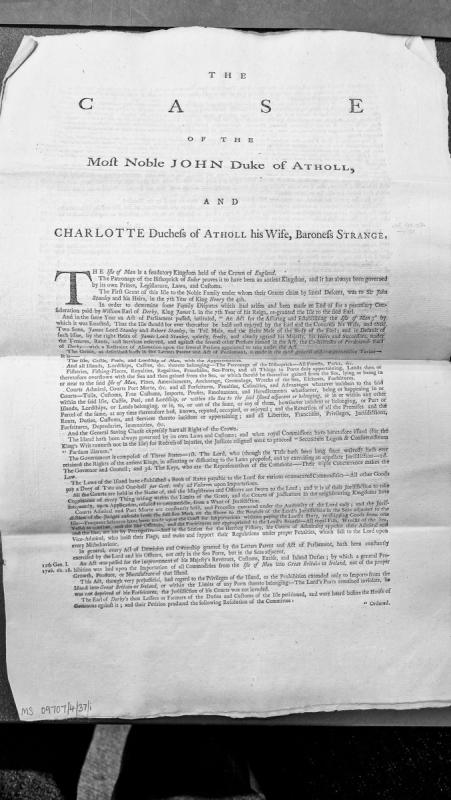
A legal document presenting the case of the Duke and Duchess of Atholl regarding their feudal rights over the Isle of Man. It traces the historical grants from Henry IV through James I, details the comprehensive privileges granted including judicial, maritime, and revenue rights, and argues for the Lords' sovereignty and jurisdiction over the island and adjacent seas.
A detailed petition submitted by the inhabitants of the Isle of Man to Parliament in response to the 1765 Revestment Act and subsequent trade restrictions. The document traces the constitutional history of Man's self-governance, details the series of British Parliamentary acts restricting trade (1710–1765), and argues that the inhabitants' ancient rights and commercial privileges were violated without consultation or compensation when sovereignty transferred to the Crown.
A detailed petition by the inhabitants of the Isle of Man arguing for restoration of ancient constitutional and commercial rights following the 1765 Revestment. The document traces Manx legal history, parliamentary acts affecting the island's trade (1710–1765), and the severe economic consequences of the 1765 Act restricting commerce. It challenges the legitimacy of Parliament's authority to strip commercial privileges without consent or compensation.
A formal petition/memorial presented by the Inhabitants of the Isle of Man to Parliament in February 1765, arguing against the loss of their ancient constitutional rights and trading privileges following the Crown's purchase of sovereignty from the Duke of Atholl. The document traces Manx constitutional history, details the progression of restrictive Parliamentary acts (1710-1765), and pleads for relief from the devastating 1765 Act that effectively closed the island's profitable smuggling-based trade.
A formal petition presented by the inhabitants of the Isle of Man to Parliament in February 1765, following the passage of the Revestment Act. The document outlines the historical constitutional status of Man, its independent legislative power (Tynwald), and the ancient commercial privileges of its people. It protests the purchase of the island by the Crown from the Duke of Atholl and the subsequent restrictive trade legislation (5 Geo 3 Cap 25 and the Act for preventing illicit trade), arguing these measures violated immemorial rights and caused severe economic hardship. The petition requests parliamentary redress and trade concessions.
The cathedral at Peel Castle, seat of the Bishop of Sodor and Man. By the time of Crown administration it was described as totally useless. The cathedral that had been the spiritual centre of the Island, that Wilson's predecessors had maintained, that the Lords had supported as part of the constitutional fabric of Mann, was allowed to decay because no institution under Crown control saw any reason to maintain it.
The longest-serving governing family in Manx history, producing Deemsters from 1408 and members of the Keys across every generation. John McCristen served as Deemster in 1408 and at Tynwald in 1422 — 'the first to put the Manx Laws in writing.' Ewan Christian served as Deemster for fifty-one years, the longest tenure on record. Edward Christian proposed elected Keys and accountable Deemsters under the Great Stanley and was imprisoned for eighteen years. William Christian — Illiam Dhone — negotiated the Parliamentary surrender of 1651 and was shot at Hango Hill in 1663. Ewan Christian of Lewaigue negotiated the Act of Settlement at Lathom in 1703. Captain Matthias Christian commanded at Ramsey and was held at gunpoint by revenue cutters. Fletcher Christian, of the Milntown branch, mutinied on the Bounty. Three Christians signed the Keys' Resolution of March 1765. The Virginia branch, emigrating in 1655, produced the Fincastle Resolutions of 1775 rejecting Parliamentary overreach, and in 1888 four Christians served simultaneously as judges in Virginia — 480 years after John McCristen first sat as Deemster. The family's farms at Ronaldsway became the Island's airport. Edward Christian of Bemahague was forced to sell in 1789; the property became Government House — maintained at Manx expense for a Lord who has never slept in it.
The Christians settled in New Kent County, Virginia. They farmed. They served. They did what the Christians had done on Mann for two and a half centuries: they governed. Robert Christian of Cedar Grove became Chief Magistrate of New Kent County — Washington's devoted friend. His son William became a Colonel, chairman of the Fincastle Resolutions committee, served in the Virginia Senate alongside Jefferson and Madison, sat on the Committee of Safety, and was killed in 1786 in Kentucky. His niece Letitia — granddaughter of the Chief Magistrate — married John Tyler, the tenth President of the United States. A Manx family that had produced Deemsters on a small island in the Irish Sea had, within four generations, produced a First Lady of the American republic.
The chronicle of the kings of Mann and the Isles, compiled by the monks of Rushen Abbey from the twelfth century onward. A Manx document, produced on Manx soil, preserving a Manx understanding of the past. The manuscript now sits in the British Library in London. There have been campaigns to bring it home. It has not come home yet.
This is Chapter 1 of a comprehensive historical work analysing constitutional and administrative changes in the Isle of Man following the 1765 Revestment (transfer of sovereignty from the Duke of Atholl to the British Crown). It traces the evolution of the governor's role, the Tynwald Court's powers, judicial reforms, and the gradual expansion of Manx political autonomy from 1765 to approximately 1890. The chapter provides detailed examination of the 1866 constitutional reforms and financial negotiations between Westminster and the Manx Legislature.