A financial valuation document estimating the annual revenues and capital worth of the Isle of Man in 1764, itemizing duties on imported commodities, land revenues, ecclesiastical income, and civil posts. The document projects potential future revenue increases and calculates total valuation using purchase multiples (40 and 14 years purchase). Directly relevant to understanding the financial basis for the 1765 Revestment negotiations.
A financial valuation document estimating the annual revenue and capital worth of the Isle of Man's sovereignty, including duties on imported commodities, land revenues, ecclesiastical income, and civil posts. The document projects potential increased duties and calculates total valuation at approximately £620,360. This is directly relevant to understanding the financial basis for the Duke of Atholl's negotiations with Parliament in the Revestment transaction.
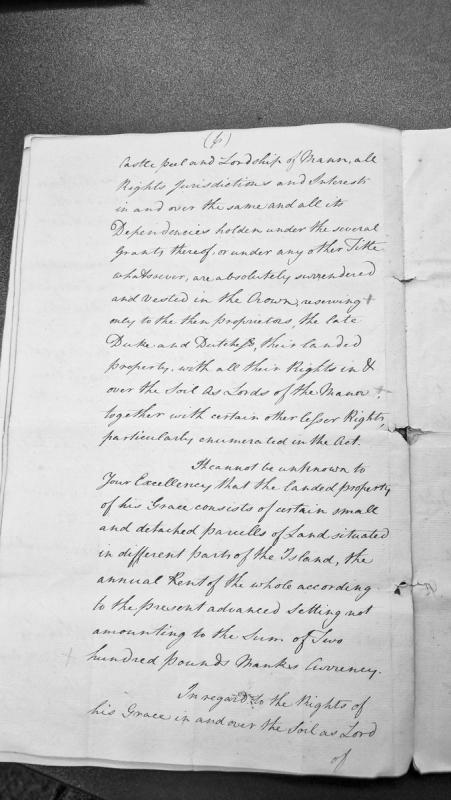
A legal document describing the surrender of Castle Peel and the Lordship of Mann to the Crown, with reserved rights for the then Proprietors (the late Duke and Duchess). It details the landed property holdings consisting of small detached parcels of land throughout the Island with an annual rent of approximately two hundred Pounds Manx Currency, and discusses the rights of his Grace as Lord of the Manor.
A formal deed of surrender by which Roger, Abbot of Furness Abbey in Lancashire, and the convent surrendered all monastery holdings to King Henry VIII, including lands, castles, manors, and rights specifically in the Isle of Man, Yorkshire, Lancashire, and Ireland. The document is bilingual (English and Latin) and demonstrates Crown sovereignty over the Isle of Man in the Tudor period, relevant as background to the constitutional position challenged in the 1765 Revestment.
A formal deed of surrender dated 11 April 1537 whereby the Abbot and Convent of Furness Abbey relinquished their monastery, lands, and possessions into the hands of King Henry VIII. The document explicitly mentions lands and properties in the Isle of Man among other English and Irish holdings. Relevant to understanding the pre-Revestment ecclesiastical and feudal claims over the Isle of Man, and the Crown's consolidation of territorial control during the Dissolution of the Monasteries.
A 1649 survey memorandum documenting rents and properties belonging to the Manor of Furness, including several holdings in the Isle of Man (rectories and lands). The document details scattered properties across Cumberland, Yorkshire, Ireland, and Man, with annual rent amounts. Relevant to understanding pre-Revestment Manx landholding structures and feudal obligations.
A 1649 survey of the Manor of Furness listing rents and properties held outside Lancashire, including several holdings in the Isle of Man (St. Michael and Mahold rectory, Rongstworth, Bubeck Magna, Swynden). The document shows the administrative and fiscal connections between English manorial estates and Manx lands, illustrating pre-Revestment property structures and revenue systems. Relevant to understanding the Duke of Atholl's holdings and the fiscal basis of lordship before 1765.
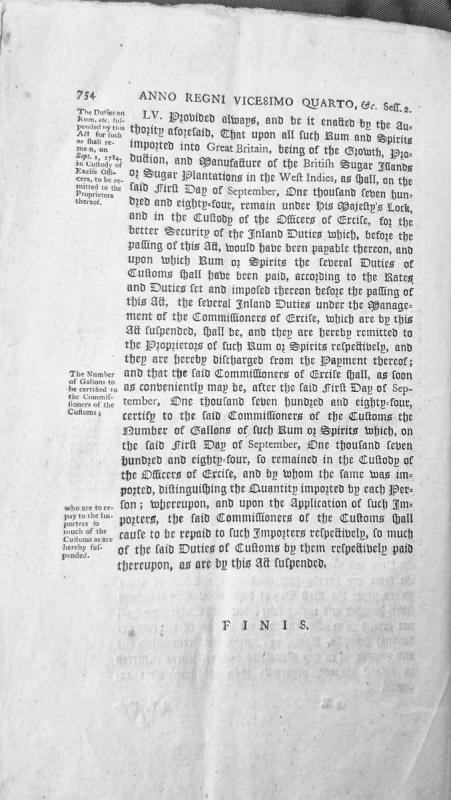
This is an excerpt from legislation (Anno Regni Vicesimo Quarto, Session 2, Section LV) concerning the suspension of inland excise duties and customs duties on rum and spirits imported from British sugar islands and plantations in the West Indies. The act provides for remittance of suspended duties to proprietors for goods in custody of Excise Officers on September 1, 1784, and establishes procedures for certification and repayment of duties by the Commissioners of Customs and Excise.
Peer-reviewed academic paper employing value-chain analysis to reassess the economic importance of the Swedish East India Company's trade between Canton and Europe. Argues that SEIC was a major transnational trader (15% of European Chinese tea imports) and that previous scholarship underestimated its impact on the Swedish economy by ignoring re-exports. Relevant to understanding East India Company operations, tea smuggling networks, and comparative chartered company strategies during the period of the 1765 Revestment.
This is the table of contents and preface from Sir Edward Coke's Fourth Part of the Institutes of the Laws of England, a foundational legal treatise describing the courts and jurisdictions of the English realm. Chapter 69 specifically covers the Isle of Man, its law and jurisdiction. The work is relevant to the Revestment project as it provides the constitutional and legal framework within which the 1765 purchase was effected.
This is the table of contents, prefatory material, and opening chapter from Sir Edward Coke's Fourth Part of the Institutes of the Lawes of England, a foundational legal treatise on the jurisdiction and composition of English courts. Chapter 69 specifically addresses the Isle of Man and its law and jurisdiction. Relevant to the Revestment project as a contemporary legal exposition of Manx constitutional standing before 1765.
A chronological reference table listing the regnal years of English sovereigns from William the Conqueror through Henry II, with explanatory notes on the differences between Historical, Civil, Ecclesiastical, and Legal year calculations. Originally published in Manx Society volumes IV, VII, and IX; republished as part of Monumenta de Insula Manniae. Relevant as contextual/reference material for dating documents in the broader medieval and early modern Manx historical record.
A chronological reference table listing the regnal years of English monarchs from William the Conqueror through Henry II, with detailed explanations of the distinction between Historical and Civil year dating conventions. This reference work provides essential chronological framework for dating documents and events from the medieval and early modern periods relevant to Isle of Man governance and sovereignty.
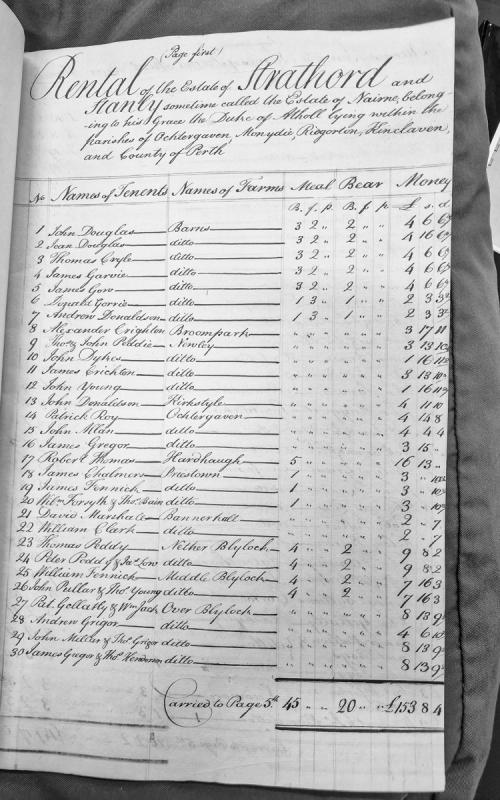
A financial ledger or revenue abstract listing 30 entries of individuals and partnerships with associated land parcels, monetary values in pounds/shillings/pence, and two columns of numerical measurements (possibly acreage or assessment values marked 'B. f. p.'). The document appears to be part of a larger tax or rent assessment roll, with a total carried forward to page 5.
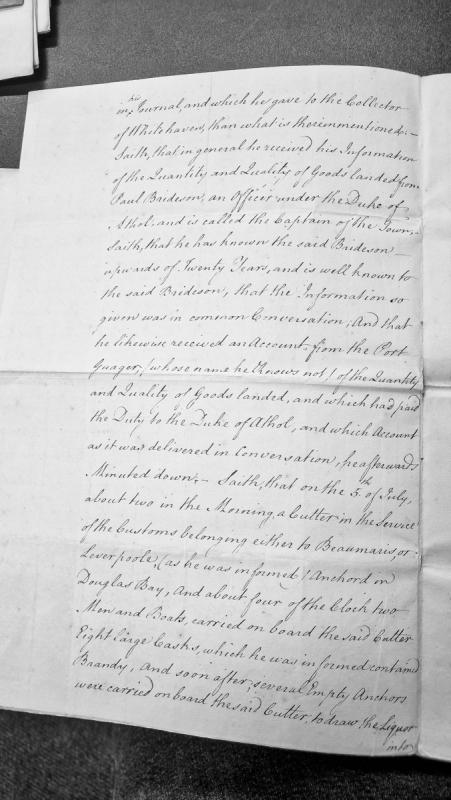
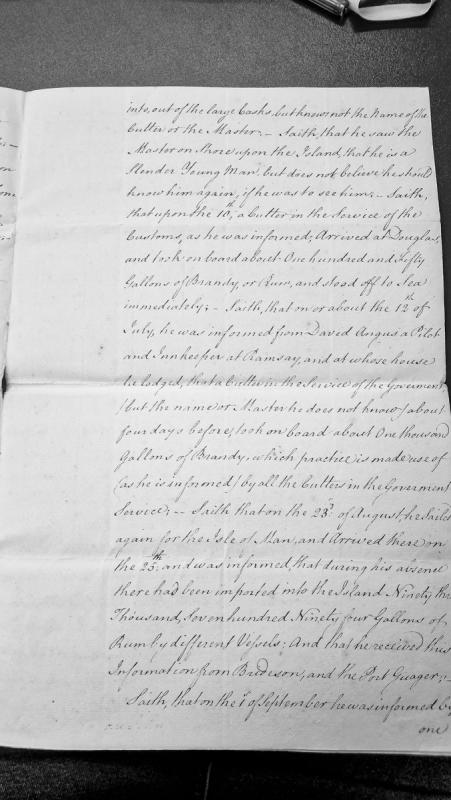
An excerpt from sworn testimony concerning the receipt of information about goods landed, their quantity and quality, and duties paid to the Duke of Athol. The witness describes conversations with Paul Brideson (Captain of the Town) and a Port Guager, and reports on customs cutter activity in Douglas Bay on 5th July involving the transfer of brandy casks.
A deposition or court testimony detailing observations of illegal spirits trading involving government customs cutters. The witness describes encounters with vessels carrying brandy and rum, conversations with pilots and innkeepers, and reports of large quantities of spirits imported to the Isle of Man during summer months.
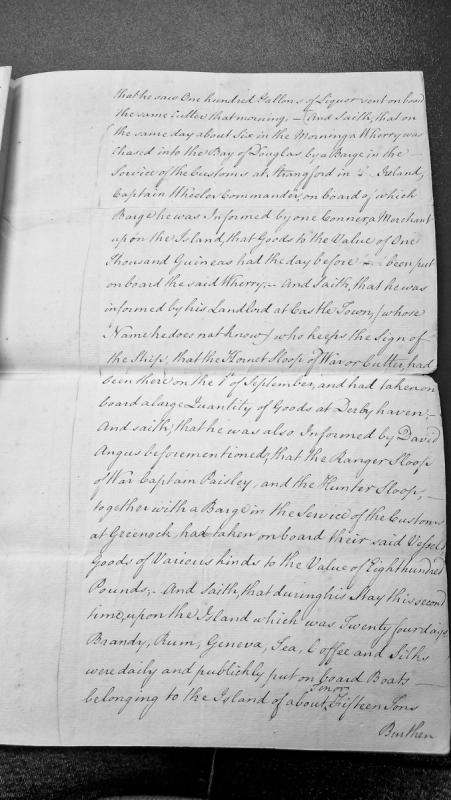
A deposition or court testimony describing observations of smuggling operations on the Isle of Man, including reports of liquor and goods being loaded onto vessels, and interactions with customs cutters and sloops of war from Ireland and Scotland. The witness provides detailed accounts of quantities and values of contraband goods.
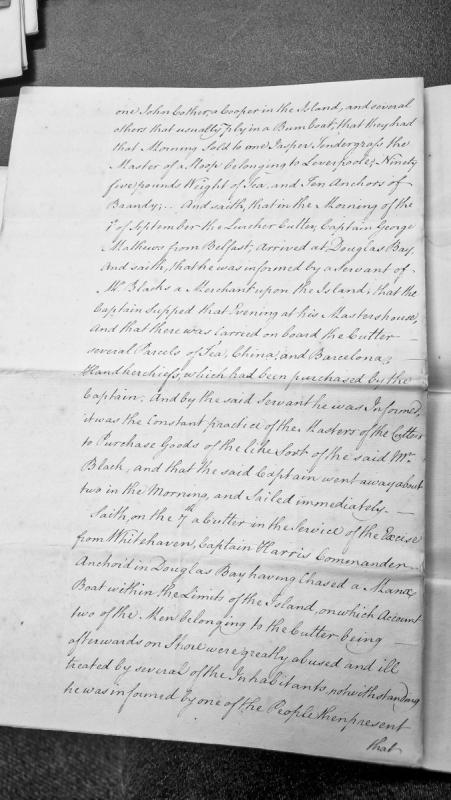
A deposition or court testimony documenting smuggling operations involving tea and brandy sales to ship captains at Douglas Bay. The account describes the arrival of the Lurcher Cutter from Belfast and an Excise cutter from Whitehaven, with details of illicit goods purchases and tensions between Excise officers and local inhabitants.
A comprehensive historical monograph examining the 1765 Act of Revestment through comparative economic analysis, focusing on the smuggling trade, Parliamentary protectionism, and the Island's unique constitutional position. Covers causes, smuggling operations, immediate aftermath, and draws parallels with the American Revolution and Edmund Burke's critique.
A comprehensive secondary source examining the 1765 Act of Revestment from economic, political, and social perspectives. Covers the commercial systems in England and Man, the growth of the smuggling trade, the constitutional position of the Isle of Man, and the consequences of revestment including trade restrictions, merchant hardship, and population decline. Includes extensive primary source quotations (Gentleman's Magazine 1751, parliamentary petitions, customs memorials) and comparative analysis with American colonial taxation.
The Prayer Book printed in Manx in 1765, the same year as the Revestment Act. Both a monument and a marker: it preserved the language in print and marked the moment after which no institution on the Island would fight for the language the way Wilson had fought for it. The coincidence of date makes it a symbol of everything the Revestment interrupted. The literary infrastructure that Wilson and Hildesley created before and during the Revestment would eventually provide the foundation for the language revival two centuries later.
In 1779, fourteen years after the Revestment, William Clucas, vicar of Malew, translated the Bishop of Sodor and Man's SPG appeal into Manx (Manx Museum MS 224a). The translation proves that Manx was still the operational language of religion and community in the parishes as late as 1779. It provides a data point between the 1765 Prayer Book and the 1874 census: the language that the administration was ceasing to support was still necessary for reaching the people in their parishes.
In 1798, when fears of French-supported Irish rebellion swept the Irish Sea, the island's volunteer companies turned out. The Keys — the same Keys who had petitioned London for decades about the impoverished state of the island — refused to criminalise their own people for sheltering Irish refugees who washed up on Manx shores. It was a moment of quiet defiance: the island would defend itself and serve the Crown, but it would not abandon its own traditions of sanctuary. Manx people had given shelter to strangers for as long as anyone could remember. The Crown's wars did not change that.
In 1827, three ships carried Manx emigrants to Ohio: the Chile, the Curler, and the Ocean. The Cleveland Herald of 3 August 1827 reported about 200 immigrants from the Isle of Man. The northern parishes of Ballaugh, Jurby, Kirk Michael, and Lezayre bled the most — parishes where the herring economy had mattered most, where the collapse of the harbours had been felt most acutely, and where the agricultural land was thinnest. Moore fixed 1824 as the date at which the Manx labourer reached his lowest depth of misery. The 1827 ships sailed three years later. The people who left were not adventurers. They were families — the Corletts and the Cannells and the Sayles and the Kellys — doing what the Keys' petition had described: removing themselves and their families to seek a livelihood, because the island that had sustained their ancestors could no longer sustain them.
Chapter 13 from a published history examining the transition of Isle of Man sovereignty from the Stanley family to the Duke of Athol in 1736. It traces the development of smuggling trade from the 16th century, analyzes the impact of customs tariffs, and details the constitutional reforms enacted by the first Duke of Athol, including trial by jury rights and parliamentary control of taxation.