Irish saint whose feast day, Laa'l Breeshey (1 February), is one of the quarter days in the Manx calendar. The crossing point between Celtic goddess and Christian saint — rushes gathered, the invitation spoken at the threshold. One of the deep-rooted Manx traditions connecting the Island to the wider Celtic world.
The old parish church at Onchan where William Bligh married Elizabeth Betham on 4 February 1781. Condemned as dangerous and replaced by St Peter's in 1833.
The village and ceremonial ground where Tynwald Hill stands. Site of the annual Tynwald Day ceremony on 5 July. The chapel of St John the Baptist adjoins the hill. The open-air parliament assembles here — the oldest continuous parliament in the world meeting at the same site.
Irish saint said to have arrived at the northeast coast of the Isle of Man in a coracle. Patron of Kirk Maughold parish. His story connects the Island to the Irish monastic tradition.
Traditionally associated with the arrival of Christianity on the Isle of Man. St Patrick's Isle at Peel bears his name, and the earliest Christian settlements on the Island are connected to his mission in the Irish Sea region.
Tidal island at Peel connected by a causeway. Site of the old cathedral ruins (St German's Cathedral) and Peel Castle. The earliest ecclesiastical centre on the Isle of Man, predating the Norse period. Bishop Wilson was installed here in 1698.
Roofless church in the central valley of the Isle of Man, associated with the buggane legend. The story says the buggane tore the roof off every time it was rebuilt. The church remains roofless to this day.
Passed in the same parliamentary session as the Isle of Man Purchase Act 1765. Both were Grenville measures. The Stamp Act provoked revolution in America; the Purchase Act destroyed Manx sovereignty. Twin instruments of the same imperial fiscal policy.
Henry IV granted the lordship of Mann to Sir John Stanley in 1405 (lifetime grant), re-granted as inheritable on 6 April 1406. The Stanley dynasty would hold the Island for over two and a half centuries. The grant came after Percy's rebellion — the Island as political reward. The family that bet on Henry at Bosworth would later collect the earldom of Derby.
Treasury document reporting on Crown lands in the Isle of Man derived from the former Bangor and Sabal Abbey (Ireland), including messuages and a water mill at Dalby. Also documents the 1666 grant of all Mines Royal (gold and silver) to the Earl of Derby and its expiration in 1735. Includes historical leasing records from 1666 onwards and notes arrears and abandonment of the property.
Treasury document surveying Crown lands in the Isle of Man formerly belonging to Bangor and Sabal Abbey, with lease history from 1666–1770, and status of Royal Mines grant to the Earl of Derby (1666–1735). Demonstrates Crown revenue administration and property management in the post-Revestment period, relevant to understanding the financial structure and assets acquired in 1765.
Report from Lieutenant Governor Cornelius Smelt to the Home Office describing the inadequate state of the sole prison on the Isle of Man (Castle Rushen), with a supporting Memorial from the House of Keys requesting funds for prison infrastructure. Documents overcrowding, lack of segregation by sex or offence, and poor conditions. Reflects post-Revestment (1765) administrative issues and governance challenges.
Official correspondence from Lieutenant Governor Cornelius Smelt to the Home Office (referenced as Ryder) enclosing a Memorial from the House of Keys regarding conditions at Castle Rushen Prison. Documents overcrowding, lack of separation facilities, and the need for gaol facilities at Douglas, Peel, and Ramsey. Reflects post-Revestment governance challenges and the transition of state responsibilities to British authority following the 1765 purchase of sovereignty.
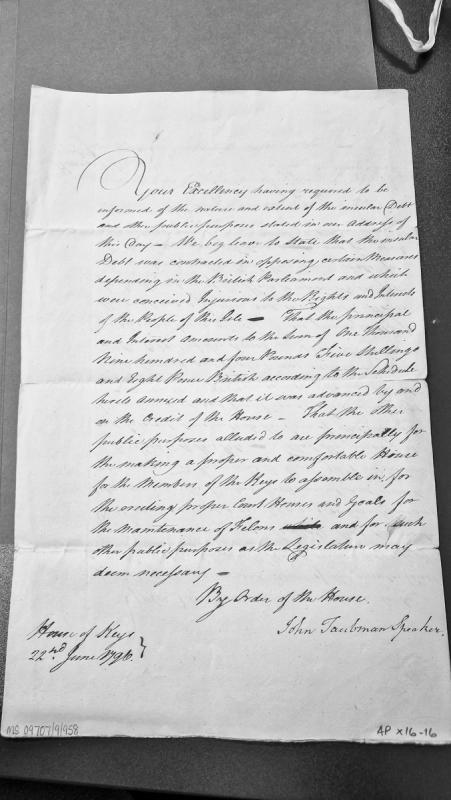
An official statement from the House of Keys to His Excellency detailing the nature and extent of the insular debt, which amounted to £1,904 5s 8d and was contracted in opposing certain measures in Parliament. The document also outlines other public purposes for which funds are needed, including a meeting house for the Keys, court houses, goals, and maintenance of felons.
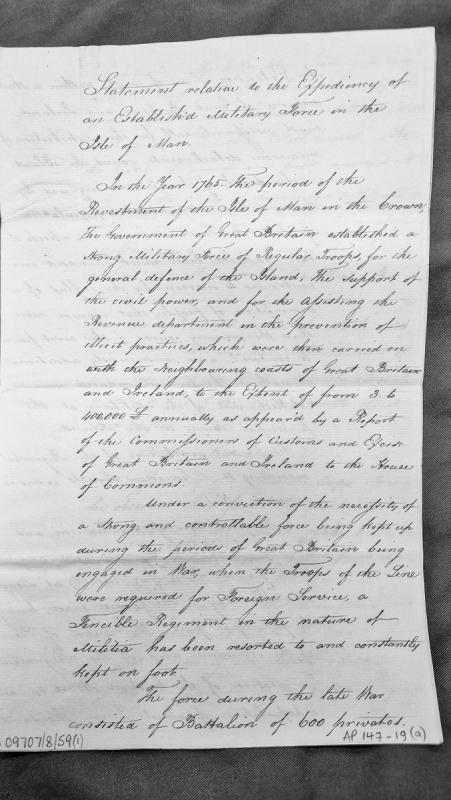
A statement justifying the establishment of a military force in the Isle of Man following the revestment of the island to the Crown in 1765. The document explains the necessity of maintaining troops for island defence, supporting civil authority, and preventing illicit trade, citing customs revenue losses of £300,000-400,000 annually.
Parliamentary statute enacted under Henry VIII annexing the Bishopric and Diocese of Man to the ecclesiastical jurisdiction of York. This is a foundational constitutional document establishing Man's religious governance within the English church hierarchy, relevant to understanding pre-Revestment institutional structures and English Crown authority over the island.
An excerpt from the Statutes of the Realm (5 Elizabeth I, 1562) permitting foreign-born merchants to import French wines into Manx ports via foreign-owned vessels, limited to 100 tonnes annually. This primary legal source demonstrates early statutory provision for trade privileges in the Isle of Man and the regulatory framework governing wine importation.
Parliamentary statute from 1542 enacting the annexation of the Bishopric and Diocese of Man to the ecclesiastical jurisdiction of York. This foundational constitutional document establishes the religious governance structure of the Isle of Man under English law and is essential context for understanding Manx institutional development prior to the 1765 Revestment.
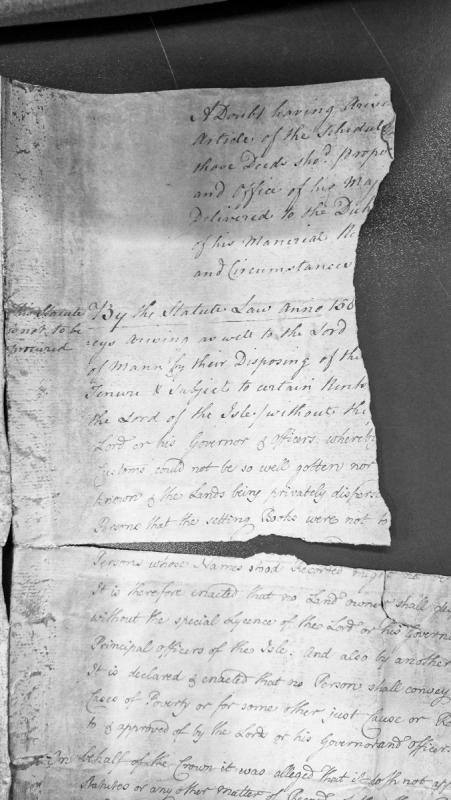
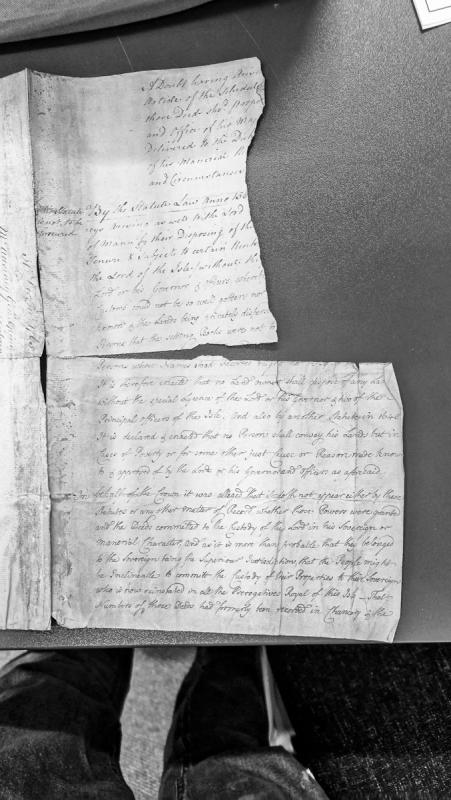
A legal document discussing Manx statutes relating to land ownership and tenure, specifically addressing the disposal of lands and the authority of the Lord of Mann and his officers. The document references statutes from anno 1580 and discusses restrictions on land conveyance without proper license from the Lord or Governor.
A legal document discussing statutes regulating land ownership and conveyance on the Isle of Man, with provisions requiring license from the Lord or Governor and principal officers. The fragment includes an argument on behalf of the Crown regarding custody of property deeds and sovereign prerogatives.
Steve Babb is a writer, teacher, and professional photographer based on the Isle of Man, where his family has lived for generations. He holds BA degrees in Business and Marketing, and is a former member of the Chartered Institute of Marketing, Chartered Management Institute, and Association of Project Managers. He served for a number of years as official documentarian for Tynwald, the world's oldest continuously sitting parliament, giving him first-hand familiarity with the constitutional system this book describes - not as historical text, but as a working institution. Prior to working in media and education Steve's professional career spanned twenty years in business consultancy across government, utilities and financial services. For the past ten years, working in education, he has designed and delivered bespoke educational resources in partnership with schools, colleges and UK universities, and has taught and lectured from key stage 2 to degree level. A comprehensive companion digital archive, built on the Omeka S scholarly platform, is in development at revestment1765.com, and will host primary sources, endnotes, media and teaching resources. Steve runs his own media company and has worked for several years as a photojournalist with close ties to local newspapers, radio stations, BBC and ITV. He is a former deputy chair of the Isle of Man branch of the Royal Television Society, a former local politician, and served as transition manager of Kensington Arts for the IoM Arts Council. He produces, directs, and edits audio and video resources. He is regularly invited to judge photography and media contests by various Manx and UK societies. He maintains close ties with Manx LitFest, Manx National Heritage, Culture Vannin, and the Office of Tynwald. Steve is also currently pursuing a PhD in History with specific regard to British Constitutional history in the long eighteenth century.
A series of linked planning documents and analytical notes for Part III of a monograph on the 1765 Isle of Man Revestment. The text outlines a forensic framework connecting the Revestment to the American Revolution by arguing that the Tea Act of 1773 and Coercive Acts of 1774 applied the same 'landing = sovereignty' doctrine and 'Company-State' extraction logic first tested on the Isle of Man. Includes proposed chapter structures (16–20), thematic pillars, research priorities, and analysis of how Benjamin Franklin and other colonial leaders recognized the Manx precedent as a warning.
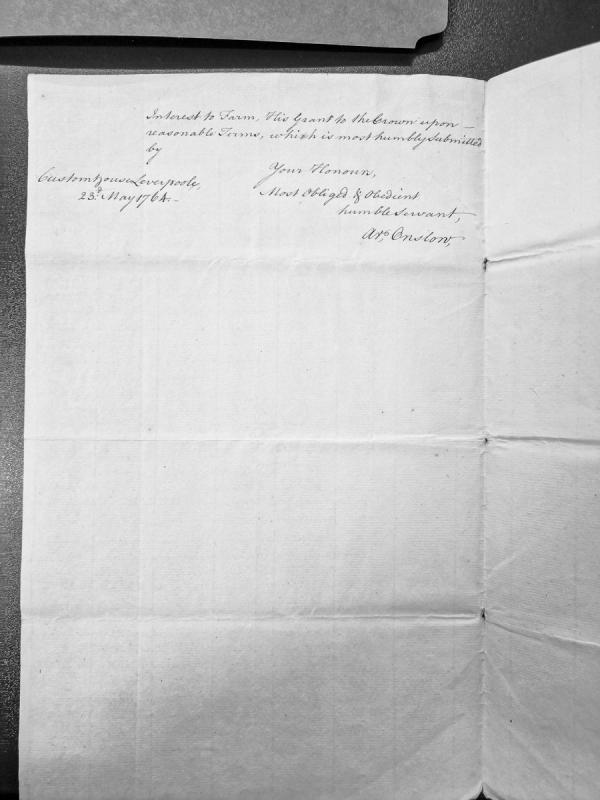
A formal submission letter from the Custom House in Liverpool dated May 23rd, 1764, regarding interest in a farm and a proposed grant to the Crown on reasonable terms. The document appears to be official correspondence relating to colonial or trade administration.
An account of subsistence payments made to customs officers and boatmen sent from Carlisle and Whitehaven to the Isle of Man by Charles Lutwidge following the 1765 Parliamentary Act to suppress illicit trade. The document details individual officer wages, daily rates (2s 6d), and ancillary costs including victualling and expresses, totalling £907 4s 3½d. It directly evidences the Treasury's operational expenditure on customs enforcement immediately after the Revestment Act.
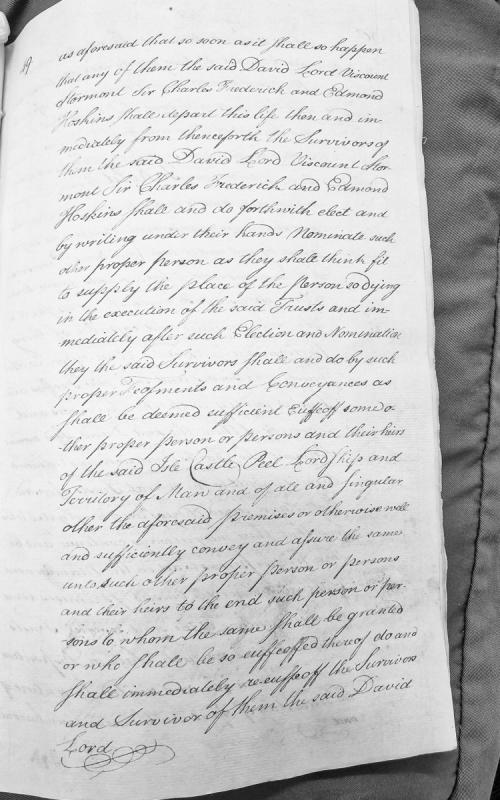
A legal document detailing the succession procedure for trustees (David Lord Viscount Stormont, Sir Charles Frederick, and Edmond Hoskins) responsible for the Isle of Man, Peel Castle, and associated territories. Upon the death of any trustee, the survivors are to elect and nominate a replacement, with property to be conveyed through proper legal instruments to maintain the trust.