A valuation document by John (3rd) Duke of Atholl, circa 1764, estimating the financial worth of the Isle of Man's sovereignty. It itemizes annual revenues (1754–1762), ecclesiastical patronage, regal powers, and comparable valuations, totalling approximately £299,773. This is an early draft preceding fuller versions, produced during the period leading up to the 1765 Revestment negotiations.
Hill near Ramsey in the north of the Isle of Man where Godred Crovan hid three hundred men before his decisive third attack on the Manx forces. His victory established the Crovan dynasty that would rule Mann for nearly two centuries.
Further legislation tightening enforcement against the trade between the Isle of Man and Britain. The legislative package of 1765 — the Purchase Act, the Mischief Act, the Smuggling Act — together dismantled the Island's commercial system.
A detailed historical chapter from a 1900 comprehensive history of the Isle of Man, covering the rise and evolution of smuggling from its beginnings in the late 17th century through 1765. It traces the legislative and administrative responses by Manx Lords and the English government, the role of major smuggling merchants like Maguire and Poole, key commodities (tobacco, tea, spirits, East India goods), and the growing conflict between revenue protection and the island's economy. Directly relevant to understanding the economic and political circumstances leading to the 1765 Revestment.
An extensive contemporary analysis of smuggling operations from the Isle of Man, extracted from Malachy Postlethwayt's Dictionary of Trade and Commerce. It details the scale of illicit trade (estimated at £700,000 annual loss), the routes, cargoes, vessels, and operational methods, while arguing for either purchasing the island from the Duke of Atholl or implementing effective enforcement measures. Includes a merchant petition from Whitehaven.
Extract from Malachy Postlethwayt's Dictionary of Trade and Commerce (1755) detailing the scale and mechanisms of smuggling operations from the Isle of Man, including routes, goods, vessels, revenue loss estimates, and proposed remedies. Includes a memorial from Whitehaven merchants. Highly relevant to understanding pre-Revestment smuggling economy and contemporary calls for Crown acquisition.
Chapter 2, Section 3 from a 1900 History of the Isle of Man covering the social and economic history of smuggling post-Revestment (1765–1866). Details the immediate chaos following the Mischief Act of 1765, the resumption of smuggling, the 1767 Act, and the eventual suppression of illicit trade through enforcement measures and the Act of 1798. Includes eyewitness accounts and Commissioners' recommendations.
A scholarly chapter examining the illicit smuggling trade in Ireland and the Irish Sea during the eighteenth century, with particular focus on the Isle of Man's role as a smuggling entrepôt until 1765. The text covers smuggling commodities (spirits, tobacco, tea), enforcement difficulties, the closure of the Isle of Man loophole, subsequent shifts to Guernsey and Continental sources, quarantine-breaking, and marine crimes including wrecking. Directly relevant to understanding the economic context and consequences of the 1765 Revestment.
A scholarly essay examining smuggling networks, quarantine violations, and maritime crime in 18th-century Ireland, with particular emphasis on the Isle of Man's role as a smuggling entrepôt before its acquisition by the British government in 1765. The text traces specific smuggling operations, merchant networks (including the Black family based in Bordeaux), and coastal lawlessness, providing detailed case studies relevant to understanding the commercial and strategic context of the Revestment.
The Island's only true mountain, clearing the qualifying 2,000 feet by a mere 36 feet. The Norse called it snjó-fall, snow mountain. From the summit, on a clear day, you can see England, Scotland, Ireland, and Wales simultaneously. The old saying adds three more kingdoms: Mann itself, Heaven, and the Kingdom of Manannán.
The only true mountain on the Island, clearing the minimum qualifying height of 2,000 feet by a mere 36 feet. The Norse called it snow mountain. From the summit, on a clear day, you can see England, Scotland, Ireland, and Wales simultaneously. The old saying goes that you can see seven kingdoms from Snaefell: Mann itself, the four surrounding countries, Heaven, and the Kingdom of Manannan. Snaefell receives seventy-five inches of rain in an average year, nearly twice what falls on most of lowland England.
Collection of four historical appendices covering 17th-century Manx customs (stranger reception protocols), a 1682 benevolence collection order, 1600 security incidents, and debt imprisonment law. These provide contemporary documentation of Manx governance structures, feudal obligations, and legal procedures predating the 1765 Revestment.
Chapter from a 1900 History of the Isle of Man covering the rise and evolution of the smuggling trade from the late 17th century through 1765. Traces the involvement of merchants like Richard Maguire and Josiah Poole, parliamentary interventions (1711 Act, 1726 Act), and the impact of duties on contraband goods including tobacco, tea, spirits, wine, and East India commodities. Essential overview of the smuggling context preceding the Revestment.
A scholarly historical chapter examining smuggling on the Isle of Man following the 1765 Mischief Act and the 1767 Act, analysing the immediate panic, subsequent resumption of smuggling, and eventual suppression through 1798 reforms. Draws on eyewitness accounts, Parliamentary speeches, and the 1791 Commissioners' Report to trace patterns of illicit trade in spirits, tea, tobacco, salt, and grain through 1853.
Chapter II, Section 3 of a 1900 history of the Isle of Man covering the smuggling trade and revenue enforcement after the 1765 Revestment. Details the impact of the Mischief Act (1765), the Act of 1767, and subsequent anti-smuggling measures, including eyewitness accounts of conditions post-1765, the 1791 Commissioners' Report recommendations, and the 1798 Act reforms. Extensively documents smuggling patterns, commodities, and the eventual decline of illicit trade.
A scholarly chapter on smuggling in the Isle of Man following the 1765 Mischief Act and subsequent revenue legislation. Covers the panic caused by enforcement, recommencement of smuggling, the 1767 Act, 1791 Commissioners' recommendations, and post-1798 decline of smuggling with residual illicit trade in spirits, tea, tobacco, salt, and grain flour until c. 1853.
A detailed academic chapter on Manx trade and industry following the 1765 Revestment, covering commercial restrictions, the licence system, manufacturing (linen, cotton, flax, woollen goods), shipbuilding, and the gradual liberalisation of trade. Examines how the connexion with Great Britain both restricted and occasionally benefited Manx commerce, and documents the rise of industries including printing newspapers and the impact of steam communication.
A comprehensive historical chapter on Manx trade and industry following the 1765 Revestment, covering commercial restrictions imposed by Westminster, the oppressive licence system, revival of trade through steam communication, shipbuilding, linen manufacture, and the gradual liberalisation of trade policy. Directly addresses the economic consequences of the crown's acquisition of sovereignty and the island's integration into British commercial frameworks.
Jewish trader in Douglas whose goods were seized in the ordinary course of the Duke's customs enforcement. One of the foreign merchants drawn to the Island because the commercial opportunity was real enough to be worth the risk.
Hill in the south of the Island where folk climbed at midsummer carrying bundles of green rushes to pay rent to Manannán — the old god of the sea who protected the Island before the saints came. Site of an Iron Age hillfort.
Iron Age hill fort on the summit of South Barrule, Manannan's seat. The place where rushes were carried at midsummer to pay rent to the old god. The archaeological remains of the fort are overlaid with centuries of ritual significance. The hill connects the pre-Christian, the Norse, and the constitutional traditions of the Island in a single landscape feature.
Manx Gaelic is closer to Irish than to any form of English. It was the everyday language of the island until the nineteenth century. The last native speaker, Ned Maddrell, died in 1974 — but the language didn’t die with him. It’s being taught again, spoken again, lived in again.
Learn ten Manx words and phrases:
Cronk-y-Keeillown — the old name for Tynwald Hill. Raad Mooar Ree Gorree — the Milky Way, named after King Orry. Bollan bane — the mugwort gathered at midsummer. Mooinjer veggey — the little people. Hop-tu-Naa — the old New Year’s Eve. Laa Mie — Good day. Ny tree cassyn — the Three Legs. Mannin — the Isle of Man. Ellan Vannin — Island of Mann. Traa dy liooar — Time enough.
Say them out loud. Teach them to someone else. A language lives when people speak it.
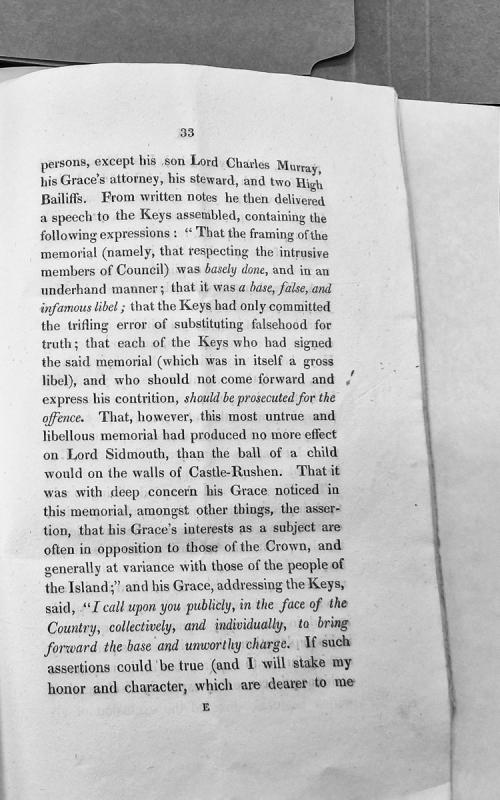
A recorded speech delivered to the House of Keys assembly, likely by the Governor or a senior official (possibly Lord Sidmouth or related figure), responding to a memorial submitted by Keys members regarding intrusive Council appointments. The speaker denounces the memorial as false and libelous, threatening prosecution of signatories who do not recant, and challenges accusations that his interests conflict with those of the Crown and people.
Historian and later Lieutenant Governor of the Isle of Man (1888–1893). His history of the Island drew on the parliamentary papers and provided the most detailed English-language account of the Mischief Act and its consequences. He recorded the bonfires after the transfer ceremony and added the detail about the Governor's claret. His verdict on the legislation was measured but unambiguous: the Acts 'not only inflicted an apparently irremediable wound on the prosperity of the Manx people; they concurrently aimed a fatal blow at their independence.'