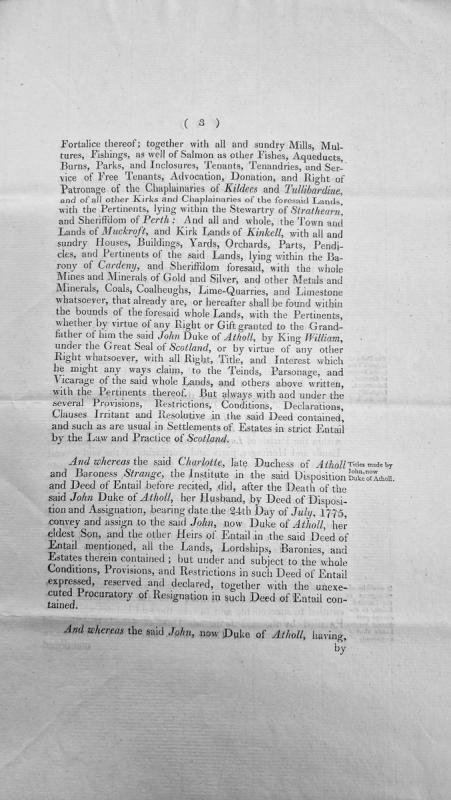
A Scottish legal document detailing the disposition and entailment of extensive lands, lordships, baronies and estates belonging to the Duke of Atholl. The document describes properties within Perthshire including Strathearn, Cardeny, and various other locations, along with rights to mills, fishings, mines, and ecclesiastical patronage. It references previous deeds of disposition from 1775 involving Charlotte, late Duchess of Atholl.
A report from George Nicolson in Edinburgh to the Scottish Privy Council regarding Spanish invasion threats to England and Scotland, with specific mention of the Isle of Man as a target for Spanish landing. The document discusses treasonous activity, fortification preparations, and security measures including imprisonment of Catholic suspects. While predating the Revestment by 174 years, it provides historical context on strategic importance of the Isle of Man and its vulnerability to foreign invasion.
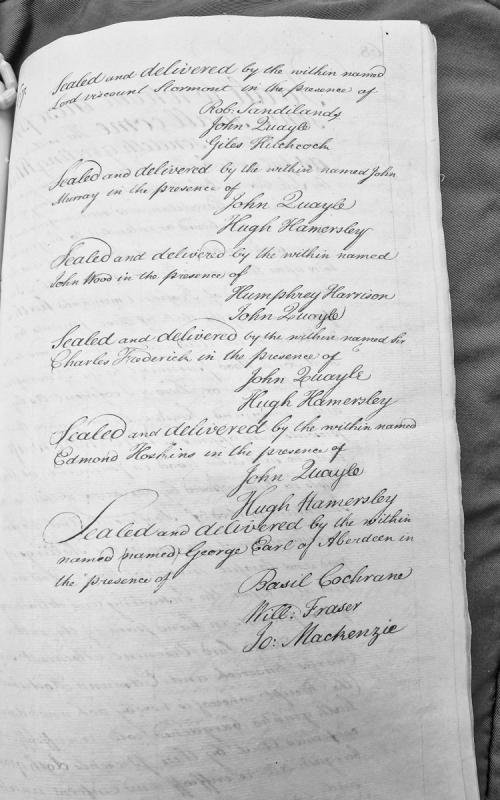
A formal document recording the sealing and delivery of an instrument by six named parties (Lord Viscount Stormont, John Murray, John Wood, Sir Charles Frederick, Edmond Hoskins, and George Earl of Aberdeen) in the presence of specified witnesses. The document appears to be a multi-party bond or recognisance with attestation clauses.
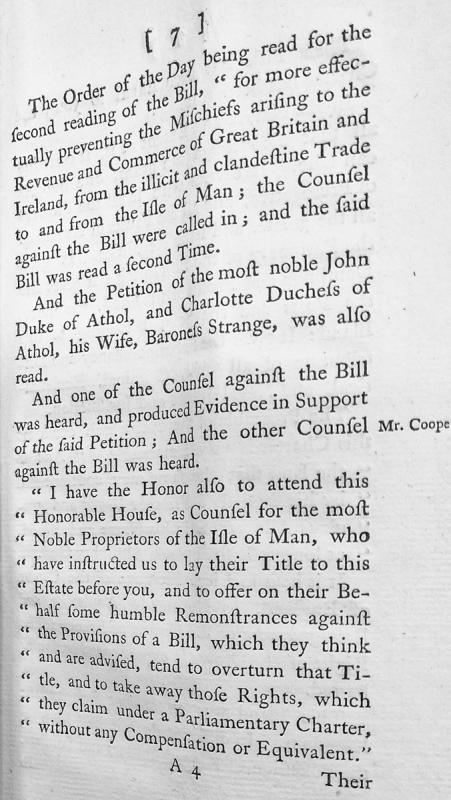
Parliamentary record of the second reading of a Bill concerning illicit trade affecting the Revenue and Commerce of Great Britain and Ireland in relation to the Isle of Man. A petition from John Duke of Athol and Charlotte Duchess of Athol is read, with counsel presenting arguments and evidence regarding the proprietors' title and rights under a Parliamentary Charter.
Extract from Rotuli Parliamentorum recording the conditional pardon and banishment of the Earl of Warwick to the Isle of Man for life by King Richard II in 1398. The document details the terms of imprisonment, guardianship arrangements with Sir William le Scrop and his brother, and conditions for revocation of the pardon. Provided in both English and Anglo-Norman French.
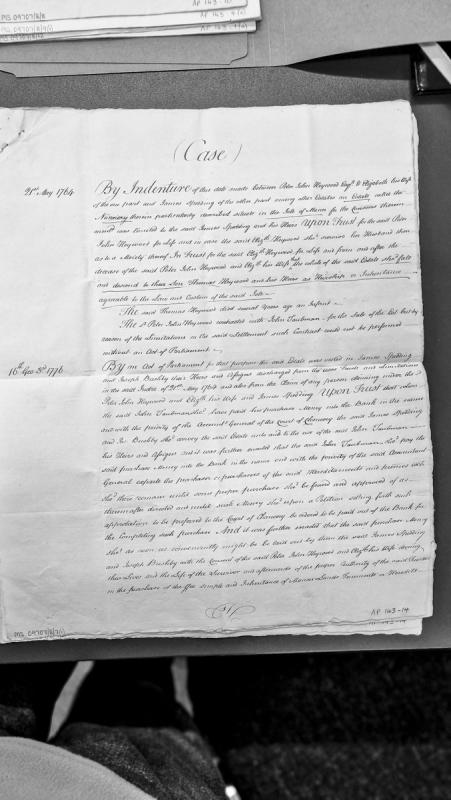
This document describes a complex property settlement involving the Nunnery estate in the Isle of Man. It outlines an original indenture of 1764 between Peter John Heywood and James Spedding, followed by Parliamentary legislation in 1776 (16 Geo 3) that vested the estate in trustees to facilitate its sale to John Taubman, with provisions for reinvestment of the purchase money in other properties.
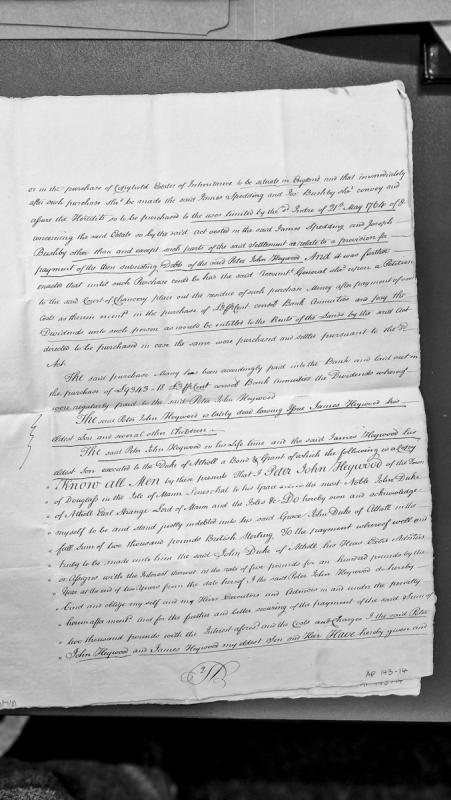
A legal document concerning the settlement of Peter John Heywood's estate, referencing an Indenture of 21 May 1764 and describing the purchase of £9343.18 in consolidated Bank Annuities. The document includes a copy of a bond executed by Peter John Heywood and his eldest son James Heywood to the Duke of Atholl for £2000 with 5% annual interest.
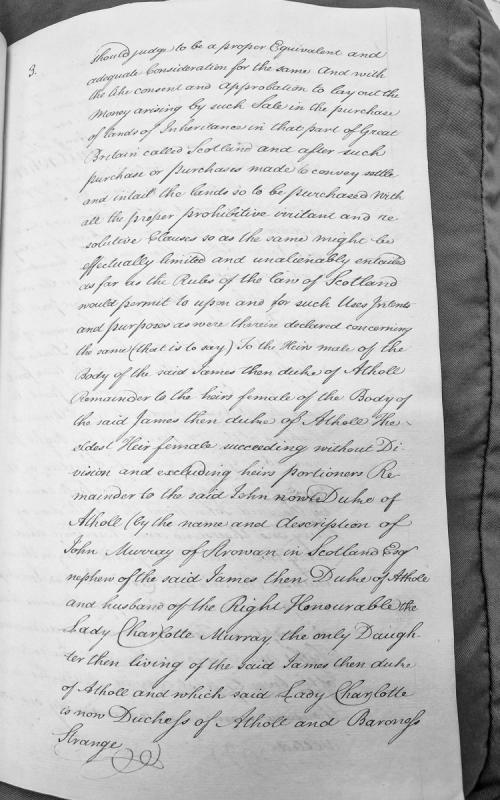
A legal document concerning the settlement and entailment of lands in Scotland purchased from the sale of other property. The document outlines the terms of entailment to the heirs male and female of James, Duke of Atholl, with remainder to John Murray of Strowan (later Duke of Atholl) and his wife Lady Charlotte Murray (now Duchess of Atholl).
Letter from Alexander Shaw, Lieutenant Governor of the Isle of Man, to Evan Nepean (Under Secretary of State) requesting copies of gubernatorial instructions and correspondence records. Shaw reports that previous Governor Smith's letter book, Royal Instructions accompanying the governorship, and instructions given to Governor Wood in 1765 (upon vesting the Isle in the Crown) cannot be located. He also notes that his predecessor Lieut Governor Dawson left only statute books and largely worthless papers. This letter is crucial for understanding post-Revestment administrative continuity and the state of governance records in the 1790s.
Letter from Peter Sidebotham, a Customs officer stationed on the Isle of Man, to the Treasury (dated 9 November 1747) detailing systematic evasion of customs regulations by the Duke of Atholl's officers, including: deliberate obstruction of informers, clandestine tobacco imports (particularly 'debenture tobacco'), night-time landings to avoid detection, and violation of salt export limits. The letter references a 1736 proposal by the Keys to prevent tobacco export and Governor James Murray's political reluctance to enforce it. This document is crucial evidence of the conflict between crown revenue interests and ducal sovereignty that precipitated the 1765 Revestment.
Extract from a letter by Peter Sidebotham, a customs officer on the Isle of Man, to the Treasury (9 November 1747) detailing endemic smuggling of debenture tobacco, the Duke of Atholl's officers' obstruction of customs enforcement, and the suppression of a proposal by the 24 Keys to control tobacco exports. Reveals the conflict between royal customs authority and ducal sovereignty.
A royal significavit (writ) from Queen Elizabeth I dated 29 September 1570, confirming the nomination of John Salesbury as Bishop of Sodor (Isle of Man). The document confirms the patronage rights of Edward, Earl of Derby, and instructs the Archbishop of York to formally confirm Salesbury's appointment. Provides insight into ecclesiastical governance structures and the feudal relationship between the crown, the Derby earls, and the Isle of Man bishopric.
A royal writ from King Henry VIII to the Bishops of London, Chichester, and Bristol, commanding them to consecrate Henry Man as Bishop of the Isle of Man. This document establishes ecclesiastical governance of the island and demonstrates royal patronage and authority over the bishopric. It is relevant to understanding the structure of Manx ecclesiastical authority preceding the Revestment period.
A royal warrant (significavit) from Henry VIII dated 22 January 1546, appointing Henry Man, professor of Sacred Theology, as Bishop of the Isle of Man, and commanding the Bishops of London, Chichester, and Bristol to consecrate him. The document is presented in both English and Latin versions and demonstrates the Crown's ecclesiastical patronage over the Manx bishopric and its temporal and spiritual properties.
Surveyor General of the Ordnance. Involved in the financial architecture of the Revestment — appears in bond and conveyance documents relating to the Atholl transaction.
Attorney General who drafted the Revestment Act without, by his own admission, knowing anything about the Isle of Man. His approach was revealing: 'the surest way for Government to have their object, by insisting on the whole being given up, and then give back such parts as your family insisted upon.' Take everything first, return what you must later. An explanatory bill was promised for the following session, 'to correct or remedy any inconveniences which might arise from an act, necessarily, hastily drawn up.' It was never introduced. The Act that Norton admitted was hastily drawn up remained on the statute books exactly as written.
Attorney General of the Isle of Man. Writing in 1882, he drew the constitutional parallel explicitly: 'In the previous year, the Parliament had asserted their right to tax the American colonists against their consent... no greater, and probably a lesser, right existed in the Parliament to tax the people of the Isle of Man.' In 1901, writing from Castletown, he argued that the proper title should still be 'King of Man' or 'Queen of Man' — the Stanleys had surrendered a Kingdom, 'the Kingly title of which having been by the voluntary act of a Predecessor changed for the lesser title — but a title merely — the substance surrendered was a Kingdom.'
Speaker of the House of Commons, who was 'warmest in his sympathy' toward the Manx deputation. He displayed great kindness and consideration, advised on the form and matter of the Memorial, and later received the thanks of the Keys. One man. Not the government. Not the Treasury. Not Parliament. One individual, in a personal capacity, showing kindness to a delegation from a small island. The institutional indifference was total. The personal warmth of a single sympathetic Speaker made it worse, not better.
First Stanley Lord of Mann, granted the lordship by Henry IV in 1405 — a lifetime grant made inheritable the following year. He never visited the Island. He governed through deputies, as most of his successors would. The grant was made 'to Sir John Stanley and his heirs for ever' — language of perpetuity that Parliament would extinguish in 1765.
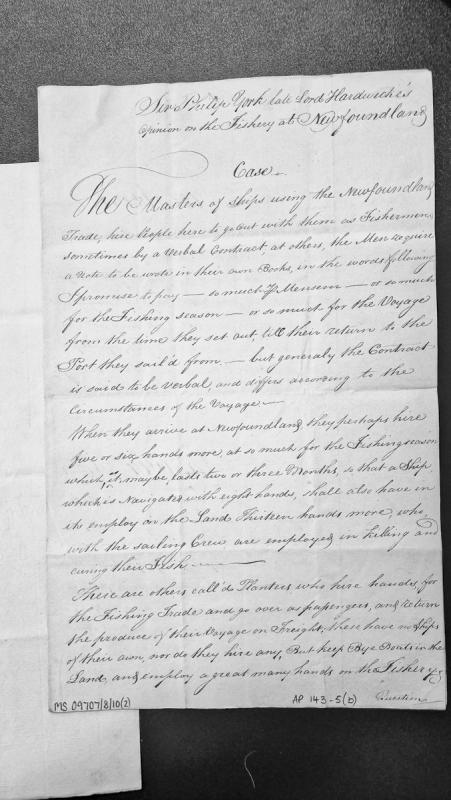
A legal opinion by Sir Philip York (late Lord Hardwicke) examining the nature of employment contracts between ship masters and fishermen engaged in the Newfoundland trade. The opinion describes various contractual arrangements, payment methods, and the distinction between crew and hired hands, as well as the role of independent planters in the fishery.
Brother of William le Scrope. Proclaimed heir-apparent at the 1393 Tynwald in the tanist tradition — the Manx succession custom — rather than by English primogeniture.
Purchased the lordship of Mann from the Montacute family in 1392. The deed included 'the title of King, and the right of being crowned with a golden crown.' Le Scrope was inaugurated at Tynwald in the old form, and his brother Stephen was proclaimed heir-apparent in the tanist tradition. He was the last lord of Mann to be crowned with gold. Le Scrope backed the wrong side when Henry IV seized the throne and lost his head for it, whereupon the lordship was granted to Sir John Stanley.
Thomas Stanley's brother. At Bosworth, he intervened with three thousand men and killed Richard III's charge, deciding the battle. His action secured the Tudor dynasty — and preserved the Stanley lordship of Mann.
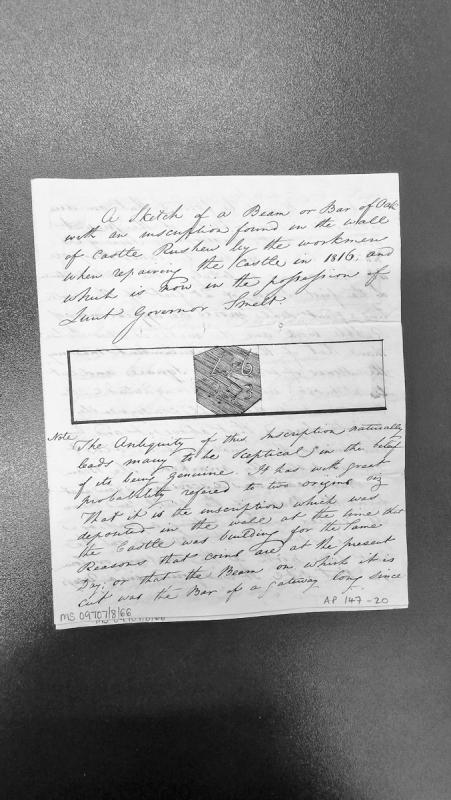
A document describing a beam or bar of oak with an inscription discovered in the walls of Castle Rushen during repair work in 1816. The item is illustrated with a sketch showing the carved end of the beam with letters and numbers. An accompanying note discusses the antiquity and potential origins of the inscription, suggesting it may have been deposited during the castle's original construction or came from a medieval gateway.
A draft valuation document, likely prepared by John (3) Duke of Atholl circa 1764, estimating the commercial and sovereign value of the Isle of Man. It calculates annual revenues (1754–1762), ecclesiastical patronage value, regal powers, and arrives at a total valuation of approximately £299,773. Directly relevant to understanding the Duke's asking price in the 1765 Revestment negotiations.