Cistercian abbey at Ballasalla, founded in 1134 when King Olaf invited Savignac monks to cross from Furness Abbey in Lancashire. The most powerful religious institution on the Isle of Man for four centuries. The Chronica Regum Manniae et Insularum was composed here c.1261. Dissolved by Henry VIII in 1540.
Cistercian abbey founded in 1134, the only abbey on the Island. The monks of Rushen compiled the Chronicon Manniae et Insularum, the chronicle that preserved the Island's history from the Norse period onward. A Manx document, produced on Manx soil, preserving a Manx understanding of the past. The manuscript now sits in the British Library in London. There have been campaigns to bring it home. It has not come home yet. Henry VIII dissolved Rushen Abbey in 1540, its assets stripped and sold off in three months.
A detailed revenue account (compotus) of the demesne lands and income of Rushen Abbey on the Isle of Man, recorded during the reign of Henry VIII. The document lists farm rents, land parcels with acreage, mill rents, and rectory farms across multiple Manx parishes. It provides valuable evidence of monastic landholding and economic organisation before the Reformation, relevant to understanding pre-Revestment Manx economic structures and property rights.
A detailed accounting (compotus) of the demesne lands and revenue of Rushen Abbey on the Isle of Man, dated 1539 during the reign of Henry VIII. The document lists individual closes (fields) with acreages and rental values in pounds, shillings, and pence, followed by a summary account of revenues from mills, rents, rectories, and tenancies across multiple parishes. Presented in parallel English and Latin versions. Relevant to understanding pre-Revestment Manx landholding, ecclesiastical property, and revenue structures.
A detailed historical account of Rushen Abbey on the Isle of Man, covering its foundation by Olave I (traditionally 1134, actually 1238), monastic organization, religious practices, temporal authority, dissolution in 1553, and associated religious houses. Includes inventory of religious plate and financial stipends granted at dissolution. Drawn from the Manx Society's Monumenta de Insula Manniae.
A scholarly historical essay on Rushen Abbey, covering its foundation by Olave I in 1134, early institutional struggles, Cistercian governance, baronial courts, liturgical practices, and dissolution in 1553. Includes detailed inventory of ecclesiastical plate and connected religious houses. Relevant for understanding pre-Revestment Manx religious and feudal institutions.
A royal safe conduct (letters patent) issued by Henry III permitting King Olave of Mann and the Islands to enter England with his retinue to negotiate peace with his brother Reginald. The document is dated 12 April 1228 and valid for fifteen days from Michaelmas. Presented in both English translation and original Latin (Rotuli Litterarum Patentium).
A royal safe conduct issued by King Henry III of England to Reginald, King of Man, permitting his safe passage and that of his men to return to the Isle of Man. The document is preserved in the Manx Society's published collection 'Monumenta de Insula Manniae' and provides evidence of the medieval relationship between English sovereignty and Manx kingship. The text is presented bilingually in English and Latin.
A royal safe conduct issued by King Henry III of England to Reginald, King of Man, permitting his safe return to the Isle of Man with his retinue. The document is bilingual (English and Latin) and illustrates the feudal relationship between the English Crown and the Manx kingdom in the early 13th century. Relevant to understanding the constitutional status of Man prior to the 1765 Revestment.
A royal charter granting safe conduct to Reginald, King of the Islands (the Hebrides), for travel to and from England for fifteen days from Easter in 1206. This document is relevant to understanding the medieval sovereignty and political relationships of island territories under English royal authority, providing comparative context for later constitutional arrangements including the Isle of Man's status.
A royal charter granting safe conduct to Reginald, King of the Islands (Hebrides/Man region), for travel to and from England for fifteen days from Easter. Issued in Latin and English, witnessed by Geoffrey son of Peter (Earl of Essex) and W. Briewer. Demonstrates early medieval diplomatic relations and the status of the island kingdoms.
The sails that drove the trading vessels were cut and stitched in lofts above the quay — sailcloth from the Tromode mills, stamped every yard with the Three Legs of Man.
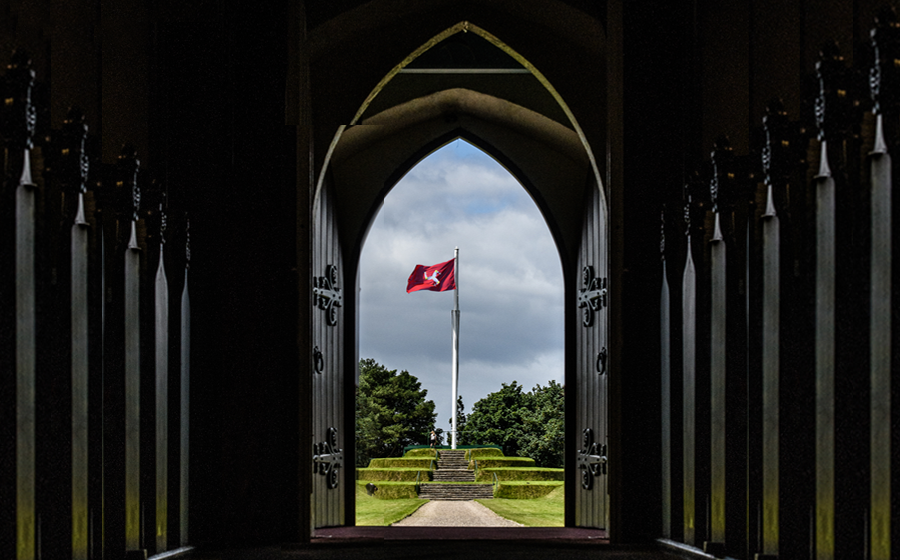
The Three Legs (ny tree cassyn) is one of the oldest national symbols in the world, and nobody is entirely sure where it came from. The motto — Quocunque Jeceris Stabit, “whichever way you throw me, I shall stand” — is a statement of survival.
Design your own version of the Three Legs. You can draw it, paint it, stitch it, build it from found objects, carve it into clay, or make it from anything you like.
The only rule: it has to look like it could stand whichever way you threw it.
Letter from Rev. Samuel Flood Page, newly appointed minister of St Peter's Chapel in Ramsey, to Home Secretary Viscount Melbourne requesting government assistance to fund a Day and Sunday School building threatened with seizure by its builder. The letter appeals for participation in Parliamentary education grants and explains the Isle of Man's exclusion from existing Church Building and National School Society funding programmes.
Letter from Samuel Flood Page, newly-appointed minister of St Peter's Chapel in Ramsey, to Viscount Melbourne seeking government assistance for struggling day and Sunday schools. The letter details the financial crisis facing the school building (£210 cost, only £100 raised, builder threatening to repossess) and highlights the Isle of Man's exclusion from Parliamentary education grants and Church Building Society funds. Contextualised by extensive editorial notes on Page's career, contemporary Manx press reports, and Treasury minute details for the 1833 education grant scheme.
A record from the Santan parish court (Lib Scac 1718) documenting a complaint by James Willaughan regarding vandalism and theft at Mr McQuire's works at Kirkwood Santan, including a broken wheelbarrow, water can, and stolen cast band. The court examined witnesses and imposed fines on Henry Crebbin and Jo Callin. The document provides early evidence for the settlement later known as Newtown and identifies James Wollahan as McQuire's Roman Catholic steward.
The Royal Navy's main base in Orkney during both world wars. HMS King Orry, a Manx Steam Packet vessel serving as an Armed Boarding Vessel, patrolled here. She was given the place of honour as sole representative at the surrender of the German High Seas Fleet on 21 November 1918.
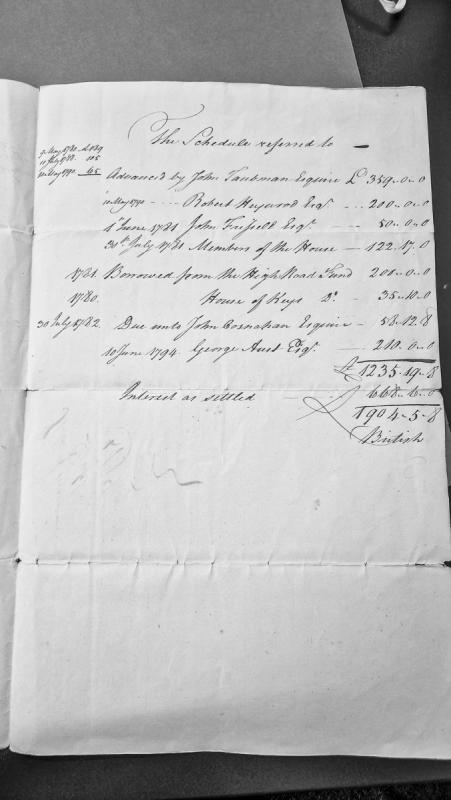
A financial schedule documenting advances made by various esquires and entities to what appears to be a Manx institution or project between 1780-1794. The document lists individual loans, borrowings from the High Road Fund and House of Keys, calculates accumulated interest, and provides a total sum of £1904-5-8.
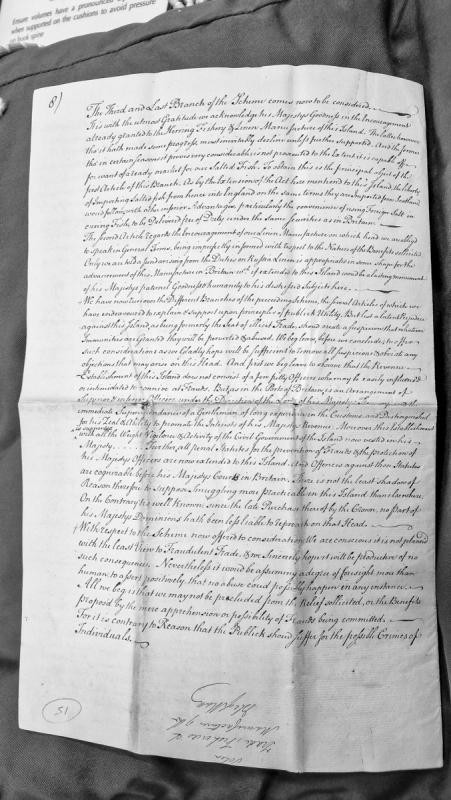
This document presents the third and final branch of a scheme to encourage herring fishery and linen manufacture on the Isle of Man. It argues for extending English trade privileges to Manx-produced salted fish and for funding Manx linen manufacture through duties on Russian linen. The document addresses concerns about the island's historical reputation for smuggling by detailing revenue establishment safeguards and legal protections now in place.
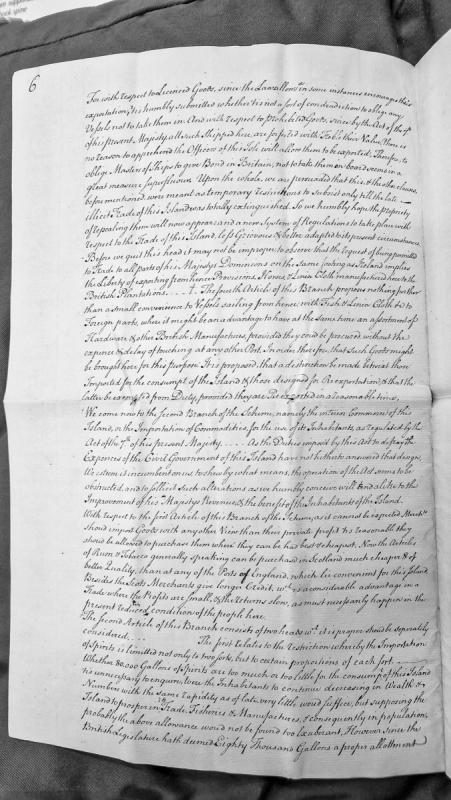
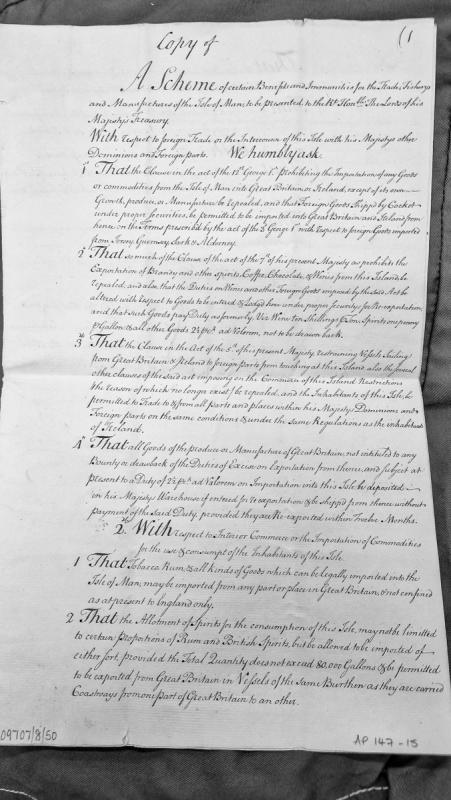
A detailed legal and commercial memorandum proposing reforms to the trade regulations of the Isle of Man. The document addresses restrictions on licensed and prohibited goods, export of provisions and manufactures, and the regulation of interior commerce through duties and import restrictions, arguing for modifications to existing acts to improve both the king's revenue and the islanders' circumstances.
A petition to the Lords of His Majesty's Treasury seeking commercial privileges for the Isle of Man, including repeal of restrictive clauses in various acts of Parliament. The document outlines desired reforms to foreign trade regulations, re-exportation terms, and interior commerce, requesting parity with Channel Islands and Ireland.
After the Treaty of Perth, the Island passed between Scottish and English claimants. Alexander III of Scotland, Edward I of England, Robert the Bruce — overlords changed but Tynwald continued to meet. Edward III's 1333 renunciation formally recognised Mann as an independent kingdom. William le Scrope was inaugurated at Tynwald in 1393 and executed six years later. Henry IV claimed the Island by right of conquest. The Percy grant of 1399 and the Stanley grant of 1405 brought the dynasty that would hold the Island for three and a half centuries.
Official report from the Scottish Customs Commissioners to the Lords Commissioners of the Treasury detailing the extent and methods of the smuggling trade between the Isle of Man and Scotland. Documents the types of goods smuggled, Manx import duties, smuggling techniques, and a violent incident at Old Kirk involving revenue officers. Directly relevant to understanding the smuggling crisis that precipitated the 1765 Revestment.
A detailed report from the Scottish Customs Commissioners to the Lords of the Treasury documenting the smuggling trade between the Isle of Man and Scotland. It describes smuggling methods, goods trafficked (spirits, tea, spices, silks, prohibited items), the duties charged by the Isle of Man proprietor, and a violent incident at Old Kirk involving revenue officers and a mob. This document directly evidences the smuggling crisis that prompted the 1765 Revestment.