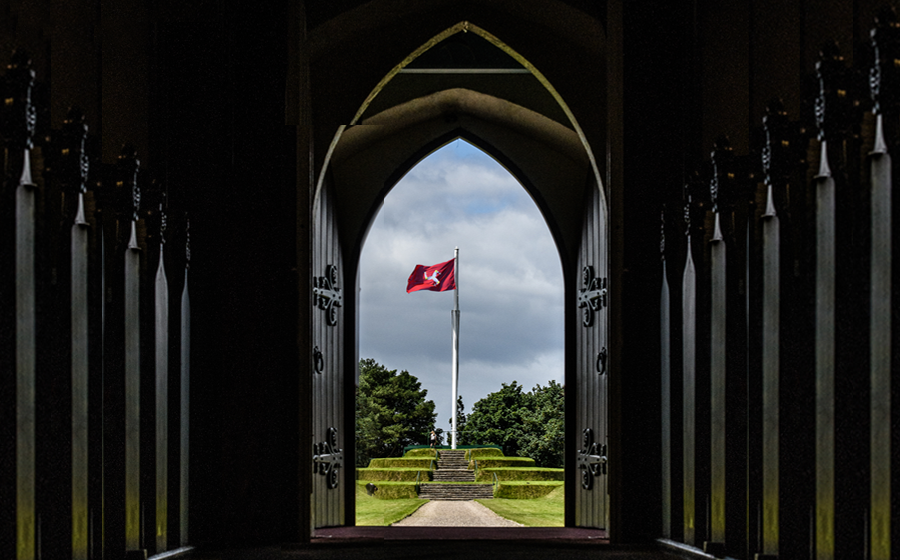
Probably one of the ablest of his family, his method of government, together with its effect on the Manx people, by whom he was called Yn Stanlagh Mooar, 'The Great Stanley,' is sufficiently interesting and important to be told at some length. Lord of Mann from 1607, he codified Manx law, strengthened Tynwald, and governed with a directness that earned both respect and the Manx language honour of a personal name.
William Christian, known universally by his Manx name Illiam Dhone (Brown-haired William), was Receiver General of the Isle of Man. In 1651, faced with a Parliamentary fleet and an absent lord, he led the Manx militia in surrendering the island rather than see it destroyed in a war that was not theirs. He was tried and executed at Hango Hill in 1663 on the orders of the restored Countess, becoming the most resonant figure in Manx national memory.
Bishop of Sodor and Man from 1698 to 1755, the longest episcopate in the history of the diocese. Wilson built schools, translated the Bible into Manx, enforced ecclesiastical discipline with a rigour that earned him both admiration and enemies, and became inseparable from the island's identity. His fifty-seven year episcopate shaped Manx society more profoundly than any lord.
Merchant, landowner, and the most documented private individual in eighteenth-century Mann. His Letter Books, preserved at Bridge House and now in the Manx Museum, provide the richest surviving account of Manx commercial and social life before the Revestment. Moore traded across the Irish Sea, built roads at his own expense, and recorded everything.
Lord of Mann from 1736 to 1765, the last private holder of the title. Governed largely from a distance, visiting the island rarely. His acceptance of Parliament's forced purchase in 1765 ended three and a half centuries of feudal lordship. The purchase price of £70,000 — negotiated under duress — was widely regarded as inadequate.
Daughter of the 2nd Duke and holder of inherited rights in Mann. After her father's death she pursued the compensation claim with tenacity, eventually securing additional payments from Parliament. The Duchess was the figure who would not let the financial settlement rest, forcing Parliament to acknowledge repeatedly that the original purchase was inadequate.
Customs officer appointed to Mann after the Revestment. Member of a dynasty that embedded itself in the island's revenue administration, creating a systematic conflict of interest between enforcement and personal profit. The Lutwidge family's rapacity became a running theme of post-Revestment extraction.
Manx merchant and profiteer who exploited the Revestment for personal advantage. His name appears 41 times across the Manx Museum archive index, a measure of his entanglement in the island's affairs. Connected to both the old mercantile establishment and the new revenue system.
First royal Governor of Mann after the Revestment, appointed by commission in 1765. His commission commanded obedience to 'the said Act of Parliament and his said Royal Commission' and required officers to attend to 'the laws of Great Britain as they respect this Island.' No mention of Manx constitution, Tynwald, Keys, or the island's own laws.
Comptroller of customs and ubiquitous figure in the island's administrative records. Appears 78 times across the Manx Museum archive index — the most frequently named individual. As auditor on revenue abstracts from 1744 to 1762 and in House of Keys business, he represents the continuity of Manx administration through the crisis.
Norse king who conquered Mann in 1079 after two failed attempts, establishing the dynasty that would rule the sea kingdom of Mann and the Isles. His settlement divided the island between the existing Manx population and his Norse followers, creating the accommodation between cultures that defined Mann for two centuries.
Manx-born naval officer who served as First Lieutenant aboard HMS Victory at Trafalgar. The most distinguished Manx military figure of the Napoleonic era and a symbol of the paradox at the heart of Crown dependency — Manx people serving the Crown with distinction while the Crown extracted from their island and gave nothing back.
The last king of the Norse dynasty founded by Godred Crovan. Magnus died at Castle Rushen in 1265, ending nearly two hundred years of Norse rule. The Treaty of Perth the following year ceded the Hebrides and the Isle of Man to Scotland. The Keys contracted from thirty-two to twenty-four members, shedding their Hebridean representatives as the territory shrank, but the institution survived the loss of the dynasty that had created it.
Purchased the lordship of Mann from the Montacute family in 1392. The deed included 'the title of King, and the right of being crowned with a golden crown.' Le Scrope was inaugurated at Tynwald in the old form, and his brother Stephen was proclaimed heir-apparent in the tanist tradition. He was the last lord of Mann to be crowned with gold. Le Scrope backed the wrong side when Henry IV seized the throne and lost his head for it, whereupon the lordship was granted to Sir John Stanley.
First Stanley Lord of Mann, granted the lordship by Henry IV in 1405 — a lifetime grant made inheritable the following year. He never visited the Island. He governed through deputies, as most of his successors would. The grant was made 'to Sir John Stanley and his heirs for ever' — language of perpetuity that Parliament would extinguish in 1765.
The most consequential political operator in fifteenth-century England. Survived every king of the Wars of the Roses. Married Margaret Beaufort, Henry Tudor's mother. At Bosworth on 22 August 1485, he positioned six thousand men between the two armies and waited. When Richard III charged at Henry, Sir William Stanley intervened. Thomas — who had committed no troops to the fighting — picked up Richard's crown, found under a hawthorn bush, and placed it on Henry Tudor's head. The man who had fought for nobody crowned the new king. Created Earl of Derby 27 October 1485.
The first Lord of Mann to adopt the lesser title, replacing King with Lord. Two explanations: political prudence after the Wars of the Roses, or a gesture of submission — 'it is not fit for a King to be subject to any but the KING of KINGS.' The title change was not made on the Island, not ratified by the estates, not discussed at the hill. It was made in England, for English reasons. The kingly title lingered despite the change — as late as 1532, the 3rd Earl still styled himself 'Soveraigne and liege Lord.'
Sea captain, merchant, and lieutenant-governor of Mann under the 7th Earl of Derby. Not a provincial figure — he had gone to sea, made a fortune, captained his own vessel, served the East India Company, and commanded a Royal Navy frigate. He proposed elected Keys and accountable Deemsters, threatening the Lord's control. The Great Stanley's assessment: 'excellent good company; as rude as a sea captain should be, but refined as one that had civilized himself half a year at Court.' Derby imprisoned him for eighteen years in Castle Rushen and Peel Castle. He died in Peel in January 1661, having never seen his programme realised. Derby's verdict: 'It was safer much to take men's lives than their estates.' Self-governance and land ownership were the same fight. Edward saw it.
French-born wife of the 7th Earl of Derby. Held the Island's castles during the Civil War while Parliamentary forces under Colonel Duckenfield came to take possession. After her husband's execution at Bolton in 1651, she and her son the 8th Earl did not forgive William Christian. The indictment of treason against Illiam Dhone was technically for treason against the Countess Dowager — not against the Lord of Mann (who was dead) and not against the Crown. Whether you could commit high treason against a lord's widow acting under commission was a question the court never asked.
Son of the 7th Earl, a child during the Civil War. Ordered the execution of Illiam Dhone from Lathom in September 1662: 'considering how much I am concerned soe farr forth as I may to revenge a father's bloud.' Issued a general pardon to everyone on the Island except William Christian. Packed the House of Keys — seven of twenty-four members replaced by his order. After the execution, no Manx-born man held the governorship again. Whether the Stanleys drew that lesson deliberately — whether the execution taught them never to trust a Manxman with the staff of government — the record does not say. But the fact remains.
Son of Illiam Dhone. After his father's execution, George appealed to the Privy Council and sent coded letters to a contact at the Three Anchors tavern in Milk Street, London. Derby sent a man named Roper to the same tavern, pretending to carry messages from George, to find out who was helping the Christian family's appeal. George produced accounts showing the substantial accuracy of his father's stewardship of the sequestrated bishopric funds. The Privy Council eventually intervened — ordering restitution of the Christian estates, committing the Deemsters to King's Bench prison, and restoring Edward Christian to his judicial office.
Negotiated the Act of Settlement of 1704 — the Manx Magna Carta. One of three members of the Keys sent with Bishop Wilson to Lathom to negotiate with the Lord. The Act confirmed customary estates of inheritance, fixed the fines, and gave Manx people back the right to hold, sell, and pass on land. It had taken a century. It had cost Edward Christian his freedom and Illiam Dhone his life. Sixty years after Edward was imprisoned, forty years after Illiam Dhone was shot, a Christian was still at the table, negotiating for the same thing both of them had fought for.
Bishop of Sodor and Man, successor to Wilson. Completed the Manx Bible — the New Testament in 1767, the full Bible in 1772, seven years after Parliament seized the lordship. The translation had been Wilson's project from the beginning. A Manx Prayer Book was printed in 1765 — the year of the Revestment itself — assuming a Manx-speaking congregation would endure. Hildesley observed that of twenty thousand people on the Island, few knew English.
English visitor who arrived on the Island around 1720. His Description of the Isle of Man became one of the most detailed accounts of Manx life in the early eighteenth century. A careful observer who documented the completeness with which Manx people inhabited the commercial world and the spirit world simultaneously. He recorded the moddey dhoo at Peel Castle — the garrison soldiers adjusting their language for a ghost — and noted that Manx people 'would be even refractory' to their clergy if they tried to preach against fairies.
Economist whose Dictionary of Trade and Commerce (1755) documented the Isle of Man's running trade with the precision of a man who understood exactly what he was looking at. He described the Island as an established entrepot with specific infrastructure, noting that the Duke of Atholl's revenues arose 'for the most part, from small duties and customs paid upon goods entered in the Isle of Man.' The language is that of a revenue system, not a criminal enterprise. The word 'smuggled' appears only when the goods cross the water to Britain.