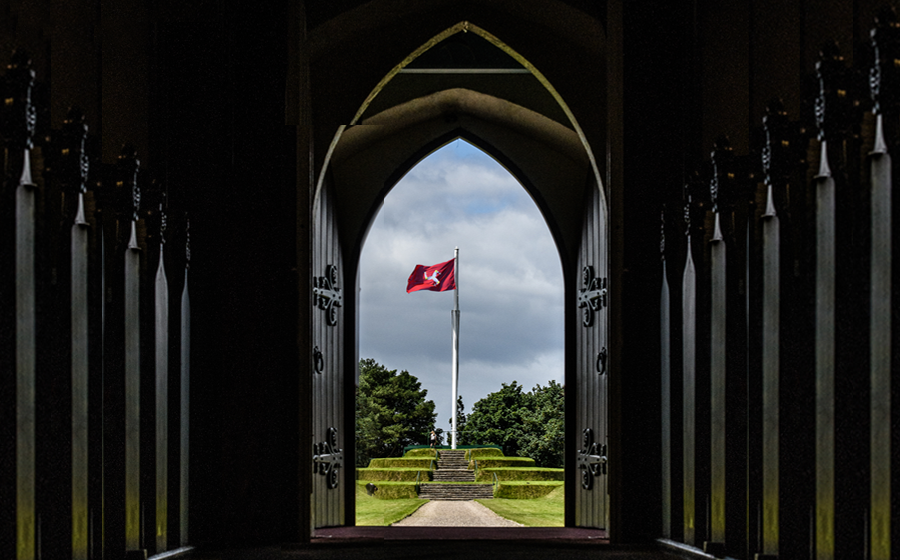
The language came back. Bunscoill Ghaelgagh opened in 2001 — a Manx-medium primary school teaching children in the language that was supposed to have died. Brian Stowell and Douglas Faragher led the revival. Tynwald still meets on the hill at St John's every July. The petitions of doleance are still heard. The survival of Manx identity is the people's achievement, not the Crown's. The indifference that caused the devastation also permitted the endurance. Crown dependence is not an administrative category. It is a living condition.
The slow rebuilding. The House of Keys Election Act of 1866 gave Manx people the right to elect their own representatives for the first time. Women's suffrage followed in 1881 — decades before Westminster. Yn Cheshaght Ghailckagh was founded in 1899 to preserve the Manx language. A.W. Moore documented the folklore, the music, the history before it was lost. But the language was dying. Ned Maddrell, the last native speaker, died in 1974. Crown dependence remained the living condition.
The Manx people left. Ohio, Cleveland, Virginia — they carried their language, their constitutional instinct, their identity. Colonel William Christian of Fincastle, Virginia, descended from the same family as Illiam Dhone. The Fincastle Resolutions of 1775 — drafted by Manx-descended Virginians — preceded the Declaration of Independence. John Sayle wrote home from Ohio in Manx Gaelic. The language lived longer in Ohio than it did on the Island.
The decades of devastation. Crown customs officers replaced the Manx establishment. The garrison was reinforced. The harbours were blockaded and destroyed. The fishing fleet was wrecked. Impressment stripped the Island of its men. The 1792 Commission of Inquiry documented what had been done and recommended remedies that were never implemented. The 1805 Parliamentary debates acknowledged the destruction and voted to send Manx surplus revenues to the Consolidated Fund. The Island paid for its own dispossession.
Eight days that ended a nation's independence. The Isle of Man Purchase Act 1765. The transfer ceremony on 11 July 1765, when the Duke of Atholl's authority was formally surrendered and Crown officers took possession. The Keys were silenced. The Tynwald fell quiet — no petitions heard, no laws promulgated in the old way, for over a decade. Parliament had purchased a feudal title. It had not acquired the Manx nation, and it had not assumed the duty of governance that came with the title.
The final years before Parliament acted. George Moore's Letter Books recorded a cosmopolitan trading world operating from Bridge House in Castletown. The family networks — Moore, Quayle, Taubman, Christian — wove together commerce, governance, and community. The Keys passed their resolution. Hugh Cosnahan carried the deputation to London. The Whitehaven merchants petitioned Westminster. Parliament moved to protect East India Company revenues. The Isle of Man Purchase Act received Royal Assent on 10 May 1765.
The Island's commercial flowering. The trade — always 'the trade,' never 'smuggling' in Manx usage — operated as a legitimate system under Manx law. The Book of Rates governed imports and exports. Customs entries recorded transactions openly. The harbours of Douglas, Peel, Ramsey, and Castletown connected the Island to a network stretching from the Mediterranean to the Baltic. Wilson's mature episcopate shaped parish life. Waldron recorded the spirit traditions. The moral dimension of the trade — whether it was commerce or crime — depended entirely on which side of the water you stood.
Illiam Dhone chose the Island over the Earl. The surrender, the Parliamentarian occupation, the Restoration, the trial, the execution at Hango Hill — and the parish register that recorded his death as a martyrdom. The Privy Council Orders and Derby correspondence revealed London's hand. Bishop Wilson arrived in 1698 and began the episcopate that would transform Manx education and church life. The Act of Settlement of 1704 codified the relationship between lord and people, defining the custodianship that Parliament would later purchase without understanding.
Three and a half centuries of Stanley rule. Sir John Stanley received the Island in 1405; the 1406 re-grant made it inheritable. The 1408 Tynwald confirmed Stanley legitimacy. The 1417 codification preserved Manx law. The Stanleys governed through deputies while they pursued English politics — the Bosworth gamble, Tudor connections, the earldom. The Great Stanley, James the 7th Earl, was the last lord to live among the Manx people. Edward Christian served as Lieutenant-Governor. Then the Civil War reached the Island, and Illiam Dhone faced the choice that would define him.
After the Treaty of Perth, the Island passed between Scottish and English claimants. Alexander III of Scotland, Edward I of England, Robert the Bruce — overlords changed but Tynwald continued to meet. Edward III's 1333 renunciation formally recognised Mann as an independent kingdom. William le Scrope was inaugurated at Tynwald in 1393 and executed six years later. Henry IV claimed the Island by right of conquest. The Percy grant of 1399 and the Stanley grant of 1405 brought the dynasty that would hold the Island for three and a half centuries.
The era of the sea kingdom. Godred Crovan's conquest at the Battle of Sky Hill in 1079 founded the dynasty that would rule for nearly two centuries. Tynwald formalised governance at a site the Manx people already considered sacred. The 32 Keys served a kingdom that stretched across the Hebrides. Norse and Celtic traditions intertwined — Thorwald's Cross at Kirk Andreas carries Odin on one face and Christ on the other. The diocese of Sodor answered to Trondheim, not Canterbury. Rushen Abbey kept the Chronicles of the Kings of Mann and the Isles. The Treaty of Perth in 1266 ended Norwegian suzerainty.
The deep ground before governance. The physical island, the spiritual landscape, the keeills and holy wells, the accommodation principle that would define Manx life for a thousand years. Celtic Christianity layered over older traditions without displacing them. Manannán's rent paid in rushes at midsummer. The spirit taxonomy — phynnodderee, buggane, mooinjer veggey — all carried Manx Gaelic names, not Norse imports. The world before Tynwald was recorded, when the Island's identity was already formed.