Volume IV of a four-volume published collection of correspondence between Richard Grenville (Earl Temple) and George Grenville, their friends and contemporaries. The text shown is a table of contents and index covering 1767-1768, documenting political negotiations, ministerial changes, East India Company affairs, American colonial issues, and figures including Lord Chatham, the Duke of Grafton, and John Wilkes. Valuable for understanding high-level political context during the Revestment period.
Published collection of correspondence from the Grenville family and contemporaries, spanning 1712 onwards, with focus on the final years of George II and first decade of George III. Editor's preface provides extensive biographical and political context for Richard Grenville, Earl Temple, and George Grenville, including their roles in Pitt's administration, the American Stamp Act, and political opposition to Lord Bute. Contains original manuscript letters formerly preserved at Stowe.
Volume IV of a four-volume published collection of correspondence and papers of the Grenville family, covering 1767-1768. Contains letters between Richard Grenville (Earl Temple), George Grenville, and their political contemporaries discussing Parliamentary business, political negotiations, American affairs, the East India Company, and Wilkes affair. Directly relevant to understanding Westminster politics during the Revestment period and the broader constitutional and commercial context.
A comprehensive genealogical and historical work on the House of Stanley from the Norman Conquest to 1776, with extensive coverage of the Isle of Man's history, society, manners, and economy. Includes primary source documents (letters, proclamations, petitions) and contemporary observations on Manx herring fishing, agriculture, revenue, laws, and social conditions. Directly relevant to the Revestment project for its treatment of Stanley family governance, the administrative transition, and Manx economic and social conditions in the post-Revestment period.
An excerpt from Draper's 1864 historical work on the House of Stanley, focusing on James, Tenth Earl of Derby (d. 1735-6) and tracing the descent of Isle of Man sovereignty through the Stanley and Athol families. Includes detailed account of the 1765 Parliamentary purchase of the island by the Crown from the Duke of Athol for £70,000, with reserved land rights and annual payments, and subsequent sales in 1806 and 1826.
Benjamin Franklin's 1760 pamphlet arguing for retention of Canada and Guadeloupe in peace negotiations following the Seven Years' War. Addresses colonial security, frontier defence against French-backed Indians, and long-term strategic interests in North America. Includes observations on population growth and governance of colonies.
Benjamin Franklin's major pamphlet on British imperial policy following the Seven Years' War, arguing for retention of Canada over Guadeloupe based on mercantilist economic theory and the value of North American colonies as markets for British manufactures. Includes comparative trade data, population statistics, and discussion of colonial governance and the risk of independence. Part of broader 1759–1763 pamphlet debate over peace settlement terms.
Benjamin Franklin's influential pamphlet arguing for British retention of Canada rather than Guadeloupe in the forthcoming Treaty of Paris, addressing mercantile theory, colonial markets, and imperial economic interests. Originally published April 1760, this is a transcription from Founders Online (National Archives). The document engages with contemporary debates on colonial value and prefigures later tensions between mother country and colonies.
Benjamin Franklin's major 1760 pamphlet arguing for British retention of Canada over Guadeloupe in peace negotiations following the Seven Years' War. Engages mercantilist economics, colonial growth potential, and the role of North American colonies as markets for British manufactures. Includes comparative trade statistics and reprints Franklin's 1751 'Observations concerning the Increase of Mankind.'
Benjamin Franklin's influential pamphlet arguing for British retention of Canada over Guadeloupe in peace negotiations following the Seven Years' War. Addresses mercantilist economic theory, colonial population growth, trade expansion with North America, and the strategic importance of continental colonies as markets for British manufactures. Includes statistical evidence on exports and population growth in the colonies.
Benjamin Franklin's 1760 pamphlet engaging in public debate over post-war colonial policy, particularly the retention of Canada versus Guadeloupe. Franklin argues for Canadian possession on grounds of American security, frontier stability, and prevention of future costly conflicts. The work addresses imperial strategy, colonial defense, Indigenous relations, and the economics of empire during the Seven Years' War aftermath.
Chapter 10 from an 1893 history of the Isle of Man, drawing on primary accounts by William Blundell, Thomas Chaloner, William Sacheverell, and Bishop Wilson to describe Manx life during the Civil War period and Restoration. Covers agriculture, herring fishery, social structure, laws, and governance under the Derby dynasty, providing context for pre-Revestment island conditions.
Chapter 10 from "Land of Home Rule" (1893) provides a detailed portrait of Isle of Man society in the 17th century following the English Civil War, drawing on primary sources by William Blundell, Chaloner, Sacheverell, and Bishop Wilson. It covers agriculture, herring fishery, social structure, laws, mineral resources, and governance under the Derby dynasty, offering crucial context for understanding pre-Revestment Manx conditions.
A bilingual (English/Latin) historical record from the Manx Society vol. 7 documenting the 1393 purchase of the Isle of Man by William Scrope from Montague, Earl of Salisbury. The entry also notes the transfer of the King's Bench and Chancery from London to York in the same year. This provides crucial context for understanding pre-1765 sovereignty claims over Man and the history of feudal ownership prior to the Revestment.
A bilingual (English/Latin) chronicle entry from Monumenta de Insula Manniae recording the 1393 purchase of the Isle of Man by William Scrope, Lord Chamberlain, from Montague, Earl of Salisbury. The entry also notes the temporary transfer of the King's Bench and Chancery from London to York. This is an early medieval precedent document relevant to understanding Manx sovereignty transfers.
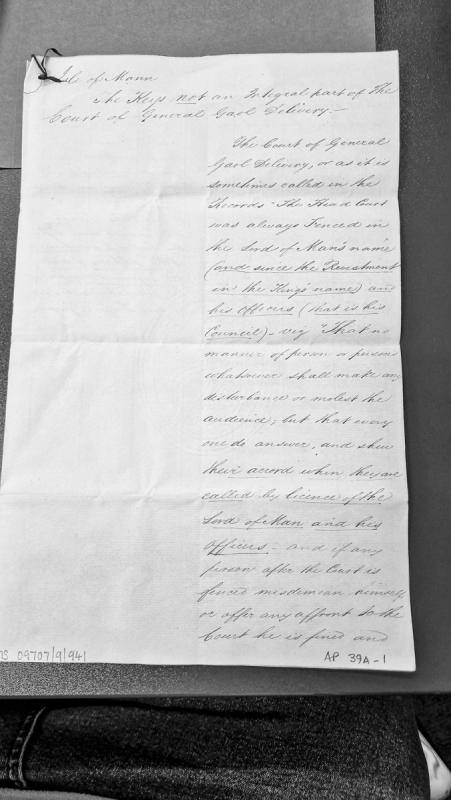
A legal document discussing the constitutional status of the Court of General Gaol Delivery (also called the Head Court) in the Isle of Man, describing its procedures for fencing the court in the Lord of Man's (later the King's) name and regulations for conduct during proceedings.
Chapter 15 from 'Land of Home Rule' (1893) examines the impact of the 1765 Revestment on Manx society, focusing on labour law reform post-1777, the island's transformation into a debt refuge under the 1737 Protection Act, suppression of smuggling, and the final purchase of the Duke of Atholl's remaining interests by the Crown in 1825. The chapter traces economic consequences from the loss of illicit trade through tourism and literary discovery, and evaluates the Stanley and Atholl dynasties' stewardship.
Volume 3 of Sir John Malcolm's authoritative three-volume biography of Robert, Lord Clive, drawn from family papers. Covers Clive's governorship in Bengal (1766–1767), including the officers' mutiny over batta reduction, revenue measures, and his return to England. Provides detailed context on East India Company administration, military discipline, and political tensions during the formative period of British rule in India.
A historical chapter examining the 1703 Act of Settlement, the foundational land tenure reform in the Isle of Man under Bishop Wilson and the 10th Earl of Derby. The text traces the evolution of Manx land tenure from Goddard Crovan through the problematic 1645 leasehold system, explaining how Wilson persuaded Derby to restore customary inheritance rights and fix rents. The author draws parallels to contemporary Irish land reform debates (1845-1870), positioning the Manx settlement as a model that Ireland should have followed.
Chapter 12 from 'Land of Home Rule' (1893) examining the 1703 Act of Settlement, which reformed Manx land tenure by converting leaseholders to perpetual tenants at low quit-rents. The chapter discusses Bishop Wilson's pivotal role in persuading the 10th Earl of Derby to resolve the land question that had troubled the island since the 7th Earl's 1645 lease reforms, and compares the Manx settlement with contemporary Irish land grievances.
A comprehensive academic study by J. R. Dickinson examining the maritime commerce of the Isle of Man across nearly two centuries, from early primary product exports (cattle, hides, fish, grain) through the rise of the illicit smuggling trade in the 17th-18th centuries. The paper analyses waterbailiff's customs accounts and port books to document how the island's strategic Irish Sea location enabled it to become a major entrepôt for contraband goods, particularly after increased English tariffs in the late 17th century, culminating in the Crown's purchase of lordship rights in 1765.
A comprehensive academic study of Manx maritime commerce across nearly two centuries, examining customs records, livestock and hide exports, and the evolution of the island's role from modest trading post to smuggling entrepôt. Dickinson contextualizes the running trade within the broader framework of Irish Sea commerce and discusses the constitutional and economic factors leading to the 1765 Revestment.
A scholarly article by J. R. Dickinson examining the maritime commerce of the Isle of Man across nearly two centuries, with particular emphasis on primary products (cattle, hides, fish, grain) in the sixteenth and early seventeenth centuries and the explosive growth of the illicit re-export trade in the late seventeenth and eighteenth centuries. The work analyzes waterbailiff customs accounts and contextualizes Manx trade within Irish Sea regional commerce, addressing the transition from the Stanley lords to the Atholl dukes and culminating in the 1765 Revestment.
A comprehensive academic study by J. R. Dickinson examining Manx maritime commerce across nearly two centuries, with particular emphasis on the evolution from legitimate primary product exports (cattle, hides, fish) to the illicit running trade in the 17th–18th centuries. Uses waterbailiff customs accounts and comparative English/Irish port records to trace trade patterns, duty structures, and the commercial context leading to the 1765 Revestment.
A comprehensive historical narrative of the 1765 revestment of the Isle of Man to the British Crown, covering negotiations between George Grenville's Ministry and James, 2nd Duke of Atholl; the legislative process; the subsequent claims by the 4th Duke for additional compensation; and the political and economic consequences for the Manx people. Central to understanding the constitutional, financial, and social dimensions of the Revestment.