A scholarly essay examining smuggling networks, quarantine violations, and maritime crime in 18th-century Ireland, with particular emphasis on the Isle of Man's role as a smuggling entrepôt before its acquisition by the British government in 1765. The text traces specific smuggling operations, merchant networks (including the Black family based in Bordeaux), and coastal lawlessness, providing detailed case studies relevant to understanding the commercial and strategic context of the Revestment.
Collection of four historical appendices covering 17th-century Manx customs (stranger reception protocols), a 1682 benevolence collection order, 1600 security incidents, and debt imprisonment law. These provide contemporary documentation of Manx governance structures, feudal obligations, and legal procedures predating the 1765 Revestment.
Chapter from a 1900 History of the Isle of Man covering the rise and evolution of the smuggling trade from the late 17th century through 1765. Traces the involvement of merchants like Richard Maguire and Josiah Poole, parliamentary interventions (1711 Act, 1726 Act), and the impact of duties on contraband goods including tobacco, tea, spirits, wine, and East India commodities. Essential overview of the smuggling context preceding the Revestment.
A scholarly historical chapter examining smuggling on the Isle of Man following the 1765 Mischief Act and the 1767 Act, analysing the immediate panic, subsequent resumption of smuggling, and eventual suppression through 1798 reforms. Draws on eyewitness accounts, Parliamentary speeches, and the 1791 Commissioners' Report to trace patterns of illicit trade in spirits, tea, tobacco, salt, and grain through 1853.
Chapter II, Section 3 of a 1900 history of the Isle of Man covering the smuggling trade and revenue enforcement after the 1765 Revestment. Details the impact of the Mischief Act (1765), the Act of 1767, and subsequent anti-smuggling measures, including eyewitness accounts of conditions post-1765, the 1791 Commissioners' Report recommendations, and the 1798 Act reforms. Extensively documents smuggling patterns, commodities, and the eventual decline of illicit trade.
A scholarly chapter on smuggling in the Isle of Man following the 1765 Mischief Act and subsequent revenue legislation. Covers the panic caused by enforcement, recommencement of smuggling, the 1767 Act, 1791 Commissioners' recommendations, and post-1798 decline of smuggling with residual illicit trade in spirits, tea, tobacco, salt, and grain flour until c. 1853.
A detailed academic chapter on Manx trade and industry following the 1765 Revestment, covering commercial restrictions, the licence system, manufacturing (linen, cotton, flax, woollen goods), shipbuilding, and the gradual liberalisation of trade. Examines how the connexion with Great Britain both restricted and occasionally benefited Manx commerce, and documents the rise of industries including printing newspapers and the impact of steam communication.
A comprehensive historical chapter on Manx trade and industry following the 1765 Revestment, covering commercial restrictions imposed by Westminster, the oppressive licence system, revival of trade through steam communication, shipbuilding, linen manufacture, and the gradual liberalisation of trade policy. Directly addresses the economic consequences of the crown's acquisition of sovereignty and the island's integration into British commercial frameworks.
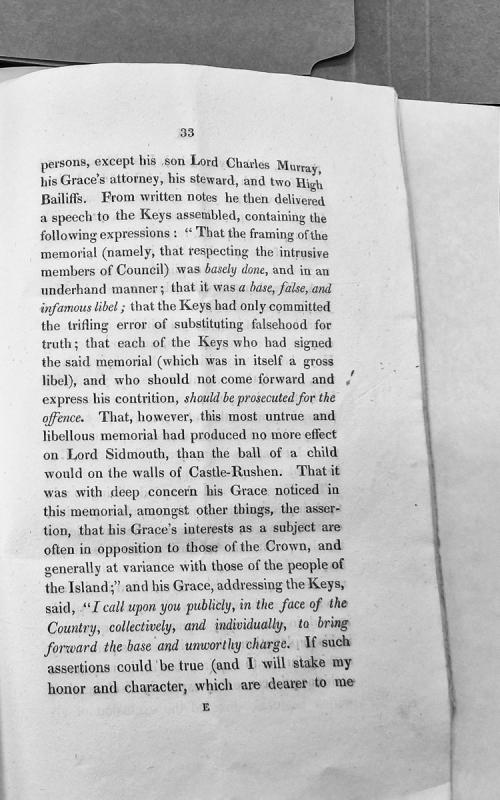
A recorded speech delivered to the House of Keys assembly, likely by the Governor or a senior official (possibly Lord Sidmouth or related figure), responding to a memorial submitted by Keys members regarding intrusive Council appointments. The speaker denounces the memorial as false and libelous, threatening prosecution of signatories who do not recant, and challenges accusations that his interests conflict with those of the Crown and people.
Treasury document reporting on Crown lands in the Isle of Man derived from the former Bangor and Sabal Abbey (Ireland), including messuages and a water mill at Dalby. Also documents the 1666 grant of all Mines Royal (gold and silver) to the Earl of Derby and its expiration in 1735. Includes historical leasing records from 1666 onwards and notes arrears and abandonment of the property.
Treasury document surveying Crown lands in the Isle of Man formerly belonging to Bangor and Sabal Abbey, with lease history from 1666–1770, and status of Royal Mines grant to the Earl of Derby (1666–1735). Demonstrates Crown revenue administration and property management in the post-Revestment period, relevant to understanding the financial structure and assets acquired in 1765.
Report from Lieutenant Governor Cornelius Smelt to the Home Office describing the inadequate state of the sole prison on the Isle of Man (Castle Rushen), with a supporting Memorial from the House of Keys requesting funds for prison infrastructure. Documents overcrowding, lack of segregation by sex or offence, and poor conditions. Reflects post-Revestment (1765) administrative issues and governance challenges.
Official correspondence from Lieutenant Governor Cornelius Smelt to the Home Office (referenced as Ryder) enclosing a Memorial from the House of Keys regarding conditions at Castle Rushen Prison. Documents overcrowding, lack of separation facilities, and the need for gaol facilities at Douglas, Peel, and Ramsey. Reflects post-Revestment governance challenges and the transition of state responsibilities to British authority following the 1765 purchase of sovereignty.
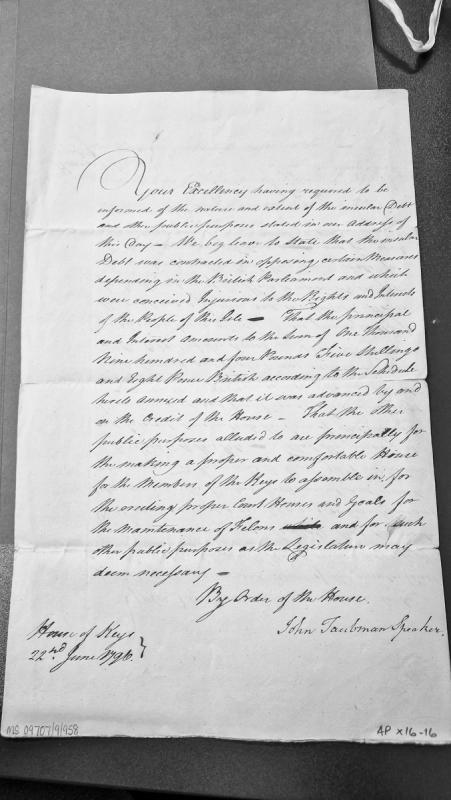
An official statement from the House of Keys to His Excellency detailing the nature and extent of the insular debt, which amounted to £1,904 5s 8d and was contracted in opposing certain measures in Parliament. The document also outlines other public purposes for which funds are needed, including a meeting house for the Keys, court houses, goals, and maintenance of felons.
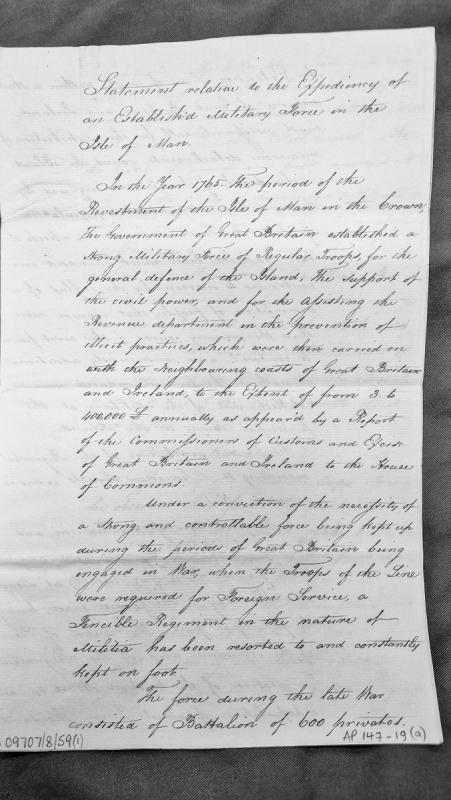
A statement justifying the establishment of a military force in the Isle of Man following the revestment of the island to the Crown in 1765. The document explains the necessity of maintaining troops for island defence, supporting civil authority, and preventing illicit trade, citing customs revenue losses of £300,000-400,000 annually.
Parliamentary statute enacted under Henry VIII annexing the Bishopric and Diocese of Man to the ecclesiastical jurisdiction of York. This is a foundational constitutional document establishing Man's religious governance within the English church hierarchy, relevant to understanding pre-Revestment institutional structures and English Crown authority over the island.
An excerpt from the Statutes of the Realm (5 Elizabeth I, 1562) permitting foreign-born merchants to import French wines into Manx ports via foreign-owned vessels, limited to 100 tonnes annually. This primary legal source demonstrates early statutory provision for trade privileges in the Isle of Man and the regulatory framework governing wine importation.
Parliamentary statute from 1542 enacting the annexation of the Bishopric and Diocese of Man to the ecclesiastical jurisdiction of York. This foundational constitutional document establishes the religious governance structure of the Isle of Man under English law and is essential context for understanding Manx institutional development prior to the 1765 Revestment.
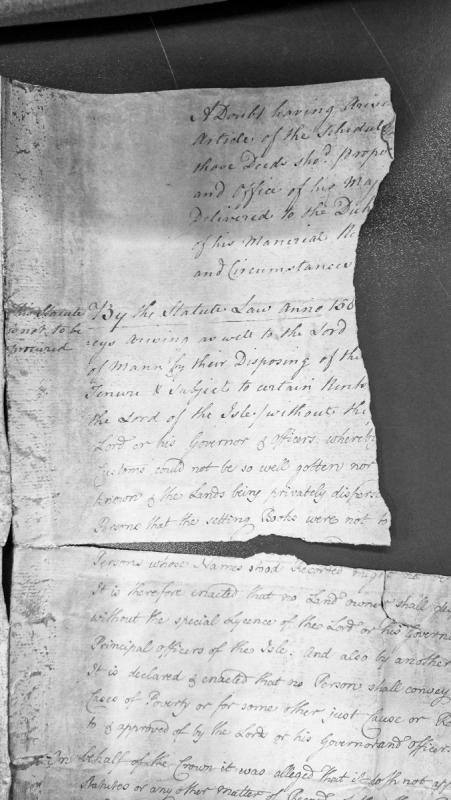
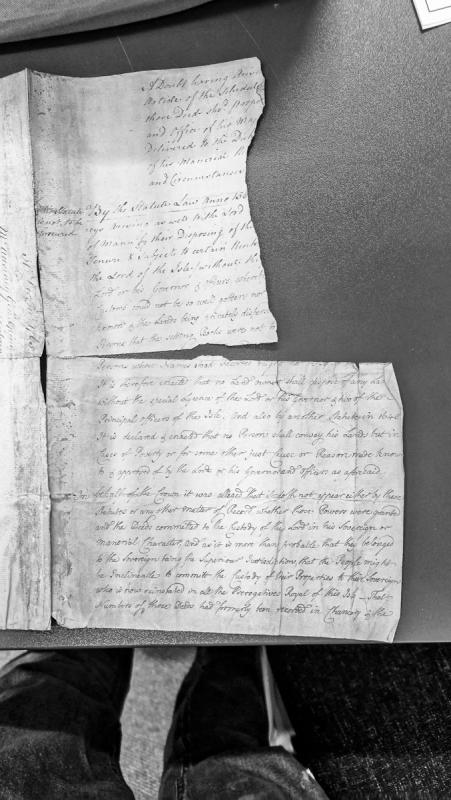
A legal document discussing Manx statutes relating to land ownership and tenure, specifically addressing the disposal of lands and the authority of the Lord of Mann and his officers. The document references statutes from anno 1580 and discusses restrictions on land conveyance without proper license from the Lord or Governor.
A legal document discussing statutes regulating land ownership and conveyance on the Isle of Man, with provisions requiring license from the Lord or Governor and principal officers. The fragment includes an argument on behalf of the Crown regarding custody of property deeds and sovereign prerogatives.
A series of linked planning documents and analytical notes for Part III of a monograph on the 1765 Isle of Man Revestment. The text outlines a forensic framework connecting the Revestment to the American Revolution by arguing that the Tea Act of 1773 and Coercive Acts of 1774 applied the same 'landing = sovereignty' doctrine and 'Company-State' extraction logic first tested on the Isle of Man. Includes proposed chapter structures (16–20), thematic pillars, research priorities, and analysis of how Benjamin Franklin and other colonial leaders recognized the Manx precedent as a warning.
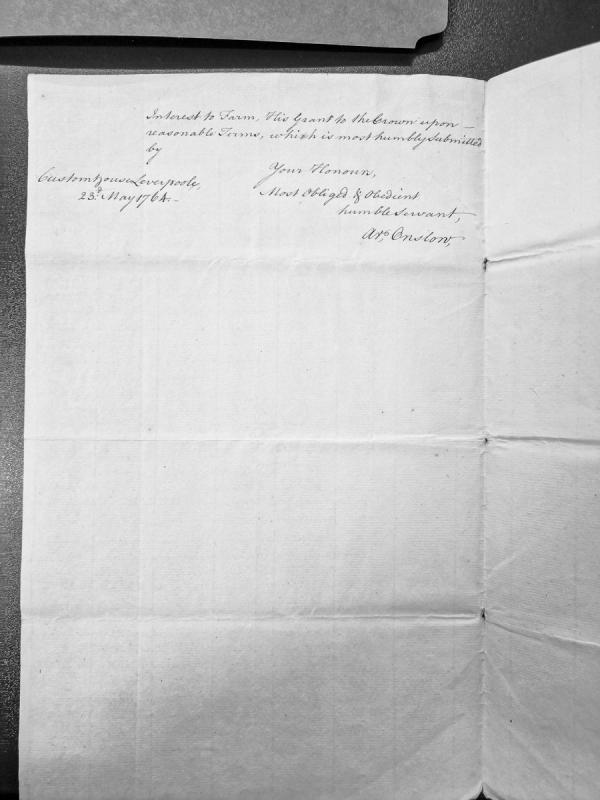
A formal submission letter from the Custom House in Liverpool dated May 23rd, 1764, regarding interest in a farm and a proposed grant to the Crown on reasonable terms. The document appears to be official correspondence relating to colonial or trade administration.
An account of subsistence payments made to customs officers and boatmen sent from Carlisle and Whitehaven to the Isle of Man by Charles Lutwidge following the 1765 Parliamentary Act to suppress illicit trade. The document details individual officer wages, daily rates (2s 6d), and ancillary costs including victualling and expresses, totalling £907 4s 3½d. It directly evidences the Treasury's operational expenditure on customs enforcement immediately after the Revestment Act.
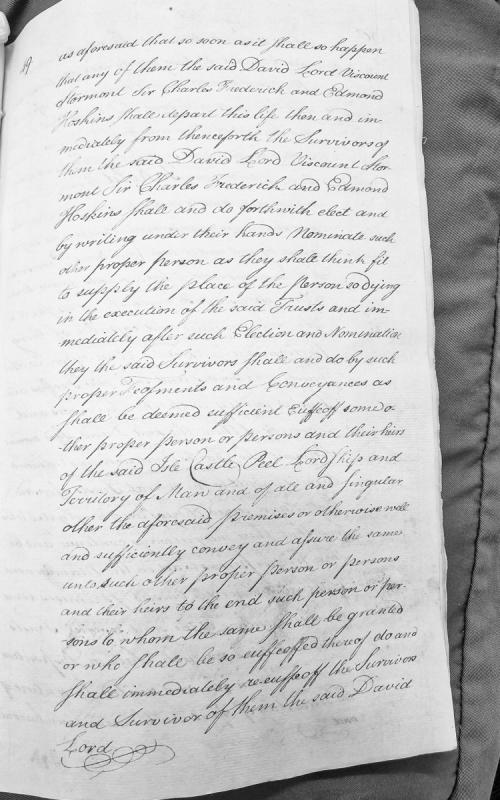
A legal document detailing the succession procedure for trustees (David Lord Viscount Stormont, Sir Charles Frederick, and Edmond Hoskins) responsible for the Isle of Man, Peel Castle, and associated territories. Upon the death of any trustee, the survivors are to elect and nominate a replacement, with property to be conveyed through proper legal instruments to maintain the trust.
A financial valuation document estimating the annual revenues and capital worth of the Isle of Man in 1764, itemizing duties on imported commodities, land revenues, ecclesiastical income, and civil posts. The document projects potential future revenue increases and calculates total valuation using purchase multiples (40 and 14 years purchase). Directly relevant to understanding the financial basis for the 1765 Revestment negotiations.