A royal grant (letters patent) from Henry IV to William Stanley (Knight, Lieutenant of Isle of Man) commanding delivery of the Island, Castle of Peel, and all dominions, royalties, franchises and profits to John Stanley for life. This document exemplifies early feudal-style governance of Man before the Revestment period, establishing the Stanley family's claim to the island and providing constitutional context for later 18th-century disputes over sovereignty.
A licence granted by King Henry IV permitting William Hobbesson, servant of the Earl of Northumberland, to purchase 12 crannocks of barley and transport it to Mann Castle for victuals. The document is presented in both English translation and original Latin patent roll text from the Irish Chancery records (Rotuli Patentes et Clausae). This demonstrates early medieval provisioning of the royal castle on the Isle of Man and the administrative mechanisms by which the English Crown controlled island commerce and supply.
A Norman French royal writ (4 Ed. II) commanding the bailiffs and officials of Sutton-on-the-port of Plymouth to send a well-equipped naval fleet to the Isle of Man and thence to Scotland in support of the Crown's war effort. The fleet is to be placed under the command of Simon de Mountaigne, designated Admiral of the royal fleet. This document illustrates medieval royal naval administration and the strategic importance of the Isle of Man as a naval staging post.
A bilingual (English and Latin) royal writ from Henry IV commanding John and William Stanley to take and hold the castle and island of Man on behalf of the Crown. This document records the formal transfer of Man from private lordship into royal custody, establishing a precedent for Crown authority over the island that precedes the 1765 Revestment by 360 years. It is drawn from the Monumenta de Insula Manniae collection, a primary source compilation on Manx sovereignty and lordship.
A bilingual (Latin and English) royal patent from Edward I appointing three justices (Nicholas de Segrave, Osbert de Spalding, John de Suthewell) to hear and determine complaints from the people of the Isle of Man against trespasses and injuries by royal bailiffs and others. This document demonstrates early English royal oversight of Manx affairs and the mechanisms of complaint and justice in the medieval island.
A 14th-century royal charter (7 Ed. III) granting custody of the Isle of Man and its appurtenances to William de Montacute for a term from Michaelmas 1334 for one year, with annual rendering of extent to the royal exchequer. Provided in both English and Latin versions. This document illustrates early medieval English sovereignty and administrative control over the island prior to the Revestment period.
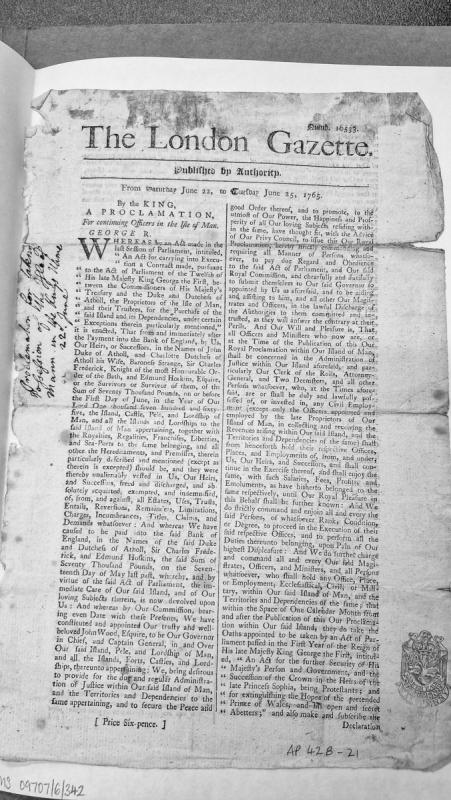
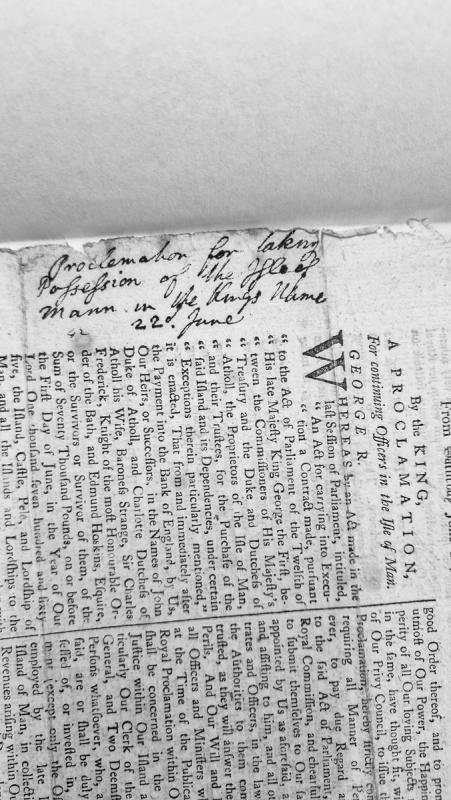
A Royal Proclamation issued by King George III published in the London Gazette, establishing the Crown's governance of the Isle of Man following the purchase from the Duke and Duchess of Atholl for £70,000. The proclamation confirms the appointment of John Wood as Governor and requires all existing civil officers to continue in their positions under Crown authority, with directives to take oaths of allegiance.
A printed royal proclamation issued by King George III regarding the continuation of officers in the Isle of Man following Parliament's enactment of a contract for the Crown's purchase of the island from the Duke and Duchess of Atholl for £70,000, payable by June 1, 1765. The proclamation directs the continuation of existing officials and officers in their posts.
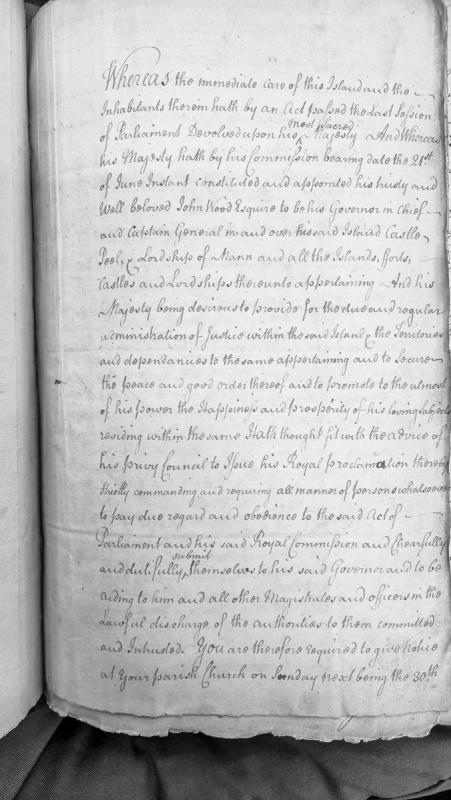
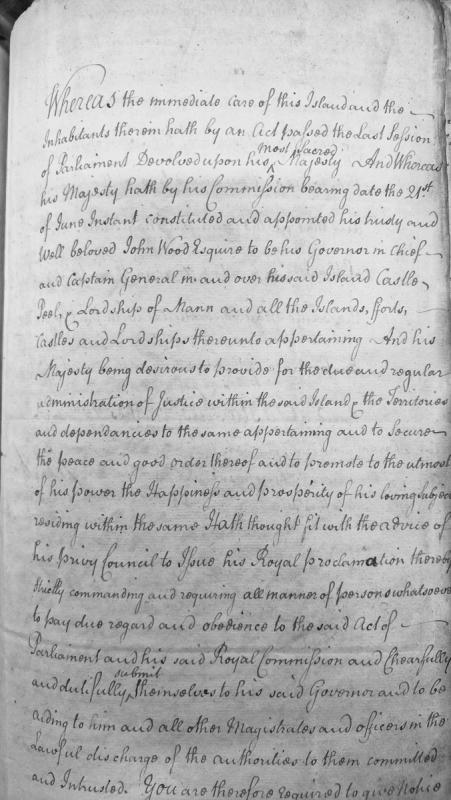
A royal proclamation issued on behalf of His Majesty, commanding inhabitants of the Isle of Man to recognize and obey John Wood, Esquire, who has been constituted Governor in Chief and Captain General by Royal Commission dated 21st June. The proclamation emphasizes the importance of maintaining justice, peace, and good order within the island and its dependencies.
A royal proclamation issued on behalf of His Majesty establishing the governance structure for the Isle of Man following an Act of Parliament. The document appoints John Wood Esquire as Governor in Chief and Captain General, and commands all persons to obey the Act of Parliament, the Royal Commission, and the appointed Governor.
A royal letter of protection issued by King Edward III to the Bishop of Man (Thomas), granting safe passage and protection for the bishop, his men, servants, and goods while travelling to and from the papal court at Rome. The document is presented in both English translation and original Latin (from Rotuli Scotiæ), and demonstrates the bishop's status as a feudal vassal owing allegiance to the English crown while undertaking ecclesiastical business.
A royal letter of protection issued by King Edward III to the Bishop of Man (identified as Bishop Thomas), granting safe conduct for the bishop's travel to and from the papal court in Rome. The document is recorded in the Rotuli Scotiæ and demonstrates the ecclesiastical and political status of the Manx bishopric within the medieval Scottish-English-Papal nexus.
A bilingual (Latin and English) royal charter in which King Edward III, with the consent of prelates, earls, barons and nobles, releases and quits all royal claims to the Isle of Man to William de Monte Acuto. This document is foundational to understanding pre-Revestment sovereignty questions and the historical trajectory of Manx governance from feudal tenure to parliamentary purchase.
A bilingual (Latin/English) transcription of a 1334 royal charter in which King Edward III, with consent of Parliament, releases and quitclaims all royal right and title to the Isle of Man to William de Monte Acuto. This document is foundational to understanding pre-Revestment claims to Manx sovereignty and establishes the legal precedent for private feudal lordship of the island.
A royal writ from Queen Elizabeth I to the Archbishop of York, dated 29 September 1570, confirming the nomination of John Salesbury as Bishop of Sodor and Man, presented by Edward, Earl of Derby, the patron of the see. The document establishes the Earl's right of patronage over the bishopric and directs the Archbishop to confirm Salesbury's appointment. Includes both English and Latin versions. Relevant to understanding the constitutional relationship between the English Crown, the Earl of Derby, and Isle of Man ecclesiastical governance in the pre-Revestment period.
A bilingual (English/Latin) royal writ from Edward III commanding Thomas de Drayton of Great Yarmouth to deliver the Bishop of Man under safe escort to London for examination, along with Scottish associates and their goods seized at Carlisle. The document illustrates early English Crown authority over Manx ecclesiastical figures and medieval maritime/commercial conflict.
A bilingual (Anglo-Norman French and Latin) royal writ from Edward III commanding Thomas de Drayton to transport the Bishop of Man from Scotland under arrest to London for examination. The document concerns the seizure of Scottish clerics and their goods at Carlisle, reflecting medieval jurisdictional tensions between England and Scotland over Isle of Man ecclesiastical authority.
A bilingual (English and Latin) royal writ from Edward II commanding sheriffs and bailiffs of northern English counties to provide naval support and supplies to defend the Isle of Man against an anticipated invasion by Robert Bruce's Scottish fleet. The document reflects early 14th-century geopolitical tensions and the strategic importance of Man as a bulwark against Scottish expansion.
A bilingual (English and Norman French) royal writ from King Edward II ordering the bailiffs and prudent men of Bristol, Portsmouth, Weymouth, Lymington, Warham, Lyme, Melcombe, and Poole to dispatch a well-manned navy to the Isle of Man by Assumption Day (15 August 1310), thence to Scotland under Admiral Simon de Montagu to conduct military operations against Scottish forces. The document demonstrates the strategic importance of the Isle of Man as a naval staging post in medieval Anglo-Scottish conflicts.
A bilingual (English/Latin) royal writ from King Edward III to the Justice of Ireland, responding to complaints from the community of the Isle of Man regarding an armed assault on their merchant vessels carrying payment of a peace fine to Scotland. The document details the seizure of goods and imprisonment of Manx envoys by Irish mariners claiming to be 'guardians of the sea,' and orders their recovery and the perpetrators' prosecution.
A bilingual (English and Latin) royal writ from King Edward II dated 15 December 1311, addressed to sheriffs and bailiffs of the northern English counties (Chester, Lancaster, Cumberland, Westmoreland). The writ commands assistance to Gilbert Makasky, seneschal of Anthony de Bek (Bishop of Durham), in provisioning and defending the Isle of Man against an anticipated invasion by Robert Bruce's fleet. The document is relevant to understanding the strategic and military importance of the Isle of Man during the Scottish Wars and the Crown's concerns about Scottish naval power.
A Norman French royal writ (4 Edward II) commanding the officials of Sutton and Plymouth to prepare a naval fleet for service in the Scottish wars. The writ initially orders vessels to Dublin, then redirects them to the Isle of Man, where they are to await Admiral Simon de Mountaigne. Demonstrates the strategic importance of the Isle of Man as a mustering point for military expeditions and the Crown's direct control over island resources in the early 14th century.
A royal writ issued by King Edward II commanding bailiffs in England, Ireland, and Wales to arrest malefactors from the Isle of Man who supported Robert de Brus (Robert the Bruce) and had caused damage to the Crown and its subjects. The writ authorizes detention in royal prisons pending further royal command. This document demonstrates early medieval royal jurisdiction over the island and the Crown's concern with Manx political allegiances during the Scottish Wars of Independence.
A royal writ from King Edward II (or successor) commanding English bailiffs to arrest malefactors of the Isle of Man who supported Robert de Brus (Robert the Bruce) and had caused damage in England. The document demonstrates medieval English crown authority over the Isle and its inhabitants, and was part of the Monumenta de Insula Manniae collection. Similar writs were issued to bailiffs in Ireland and Wales.
A royal writ from King Edward III commanding the release of goods and chattels of the Bishop of Man, seized at the port of Lowestoft after a storm at sea. The Bishop was en route to Rome on ecclesiastical business. The document illustrates the status of Man under English allegiance and sovereignty, and the protection of Manx subjects' property rights in English ports.