John Wetherall, a revenue officer, reports to the Chief of Commissioners and Governors of Irish Revenue on smuggled goods identified as originating from the Isle of Man. The report details classification methods for recognizing Manx contraband (tea in small casks, tobacco in trusses, spirits in ankers) and lists goods seized and sold, including tea, tobacco, brandy, geneva, rum, and foreign textiles. The letter reflects ongoing customs enforcement concerns during the period leading up to the 1765 Revestment.
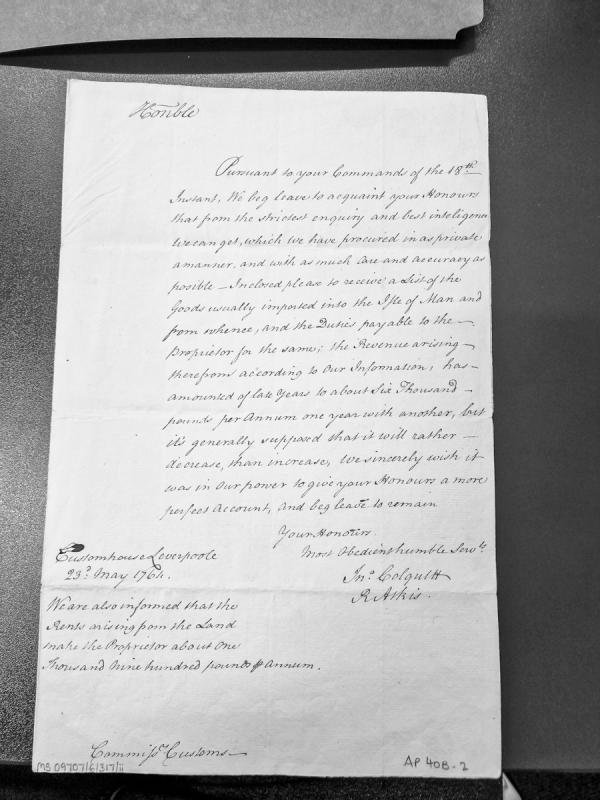
A letter from the Customhouse at Liverpool responding to commands dated 18th instant, providing information on goods imported to the Isle of Man, their origins, duties payable to the Proprietor, and revenue estimates. The report indicates annual revenue of approximately £6,000 and land rents of approximately £1,900 per annum.
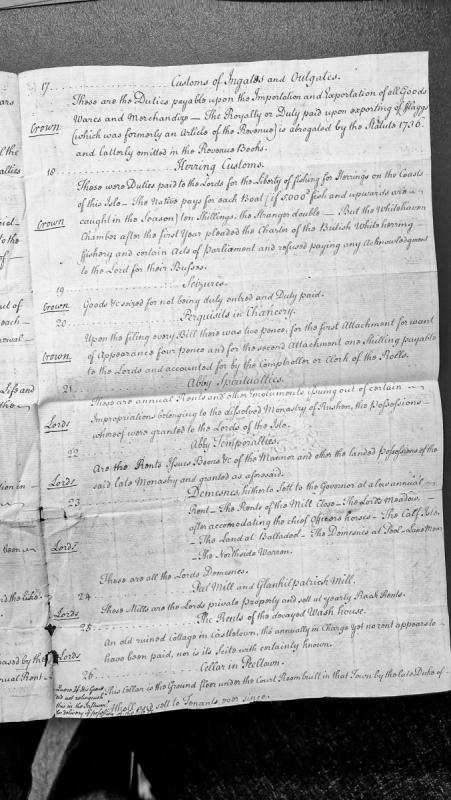
A detailed enumeration of revenue sources payable to the Lords of the Isle of Man, covering customs duties on imports/exports, herring fishing licenses, court fees, ecclesiastical rents from dissolved Rushen Monastery, and demesne lands. The document provides historical context on statutory changes and property management practices.
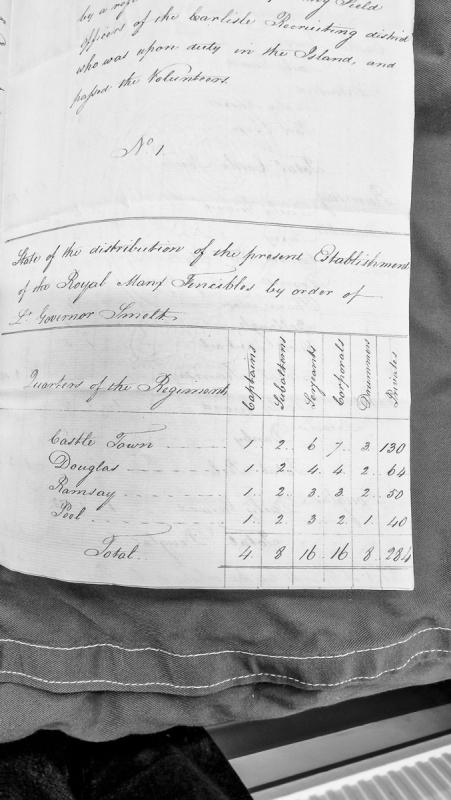
A tabulated revenue abstract showing financial data across four Manx towns (Castle Town, Douglas, Ramsay, and Peel) with columns of numerical values and totals. The document appears to be part of administrative or fiscal records tracking revenue distribution or assessments.
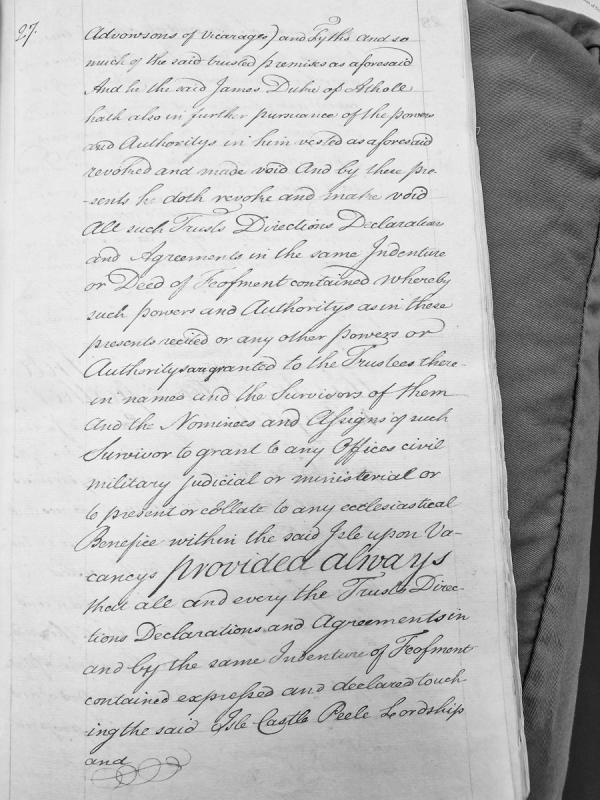
A legal document recording the Duke of Atholl's revocation of trusts, directions, declarations and agreements contained in a prior Indenture of Feofment. The revocation concerns powers to grant offices (civil, military, judicial, ministerial) and to present or collate to ecclesiastical benefices within the Isle of Man, with certain provisions preserved regarding Castle Peel lordship.
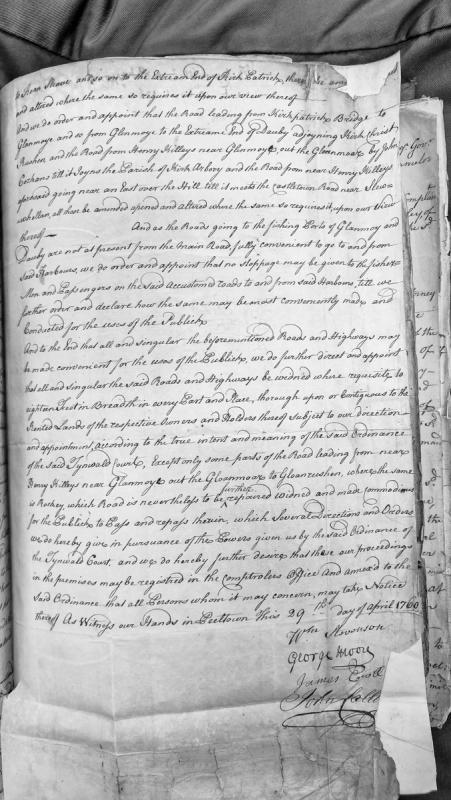
Official order from Tynwald Court officials directing the widening, opening, and repair of various roads in the Kirk Patrick and surrounding parishes to eighteen feet in breadth. The document specifies roads to fishing ports at Glanmoye and Dauby, and ensures no stoppage is given to fishermen and passengers until further notice.
Letter from the Duke of Grafton (Secretary of State) to the Lords Commissioners of the Treasury reporting His Majesty's approval of barracks plans for the Isle of Man, drawn by Engineer Captain Dawson. The King approved the plans except for the removal of stables, as cavalry were being withdrawn from the island. The letter confirms post-Revestment military fortification of the island.
A royal letter patent from Queen Elizabeth I granting assent to the nomination of John Mericke (M.A.) as Bishop of the Isle of Man, following the death of Bishop John Salesbery. The document affirms the Earl of Derby's hereditary right of patronage over the Manx bishopric and directs the Archbishop of York to confirm, consecrate, and invest Mericke. It demonstrates the overlapping jurisdiction of the Crown, the Earl of Derby, and the Church over Man's ecclesiastical affairs.
A dual-language (English and Latin) royal warrant from King Charles I granting assent to the nomination of Richard Parre as Bishop of Man and Sodor. The document confirms the Earl of Derby's patronage rights over the bishopric (granted by Parliament in James I's reign) and directs the Archbishop of York to consecrate and invest Parre. Relevant to understanding Manx ecclesiastical governance and the Crown's relationship with the Island during the Stuart period.
A dual-language (English and Latin) royal writ granting Charles I's assent to the nomination of Richard Parre as Bishop of Man and Sodor. The document records the patronage chain from Parliament through William, Earl of Derby, and directs the Archbishop of York to consecrate and invest Parre. It illustrates the constitutional relationship between the Crown, the Derby family's lordship of Man, and ecclesiastical authority during the 1630s.
A royal letter patent issued by Queen Elizabeth I granting royal assent to the Earl of Derby's nomination of John Mericke as Bishop of the Isle of Man, following the death of the previous bishop John Salesbery. The document affirms the Earl of Derby's hereditary right of patronage over the Manx bishopric and directs ecclesiastical authorities to consecrate and invest the nominee. Presented in both English and Latin (Foedera) versions.
A royal writ issued by Queen Elizabeth I confirming the Earl of Derby's right of patronage over the bishopric of the Isle of Man and granting royal assent to the presentation of John Mericke (M.A.) as bishop. The document establishes that the Earl of Derby's right of nomination and presentation to the bishopric is confirmed by royal authority and reaffirms the Queen's supreme jurisdiction over the island in both ecclesiastical and secular matters.
A formal letter patent from Queen Elizabeth I granting royal assent to the Earl of Derby's presentation of John Mericke (Master of Arts) as Bishop of the Isle of Man. The document affirms the Earl of Derby's hereditary right of patronage and nomination to the bishopric, and commands the Archbishop of Canterbury to confirm, consecrate, and invest Mericke. This source illustrates the Crown's ecclesiastical supremacy over the Isle of Man and the Earl of Derby's feudal rights over the island during the Tudor period.
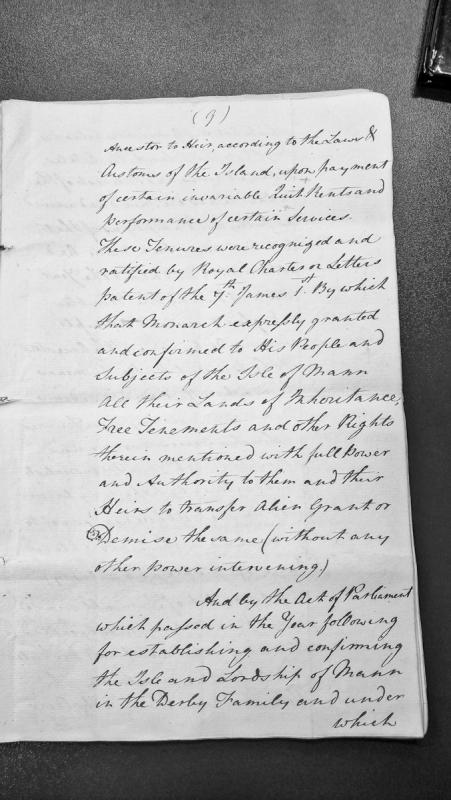
A legal document discussing the historical basis of land tenure in the Isle of Man, referencing a Royal Charter or Letters Patent from James I confirming ancestral inheritance rights, quit rents, and services. It also mentions a subsequent Act of Parliament establishing the Isle and Lordship of Mann in the Derby Family.
A 1610 royal charter (issued under James I) granting Manx subjects and residents the right to transfer, alienate, and demise lands, tenements, and chattels within the Isle of Man by sealed deed, without the ceremonies required in England. Notably permits married women to alienate property with their husband's consent and acknowledgment before the Court of Chancery. Preserves existing Manx property law customs alongside these new concessions.
A Latin charter (De Conciliis et Subditis de Insula Mann) issued by King James I granting property rights and alienation privileges to all subjects and persons residing in or possessing lands in the Isle of Mann. It permits free transfer of lands, tenements, and chattels by sealed deed without additional formalities, and extends these rights to married women with spousal consent and acknowledgment in English Chancery. This document establishes the constitutional and legal framework for property ownership on the Isle, predating the 1765 Revestment and illustrating the Crown's prerogative claims to regulate the island's laws.
A royal charter issued by Edward II protecting Manx men from injury or hindrance when travelling to England and returning home, valid until Christmas 1312. The document is bilingual (English and Latin) and demonstrates early royal recognition of the Isle of Man's distinct status and the Crown's commitment to protect Manx trading interests. Relevant to understanding constitutional protections and early cross-channel commerce.
A bilingual (Latin and English) royal charter issued by Edward II protecting the inhabitants of the Isle of Man from harassment and damage when travelling to or from the island. The document grants safe passage and royal favour to Manx people in recognition of their loyalty and adherence to the English Crown. This early 14th-century charter establishes royal protection of Manx interests and demonstrates the island's feudal relationship with the English monarchy.
A bilingual (Latin and English) royal charter from King Henry III granting King Olave of Mann an annual stipend of forty marks, one hundred crannocks of corn, and five doles of wine in return for guarding the coasts of Ireland and England adjacent to the Isle of Mann. This document demonstrates early medieval recognition of Mann's strategic maritime position and the Crown's reliance on the King of Mann for naval defence.
A charter from Henry III confirming King Olave of Mann and the Islands as guardian of the coasts between England, Ireland, and the Isle of Mann in exchange for annual payment of forty marks, one hundred crannocks of corn, and five doles of wine. The document establishes the King of Mann's early feudal relationship with the English Crown and his strategic role in coastal defence and maritime control.
A royal writ from King John of England commanding his seneschals, governors, and bailiffs in Ireland to assist Reginald, King of Mann, against the Wikini (Norwegian sea rovers) and other enemies. This document illustrates early medieval relations between the English Crown and the Kings of Mann, and the strategic importance of Mann in controlling Irish Sea trade and defence. It is relevant to understanding Mann's constitutional and feudal relationship with England prior to the 1765 Revestment.
A royal writ from King John of England commanding his Irish officials to assist Reginald, King of Mann, against Viking (Wikini) attackers in his territory. The document emphasises Reginald's feudal bond to the English Crown and reciprocal defensive obligations. Provides early 13th-century context for Mann's relationship with the English Crown and Viking threats to the island.
A dual-language (English and Norman French) royal writ from King Edward II commanding the bailiffs and prudent men of Bristol, Portsmouth, Weymouth, Lymington, Wareham, Lyme, Melcombe, and Poole to dispatch well-manned and provisioned naval vessels to the Isle of Man by the octaves of the Assumption of Our Lady. The vessels are to conduct Sir Simon de Montagu (appointed admiral) and the English navy from there to Scotland against the King's enemies. This document illustrates the strategic importance of the Isle of Man as a naval staging post during the Scottish wars.
A royal writ from King John commanding Henry, son of Earl, to release Manx prisoners held at Porchester Castle and report their names and number. A parallel writ was issued to the Sheriff of Salisbury regarding prisoners at Dover. This document records early medieval diplomatic relations between the English Crown and the Kingdom of Mann.
A 13th-century royal writ commanding the delivery of prisoners belonging to Reginald, King of Mann, who were held in custody at Porchester and Dover. This document illustrates early medieval relations between the English Crown and the Kingdom of Mann, predating the 1765 Revestment by over five centuries and providing contextual evidence of Mann's independent status and diplomatic standing.