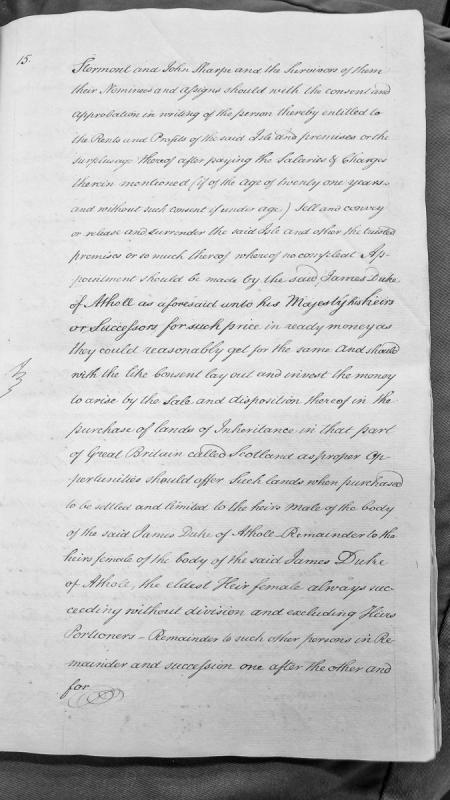
A legal document outlining the conditions under which Stormont and John Sharpe, as trustees and survivors, may sell the Isle of Man and other premises with appropriate consent. The proceeds are to be reinvested in Scottish lands settled on the heirs of James Duke of Atholl, with specific entail provisions favoring male heirs and excluding portioners.
This is a Python script designed to automatically download and archive web-based transcriptions from the Manx Notebook's Manx Society Volume 4 collection. It is not a historical document or source material, but rather a technical tool used to capture primary source transcriptions from the isle-of-man.com domain.
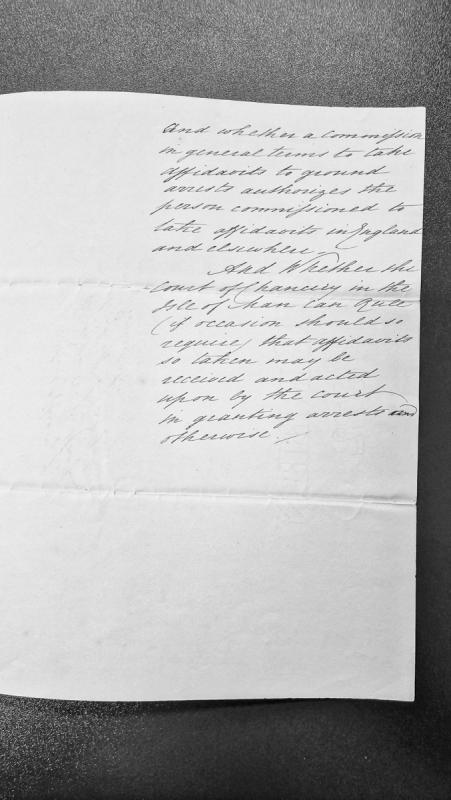
A legal document posing two questions about the scope of a general commission to take affidavits for arrest proceedings: whether such a commission authorizes taking affidavits in England and elsewhere, and whether the Court of Chancery in the Isle of Man can rule on the admissibility of such affidavits in arrest proceedings.
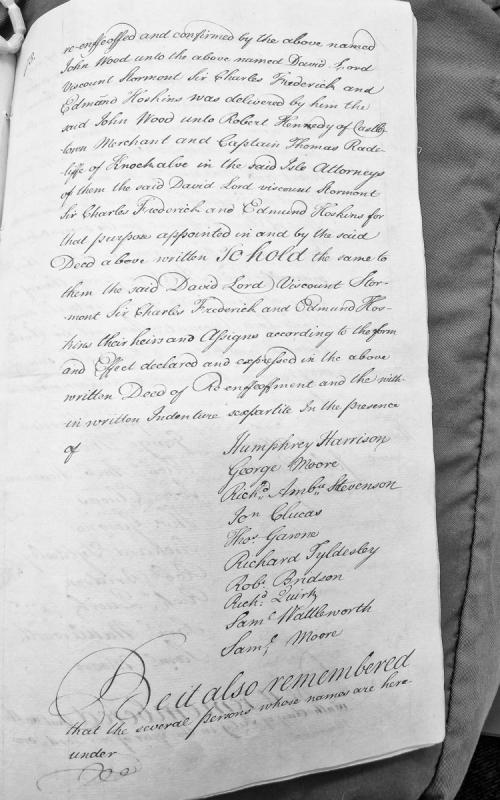
A legal document recording the re-enfeoffment and confirmation of property by John Wood to David Lord Viscount Stormont, Sir Charles Frederick, and Edmund Hoskins. The deed was delivered through attorneys Robert Kennedy and Captain Thomas Radcliffe, with multiple witnesses present on the Isle of Man.
A contemporary newspaper opinion piece published in The Public Advertiser arguing for Crown acquisition of the Isle of Man from the Duke of Atholl. The article details smuggling operations, revenue losses, threats to the East India Company and domestic distillery, and proposes compensation via an annual customs annuity. It references the 1721 Act authorizing Treasury negotiations and draws comparison to the Scottish hereditable jurisdictions purchase.
A contemporary newspaper article from The Public Advertiser (17 August 1754) setting forth arguments for Crown purchase of the Isle of Man from the Duke of Atholl. Focuses on smuggling as the central justification, detailing the scale of illicit trade, revenue losses, impact on the East India Company, and French economic advantage. Directly relevant to understanding pre-Revestment political arguments.
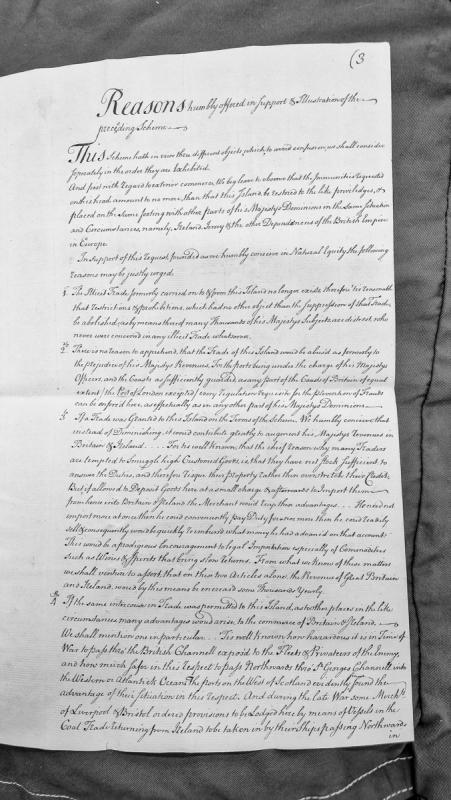
A formal petition presenting reasoned arguments for granting the Isle of Man trade privileges equivalent to other British dependencies such as Ireland and Jersey. The document addresses four main points: the cessation of illicit trade, effective revenue protection, potential increase in British revenues, and strategic commercial advantages during wartime.
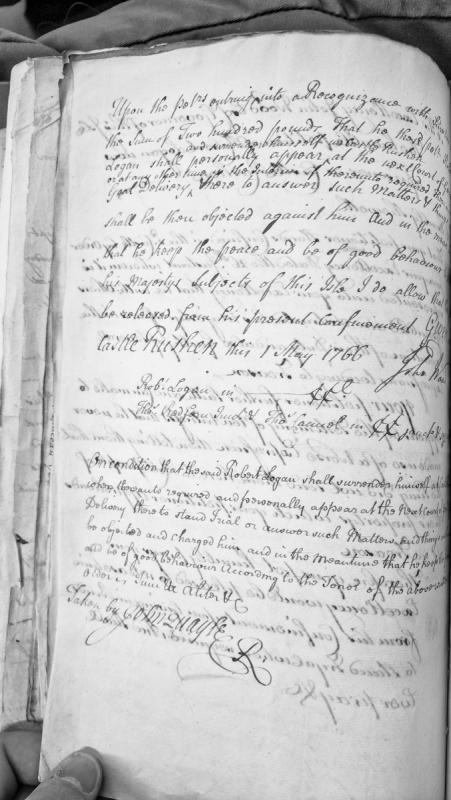
A recognisance document recording Robert Logan's bond of £200 for his release from confinement in Castle Rushen. Logan is bound to appear at the next Court of General Delivery and to keep the peace. Two sureties (Thomas Redfan and Thomas Camel) are named as indictors, each bound in £50.
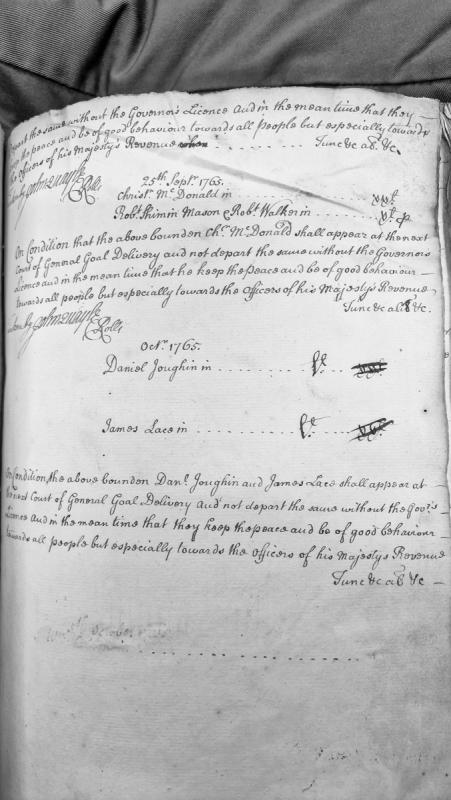
A series of recognisance bonds requiring individuals to appear at the next Court of General Gaol Delivery and keep the peace, with special regard for officers of His Majesty's Revenue. Multiple recognisances are recorded, dated September and October 1765, with sureties named.
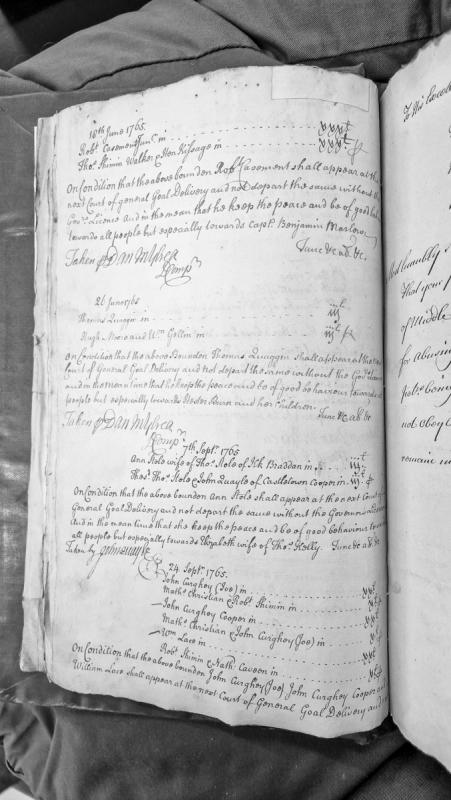
A collection of bonds and recognisances binding several individuals to appear at the next Court of General Gaol Delivery and keep the peace. Multiple entries dated June to September 1765 record sureties and conditions for Robert Casement, Thomas Quaggin, Ann Stole, John Curghoy, and William Lace, with specific peace-keeping requirements towards named individuals.
A Manx administrative record documenting complaints about damage to equipment and theft at works at Santan (Ashold, later Newtown), with testimony from witnesses and fines imposed on Henry Crebbin and Jo Callin. The document provides evidence of local governance and property disputes in early 18th-century Mann, with editorial annotations identifying later place-name development and notable burials.
A bilingual (English/Latin) record of oaths of fealty sworn to King Edward I of England by Scottish clergy, nobility, and communities in 1291, including notable figures such as Maria, Queen of Man. The document is part of Monumenta de Insula Manniae (vol. 2) and demonstrates the overlapping jurisdictions and relationships between England, Scotland, and the Isle of Man during the medieval period, relevant to understanding pre-Revestment territorial claims.
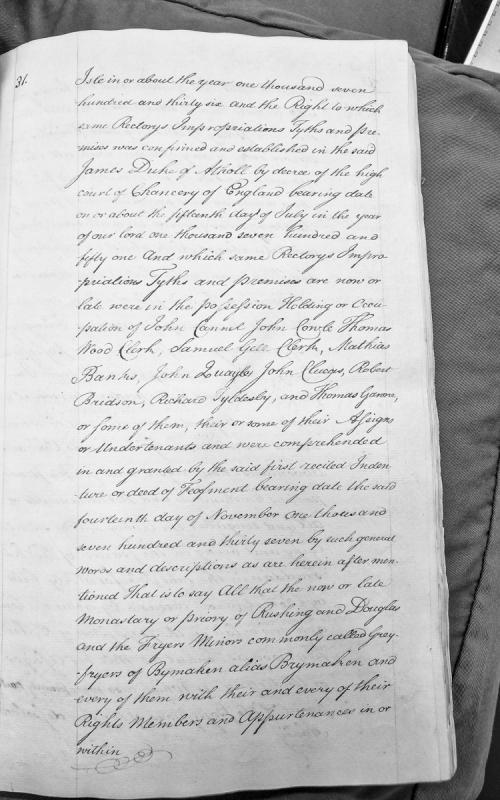
Fragment of a legal document concerning rectory impropriations, tithes and premises in the Isle of Man. References a 1751 Chancery decree confirming rights to James Duke of Atholl, and lists multiple tenants and occupiers of monasteries and friaries including those at Rushen and Douglas.
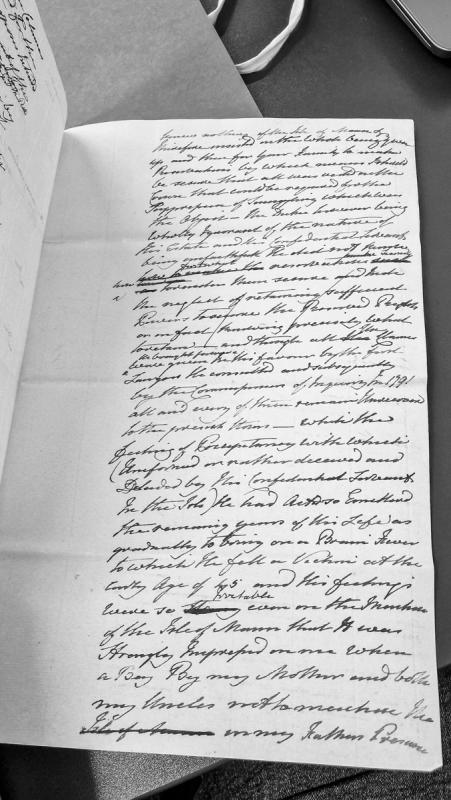
A fragmentary personal account describing the Duke's ignorance of his Isle of Man estate, the unfaithfulness of his confidential servants, and failed attempts to suppress smuggling. The narrator recounts how the Duke's frustration and feelings of incompetency led to illness and death at age 45, and the lasting emotional impact on the narrator's family.
A comprehensive chronological listing of British military regiments and detachments stationed on the Isle of Man from 1765 to 1896, with documentary evidence from Manx newspapers, census returns, and parish records. The document traces the shift from no British garrison pre-Revestment to permanent military presence post-1765, including Fencible forces, Royal Veterans, and line regiments. It is directly relevant to understanding the military occupation and control mechanisms following the 1765 Revestment.
A comprehensive chronological list of British military regiments and detachments stationed on the Isle of Man from the 1765 Revestment through 1896, compiled from newspaper reports, census records, parish registers, and historical sources. Includes recruitment areas, commanding officers, and notes on troop movements, accommodations, and local impacts.
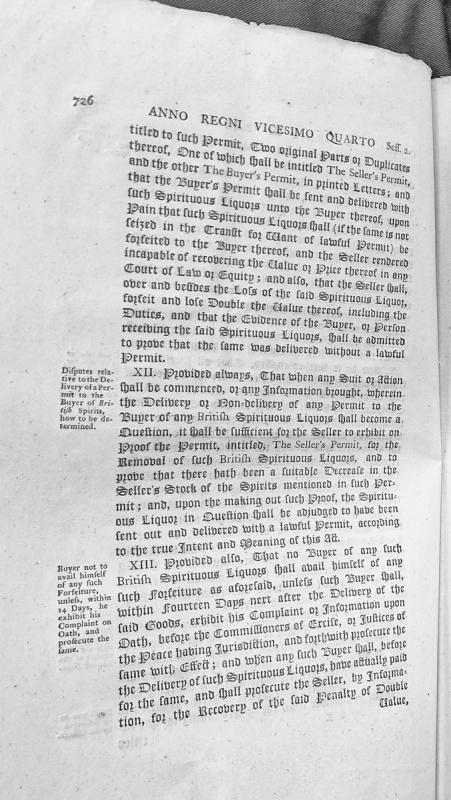
This is a legislative excerpt (page 726) from an Manx act regulating the sale and delivery of British spirituous liquors. It details the requirements for seller's and buyer's permits, penalties for non-compliance, procedures for dispute resolution, and conditions under which buyers may claim forfeitures. The text appears to be from the 24th year of a royal reign, session 2.
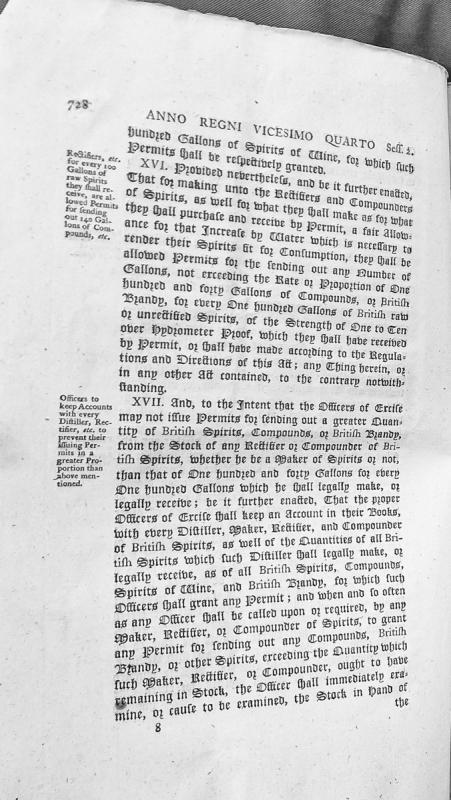
This is an excerpt from legislation (sections XVI and XVII) governing the permit system for spirits rectification and compounding. It establishes that rectifiers and compounders may issue permits for spirits at a ratio of 140 gallons of compounds per 100 gallons of raw spirits received, accounting for necessary dilution with water. It further requires excise officers to maintain detailed accounts with distillers, rectifiers, and compounders to prevent over-issuance of permits.
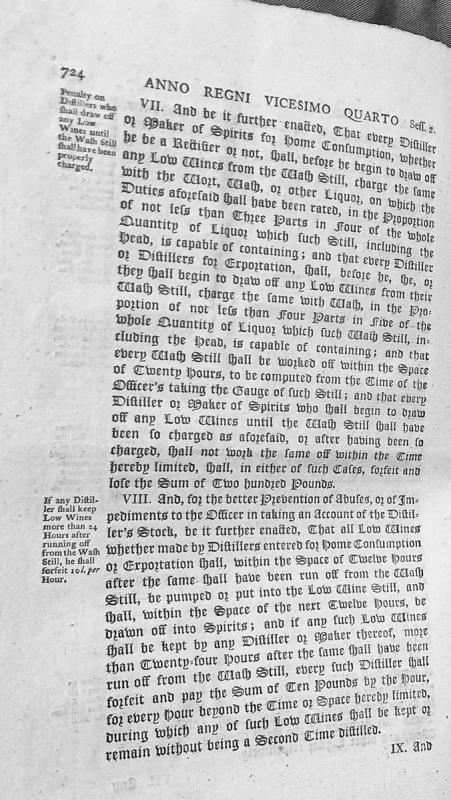
This is a legislative text (sections VII-IX) regulating the distillation of spirits in the Isle of Man, specifying minimum liquid charges for wash stills, time limits for working off stills, and penalties for non-compliance. It imposes strict requirements on how low wines must be handled after separation from the wash still, with substantial financial penalties for violations.
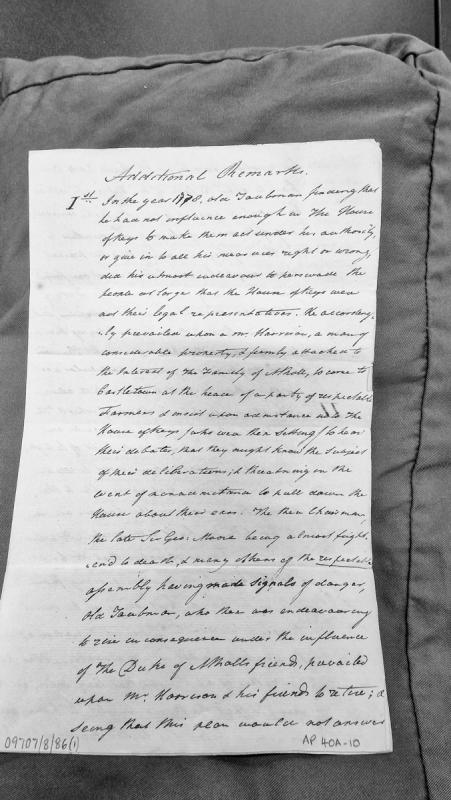
A historical account describing events in 1778 when Taubman allegedly persuaded Mr. Harrison and farmers to demand admission to House of Keys sessions to observe debates, threatening violence if denied. The incident involved Sir George Moore as Chairman and appears to document political tensions regarding representation and authority on the Isle of Man.
Official response from Carlisle customs officers John Norman and William Wilson to a Parliamentary or ministerial inquiry about smuggling trade between the Isle of Man and Great Britain. The letter reports on armed smuggling gangs operating in the Borders, describes a specific incident in June 1764 near Hayton Castle involving 40 horse-loads of brandy and tea, and recommends military deployment to suppress the trade.
A letter from Carlisle customs officials John Norman and William Wilson responding to instructions to investigate the smuggling trade between the Isle of Man and Great Britain. The letter reports on smuggling activities in the Scottish Borders, violent encounters with armed smugglers, and recommends military intervention to suppress the trade.
Report from Dublin customs authorities (Ponsonby, Bourke, Trevor, Burton) to the Lord Lieutenant responding to an enquiry about smuggling between the Isle of Man and Ireland. Details the geography, personnel, vessels (wherries from Rush), contraband goods (tea, brandy, tobacco, East India goods), enforcement measures, and estimated revenue loss. A key document on the operational scale of the smuggling trade and official Irish response.
Official response from Lancaster Customhouse officers (Foxcroft and Smethurst) to enquiries about trade and smuggling from the Isle of Man. Reports minimal direct trade from Lancaster to Mann, notes vessels bound for Africa call at the island for India goods imported from Holland, and directs enquiries to Liverpool and Whitehaven ports as better sources of intelligence on Manx trade. Directly relevant to understanding smuggling networks and inter-port communication before the 1765 Revestment.
Official response from Lancaster Customhouse officers (Robert Foxcroft, Collector, and J. Smethurst, Deputy Comptroller) to enquiries about trade and goods imported into the Isle of Man. The officers report minimal direct trade from Lancaster to Man, note that India and other goods are imported via Holland, and suggest Liverpool and Whitehaven as better sources for information on Manx import duties and trade patterns.