A 1607 petition submitted to the Crown concerning the succession to the Isle of Man following the death of Ferdinando, Earl of Derby. The petition traces the Stanley family's 200-year tenure under a grant from Henry IV, details the dispute between William (heir male) and Ferdinando's three daughters (heirs general), and complains that the Attorney General has challenged the original grant on technical legal grounds, preventing the rightful heirs from taking possession.
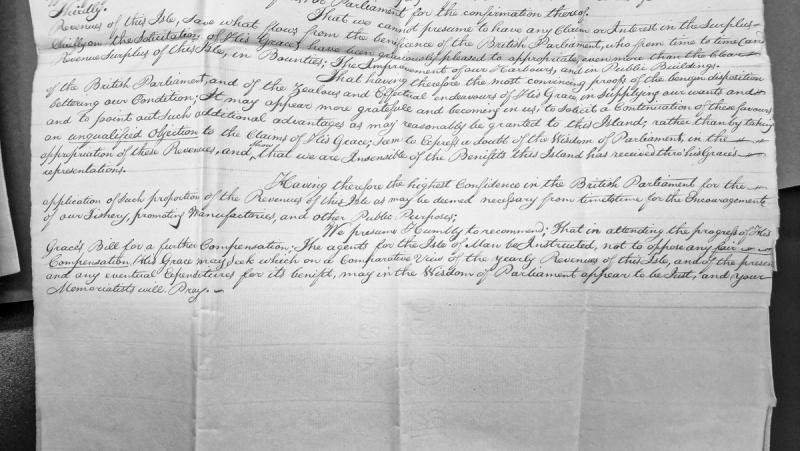
This petition addresses the Isle of Man's relationship with British Parliament regarding revenue appropriation and compensation. It expresses gratitude for parliamentary support and recommends that agents for the Isle of Man not oppose fair compensation claims, deferring to Parliament's wisdom on matters of revenue allocation and public improvements.
A two-part petition from J. F. Cosnahan to the Duke of Atholl dated March 1817, seeking intercession with the Prince Regent for remission of John Bean Hannay's seven-year transportation sentence for violation of slave trade abolition acts. Hannay, a young Manxman, had assisted in transporting slaves whilst serving as mate and later captain of a vessel. The petition emphasizes his youth, inadvertence, and family hardship (widowed mother with six daughters; loss of his brother at sea). A second letter follows, noting plans for a petition signed by Liverpool merchants. Includes genealogical and contextual annotations identifying the Hannay family and related individuals.
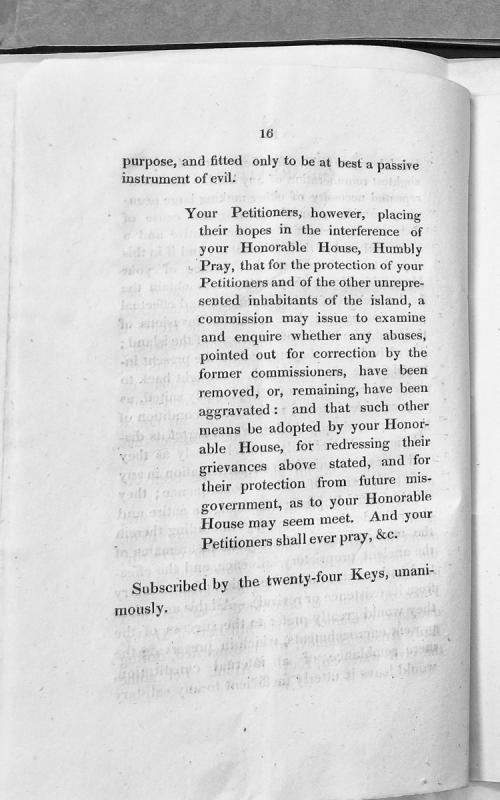
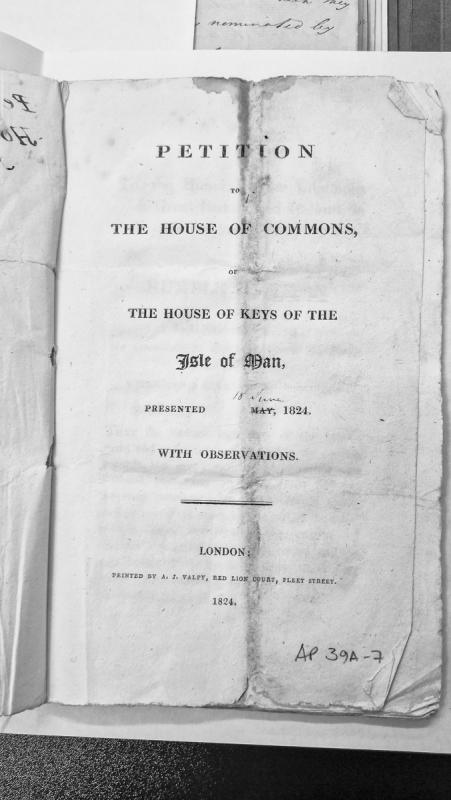
A petition from unrepresented inhabitants of the Isle of Man, subscribed unanimously by the twenty-four Keys, requesting the House of Keys to issue a commission to examine whether abuses previously pointed out have been removed or aggravated, and to adopt means to redress grievances and prevent future misgovernment.
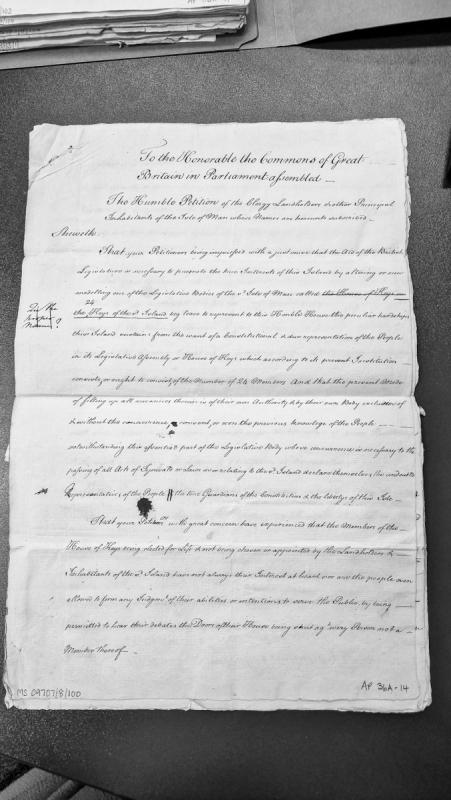
A petition from clergy, landholders, and principal inhabitants of the Isle of Man to the British Parliament requesting legislative intervention to reform the House of Keys. The petitioners criticize the lack of constitutional representation, the self-electing nature of the body's membership, and the lifetime tenure of its 24 members, arguing these practices exclude the people from participation and accountability.
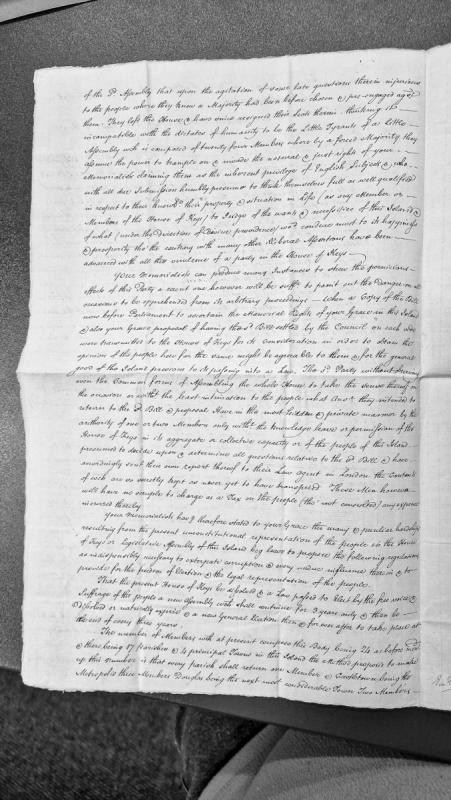
A petition to the Duke of Atholl (addressed as 'your Grace') from memorialists complaining of arbitrary conduct by a factional majority in the House of Keys, their resignation in protest, and proposals for electoral reform including dissolution of the current 24-member assembly and establishment of a new body elected by the people's free voices with a three-year term.
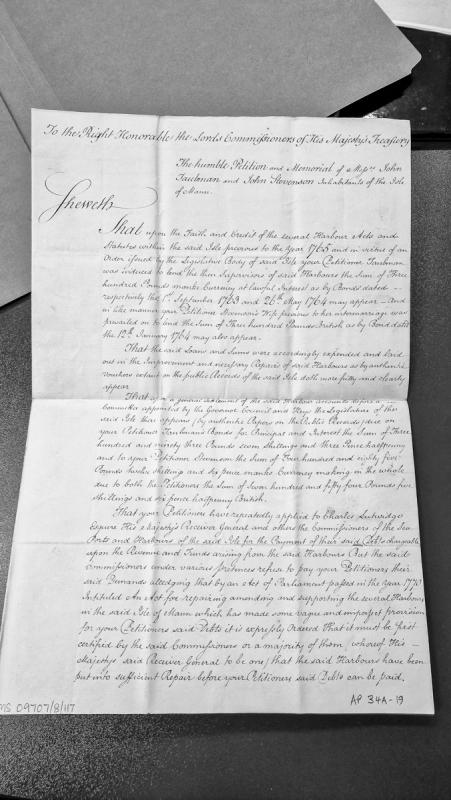
A petition to the Lords Commissioners of His Majesty's Treasury from John Taubman and John Stevenson, inhabitants of the Isle of Mann, seeking payment of loans made to harbour supervisors in 1763-1764. The petitioners claim approximately £754 5s 6½d is due for principal and interest, but commissioners refuse payment pending harbour repair certification under the 1770 Harbour Act.
Two petitions and memoranda documenting a dispute over land enclosure near Douglas Fort. Brew and Kelly, contractors hired by Charles Killey to wall an intack belonging to George Moore, seek legal recourse after Governor Cochrane ruled an encroachment had been made on ducal property. The documents reveal tensions between petitioners, the Governor, the Attorney General, and the Deemster, illustrating Manx legal procedure and the vulnerability of property holders to gubernatorial discretion.
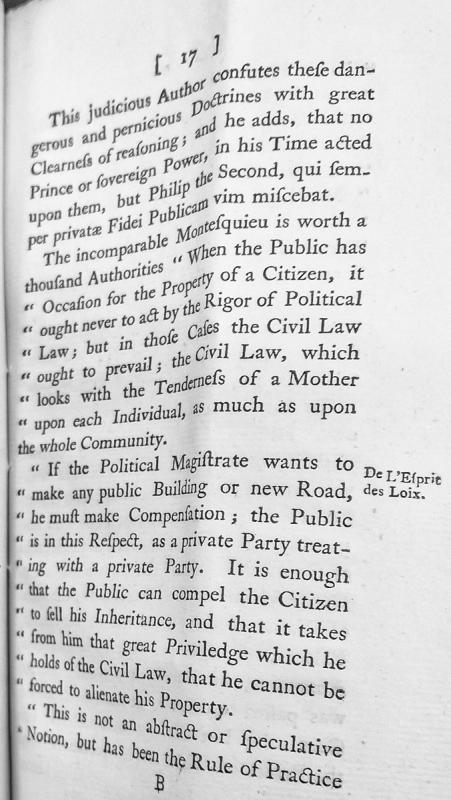
A printed philosophical text discussing doctrines of state authority over private property. The author critiques dangerous theories through reasoning, citing Philip II as an example, and extensively quotes Montesquieu's L'Esprit des Loix on the distinction between political and civil law in matters of eminent domain and compensation.
Extract from Pliny the Elder's Natural History (Book IV, Section XXX) describing Britain, Ireland, and surrounding islands including references to Mona (Isle of Man). Includes parallel Latin and English text. Relevant to understanding pre-medieval geographical and classical knowledge of the Isle of Man and its position in relation to Britain.
Extract from Pliny the Elder's Natural History (A.D. 23) describing Britain, Ireland, and surrounding islands including Mona (identified as the Isle of Man in footnote). Provides Roman geographical knowledge of the British Isles, distances, circumferences, and neighbouring islands. Includes parallel Latin text from Caius Plinius Secundus.
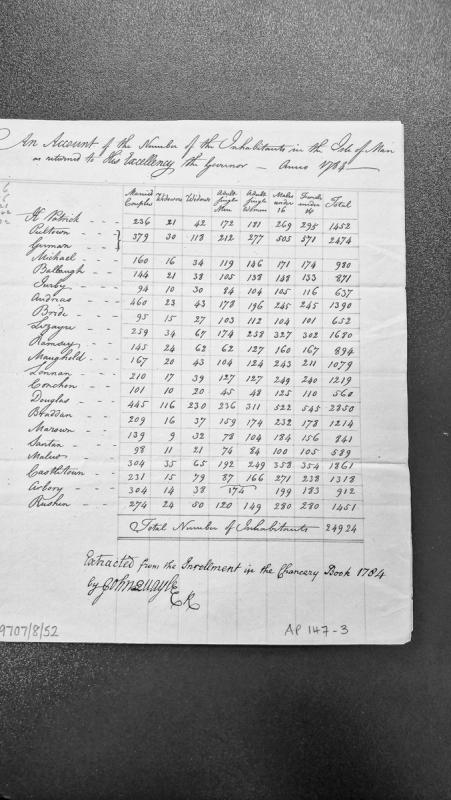
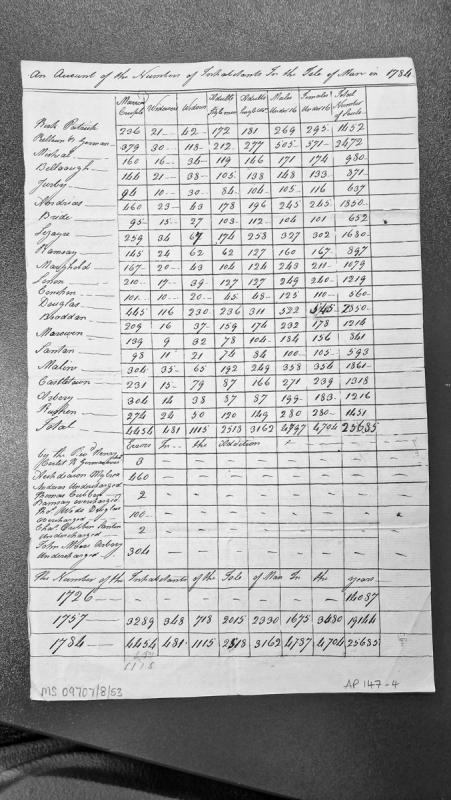
A tabular population census extracted from the Chancery Book Inrollment for 1784, listing the number of inhabitants across all Manx parishes. The document provides a comprehensive enumeration of the population distributed across 20 parishes, with a total of 24,924 inhabitants recorded across multiple columns (possibly representing different age groups, genders, or administrative categories).
A tabulated population census for the Isle of Man organized by parish, showing numerical data across seven columns with a total of 25,635 inhabitants recorded in 1784. The document includes noted corrections for errors in addition and transcription discrepancies identified by various clergy and officials.
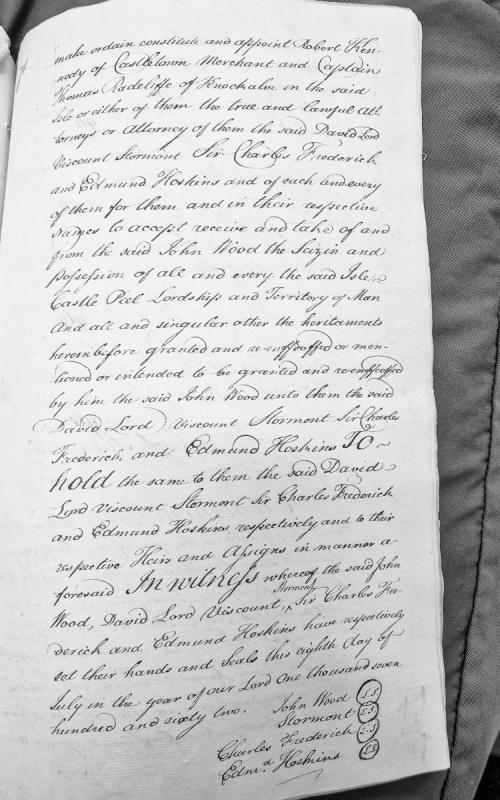
A legal instrument appointing Robert Kennedy and Captain Thomas Radcliffe as attorneys for David Lord Viscount Stormont, Sir Charles Frederick, and Edmund Hoskins to accept seizin and possession of the Isle of Man, Peel Castle, and associated lordship and territory from John Wood. Signed and sealed by all four principal parties on 8 July 1762.
Preface to a 1965 popular history of the 1765 Revestment Act, outlining the scope and structure of the work. Covers smuggling, constitutional issues, compensation disputes between the Atholls and Crown, and enforcement of the Act. Acknowledges reliance on contemporary newspapers and official documents.
Preface to a 1965 popular history of the 1765 Revestment Act. Outlines the scope of the work: examination of causes and effects of the Act, the smuggling trade, constitutional conditions, and enforcement. Notes that legal battles between the Dukes of Atholl and the Crown extended over 25 years with compensation approaching £500,000. Acknowledges archival and museum sources.
Preface to an early 19th-century descriptive and historical account of the Isle of Man, covering its geography, constitution, laws, and history. The author discusses the scarcity of reliable published works on Mann and references Nathaniel Jefferys' 1808 competing publication. Relevant for understanding contemporary perceptions of Manx exceptionalism and constitutional uniqueness post-Revestment.
Preface to a historical work on the Stanley family published in 1864. The volume compiles chapters originally serialised in the Ormskirk Advertiser and includes additional notices on various Stanley properties and family branches. Relevant to the Revestment project as the Stanleys were major landowners with connections to Isle of Man affairs and the ducal interests involved in the 1765 transaction.
Editorial preface to a scholarly collection of historical documents relating to the Isle of Man, compiled by J. R. Oliver. Discusses the scope and sources of the collection (Patent Rolls, Close Rolls, monastic records, charters), the challenges of archival research, and the loss of historical documents. Includes discussion of the Chronicon Manniae manuscript and acknowledgments of archival contributors.
Editorial preface to a 19th-century collection of historical documents relating to Isle of Man. Discusses manuscript sources, archive locations (Record Office Fetter Lane, British Museum, Duchy of Lancaster), the condition and loss of early records, and provides scholarly context for the Chronicon Manniae and other primary sources. Identifies key repositories and limitations of surviving documentation.
A formal petition from Presbyterians resident in the Isle of Man, dated August 1763, requesting the Duke of Atholl's permission to establish a Presbyterian minister on the island. The petitioners emphasize their loyalty, their harmonious relations with the established Church, and the lack of opposition from civil or ecclesiastical officials. This document reflects religious governance, toleration policy, and the Duke's authority over the island two years before the Revestment.
A formal petition from Presbyterian residents of Isle of Man (primarily Douglas) to James, Duke of Atholl, requesting his consent to employ a Presbyterian clergyman. The signatories had formed articles of agreement for the minister's subsistence and sought recommendations from Scotland. The document illustrates religious toleration and community organisation on the island prior to the 1765 Revestment.
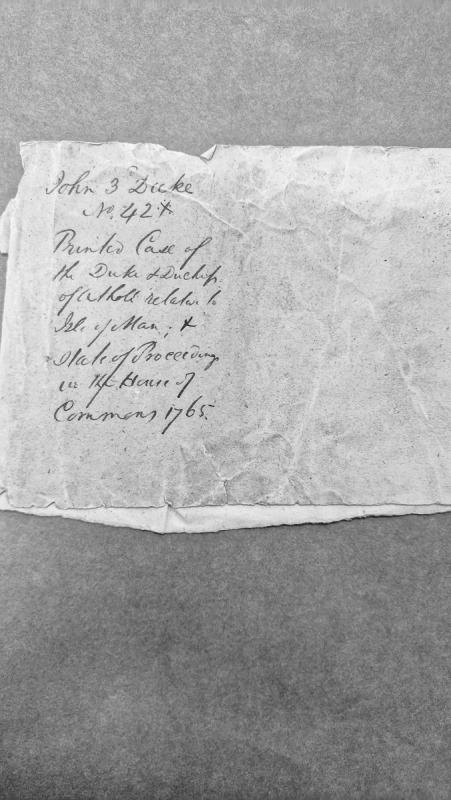
A printed pamphlet presenting the case of the Duke and Duchess of Atholl regarding their interests in the Isle of Man, accompanied by documentation of proceedings in the House of Commons during 1765. This appears to be a formal legal publication of proceedings and arguments related to Atholl family claims.
A printed work produced by the London printer A. J. Valpy at Red Lion Court, Fleet Street in 1824. The document appears to be a title page or colophon indicating the printer and publication location.
Historical account of the Priory of St. Bee's in Copeland, Cumberland, detailing its founding (c. 650), reconstruction under Henry I, and its holdings including lands in the Isle of Man. The prior held baronial status in Man and was obliged to attend the king and lords of the island. The text documents ecclesiastical landholding patterns relevant to understanding Man's feudal structures before the 1765 Revestment.