A papal letter (A.D. 1224) from Pope Honorius III to the Archbishop of York regarding Bishop Nicholas of Mann and the Isles, who had been forced into exile and sought permission to resign his bishopric. The letter grants authority to the Archbishop to permit the resignation if circumstances warrant. Presented in both English translation and original Latin (from Vatican records).
A papal bull from Pope Honorius III (anno vii, epistola 164) addressed to King Reginald of Man, confirming his donation of the Isle of Man to the Roman Church in fee, with an annual rent of twelve marks sterling payable to Furness Abbey. The letter establishes ecclesiastical sovereignty and feudal obligation, providing historical context for ecclesiastical claims over Mann before secular revestment.
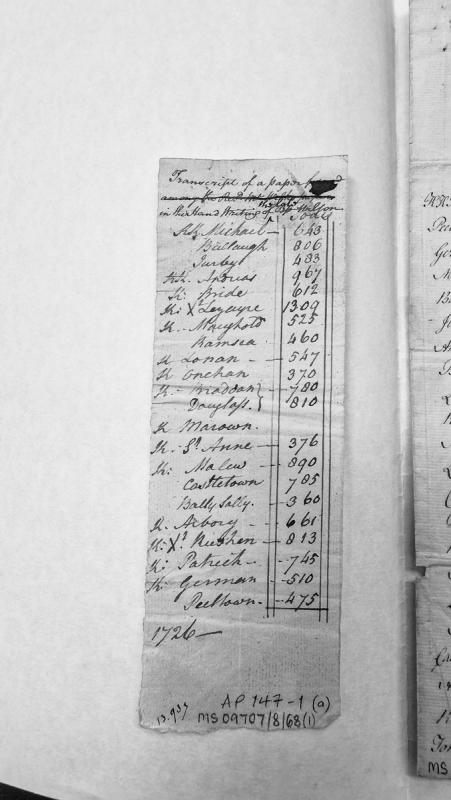
A tabulated list of soul counts (population figures) for twenty parishes across the Isle of Man, dated 1726. The document is noted as being in the handwriting of the late Mr Wilson and appears to be part of a larger administrative or ecclesiastical record.
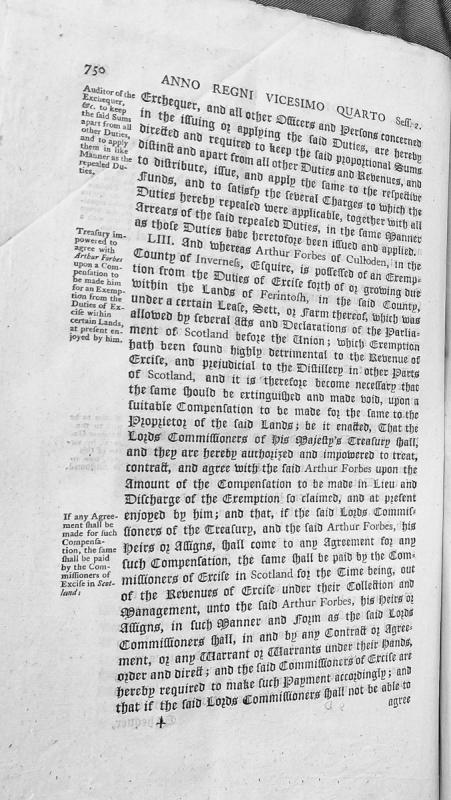
This is an excerpt from a parliamentary statute (Anno Regni Vicesimo Quarto, Session 2) dealing with the distribution of excise duties and authorising the Treasury to negotiate compensation with Arthur Forbes of Culloden for the extinction of his exemption from excise duties on the lands of Ferintosh in Scotland. The document outlines procedures for handling duty revenues and payment mechanisms through the Scottish Excise Commissioners.
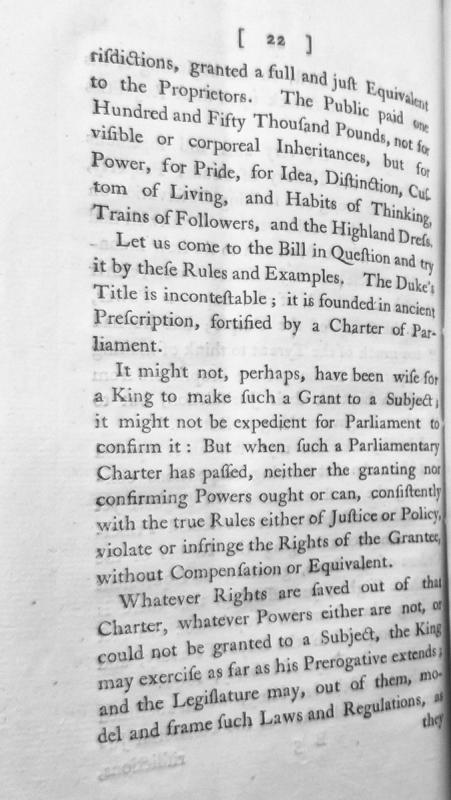
A legal or parliamentary opinion discussing the inviolability of rights granted by parliamentary charter, using historical examples of compensation (Act of Union with Scotland, Highland estates). The document argues that parliamentary grants to subjects cannot be violated without compensation, and discusses the limits of royal prerogative and legislative power.
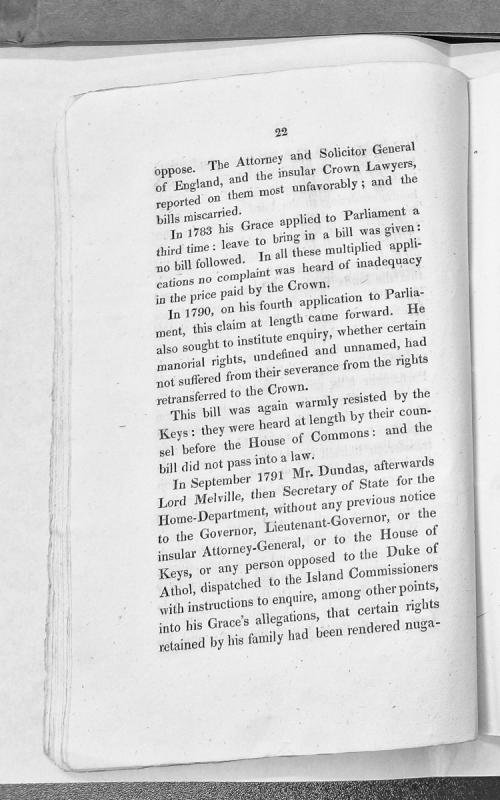
This is a historical narrative account describing the Duke of Athol's multiple parliamentary applications (1783-1790) regarding compensation for Manx property rights and manorial rights transferred to the Crown. It documents parliamentary resistance from the House of Keys and subsequent government inquiry commissioned by Mr. Dundas in September 1791.
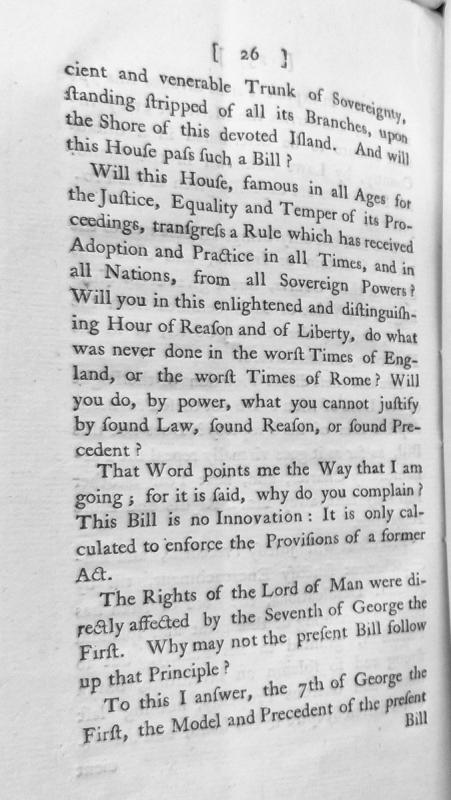
This is an excerpt from a parliamentary or legislative debate regarding a proposed bill that would affect the rights of the Lord of Man. The speaker questions whether the House will pass unprecedented legislation that violates established legal principles and precedents, referencing the 7th of George the First as a prior legal foundation.
Published compilation of House of Lords and House of Commons debates from January–May 1806, covering major political issues including the Melville impeachment, naval votes of thanks, military establishments, Indian affairs, slave importation, and American intercourse. While not directly about the Isle of Man Revestment (1765), this record documents the parliamentary culture, procedure, and key figures active four decades later.
Official record of debates in both Houses of Parliament during the fifth session of the seventh Parliament of the United Kingdom (George IV), 3 February–29 March 1824. Includes King's Speech, debates on trade, revenue, slavery, game laws, Irish affairs, East India Company monopoly on tea, and notably a debate on the Criminal Judicature of the Isle of Man (18 Feb 1824, with minority list on 18 Feb). Primary source for understanding contemporary Parliamentary attitudes toward colonial and domestic governance.
Published compilation of Parliamentary debates from April 22 to July 28, 1828, covering House of Lords and Commons proceedings during the reign of George IV. Includes debates on Corn Laws, Corporation and Test Acts Repeal, Roman Catholic Claims, East India Company trade matters, and administrative/constitutional issues. Relevant to Revestment project as comparative context for Westminster legislative procedure and contemporary political pressures.
Hansard's Parliamentary History Vol. XVI covering debates in both Houses from 14 November 1826 to 22 March 1827. Contains King's Speech (21 Nov 1826), debates on Corn Laws, Roman Catholic Emancipation, emigration, trade, and navigation laws. Primary source record of contemporary Parliamentary proceedings during a period immediately after the 1765 Revestment era but relevant for understanding constitutional procedures, commercial regulation, and colonial/trading policy.
Official record of House of Lords and House of Commons debates for the Fourth Session of the Seventh Parliament (George IV), covering May 1 to July 19, 1823. Includes debates on commercial policy, Irish affairs, legal reform, and currency issues. Contains parliamentary papers, petitions, and voting lists. While not directly about the Isle of Man Revestment (1765), it documents parliamentary procedure and trade policy relevant to understanding post-Revestment colonial and commercial governance.
Official record of debates in both Houses of Parliament during the 1825 session (February–July), covering Roman Catholic Claims, Corn Laws, Game Laws, Colonial Intercourse, Customs Consolidation, and other major legislative topics. Includes table of contents, division lists, and King's speeches.
Official record of debates in both Houses of Parliament during the Seventh Session of the Seventh Parliament of the United Kingdom (2 February–17 March 1826). Contains King's Speech, House of Lords and Commons debates on currency, banking, corn laws, Ireland, East India Company operations, slavery, and commercial distress. Hansard's continuation series covering political and economic crises of the period.
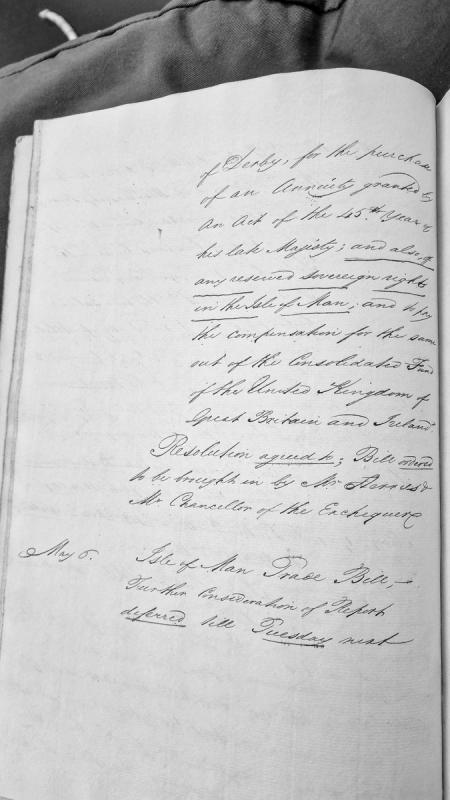
Fragment of parliamentary proceedings discussing the purchase of an annuity for the Earl of Derby granted under an Act from the 45th year of the late Majesty's reign, and the compensation for reserved sovereign rights in the Isle of Man to be paid from the Consolidated Fund. Includes resolution and notes on further consideration of the Isle of Man Trade Bill.
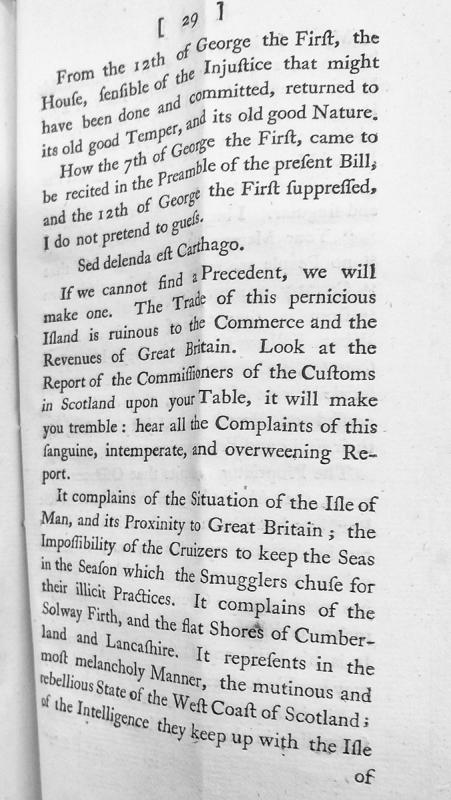
This is page 29 of a printed parliamentary speech or pamphlet discussing the Isle of Man's role in smuggling and its impact on British commerce. The speaker critiques a bill referencing the 7th of George the First while suppressing the 12th, and cites a Report of the Commissioners of the Customs in Scotland detailing the island's proximity to Britain and the difficulty of preventing smuggling activities on the west coast.
This document is a meta-analytical review of three draft chapter frameworks (Ch 22-24) for Part IV of a research project on the 1765 Isle of Man Revestment. It assesses source readiness, identifies verification gaps, and reports on discovery of primary sources including Bacon's 1606 naturalization speech from Cobbett's Parliamentary History Vol. I and Mills' Ancient Ordinances containing the 1609 Letters Patent and 1610 Act of Parliament. The document combines framework assessment with forensic validation of coordinate sovereignty thesis.
This is a working editorial/research document compiled during manuscript development, not a primary historical source. It documents planning discussions for Part IV of a book on the 1765 Isle of Man Revestment, including chapter outlines, primary source identification needs, and synthesis of evidence already gathered from Parts I–III. The document traces evidence of parliamentary retrospective admissions (1790–1829) regarding the coercive nature and legal questionability of the 1765 transaction.
A transcription of Royal Letters Patent from 1607 granting sovereignty of the Isle of Man, its castle, and regalities to Henry Earl of Northampton and Robert Earl of Salisbury. The grant was made at the petition of William Earl of Derby and other heirs of Ferdinando Earl of Derby. This document is a foundational record of early modern Manx lordship and demonstrates the mechanisms of royal grant and feudal tenure that preceded the 1765 Revestment.
A transcription of a 1585 patent roll entry recording Queen Elizabeth I's grant to Thomas Preston of the Rectories of St. Michael and St. Maughold in the Isle of Man, with associated lands and revenues, held on a 31-year lease at £6 13s. 4d. annual rent. This document illustrates early Tudor administration of Isle of Man ecclesiastical property and revenue sources.
A transcription of a 1606 Crown patent granting a 40-year lease of the dissolved monasteries of Rushen and Douglas in the Isle of Man to Sir Thomas Leigh Knightly and Thomas Spencer. The document records the fine (£101 15s. 11d.) paid to the Exchequer and identifies reserved Crown rights including woods, wardships, marriages, mines and quarries. Relevant to understanding pre-Revestment Crown sovereignty over Manx ecclesiastical and secular properties.
A transcription of a Crown patent (Letters Patent) leasing the former monasteries and priories of Rushen and Douglas on the Isle of Man to Sir Thomas Leigh Knightly and Thomas Spencer for forty years, with reserved rights over woods, wardships, mines and quarries. This document illustrates early modern Crown property management on Man and the post-Reformation disposition of ecclesiastical lands.
Extract from the Irish Chancery Patent Rolls (Rotulorum Patentium et Clausorum Cancellariae Hiberniae) recording the King's commitment of the Isle of Man to John de Athy's custody during pleasure (dated 6 July 1318, 10 Edward II). Also records a grant of permission to the Abbot of Ives in Ulster to visit the Abbey of Rushen in Man. Relevant as early medieval evidence of English crown administration over the Isle of Man prior to the Revestment period.
Two royal grants from the Patent Rolls of the Irish Chancery (11 Edward II, 1318): the appointment of John de Athy as custodian of the Isle of Man, and permission for the Abbot of Ives in Ulster to visit the Abbey of Ruysshyn on the island. These documents illustrate early medieval governance and ecclesiastical links between Ulster and Man.
Extract from Paulus Orosius's historical account (Historiae adversum Paganos, Book I), describing the geography of Britain and surrounding islands including Mevania (the Isle of Man). Presented in both English translation and original Latin, with editorial annotations. A foundational classical source for early references to the Isle of Man by name.