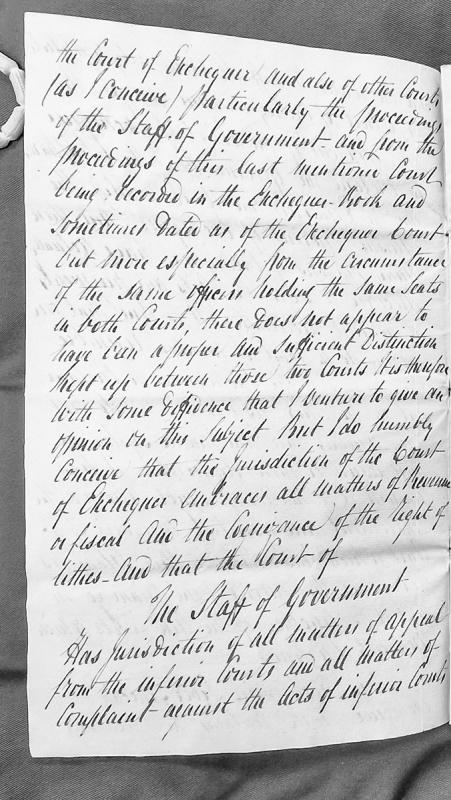
A legal opinion discussing the jurisdictional distinctions between the Court of Exchequer and the Staff of Government court in the Isle of Man. The author expresses uncertainty about the proper separation of these courts, noting that officers hold seats in both and proceedings are sometimes recorded interchangeably in the Exchequer Book. The opinion concludes that the Court of Exchequer has jurisdiction over revenue and fiscal matters including tithes, while the Staff of Government has jurisdiction over appeals and complaints against inferior courts.
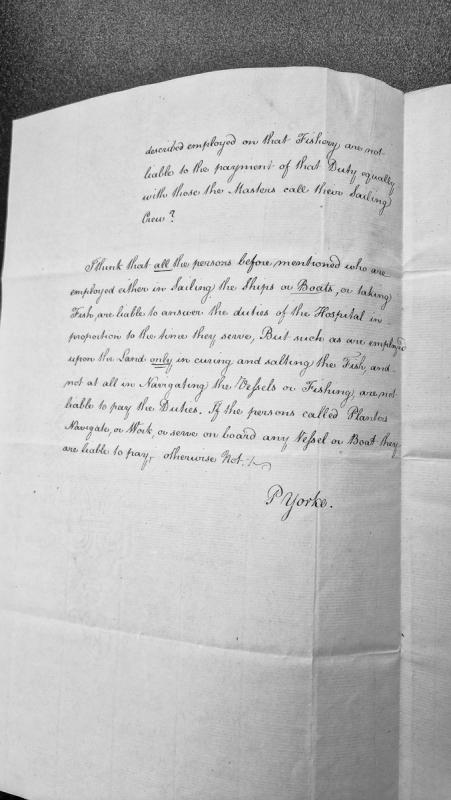
A legal opinion addressing the question of whether certain workers employed in the Manx fishery, particularly those involved in curing and salting fish on land versus sailing and fishing at sea, are liable to pay Hospital duties. The opinion clarifies that only those engaged in sailing vessels or fishing are liable, while those employed solely in land-based processing are exempt.
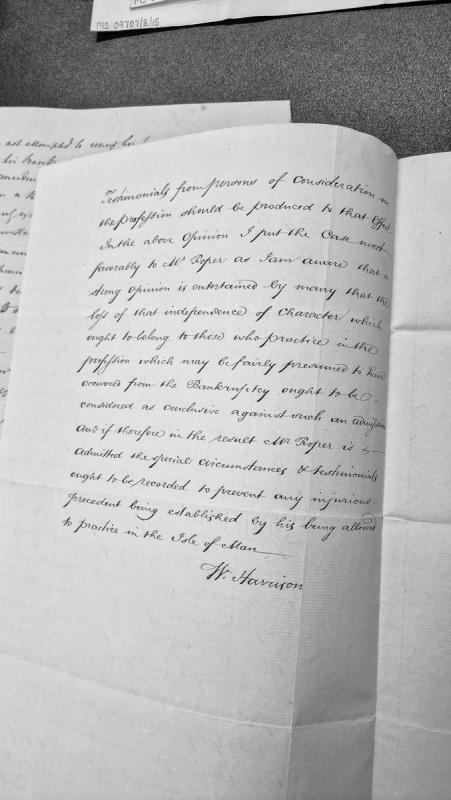
A legal opinion regarding the admission of Mr Roper to practice his profession following bankruptcy. The opinion discusses the loss of professional independence resulting from bankruptcy and recommends that if admission is granted, special circumstances and testimonials should be recorded to prevent establishing a problematic precedent in the Isle of Man.
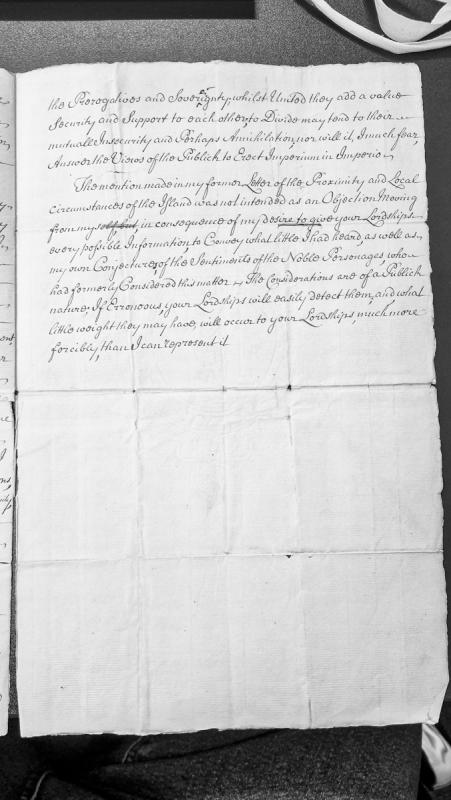
A fragment of correspondence discussing constitutional matters concerning the Isle of Man's sovereignty and prerogatives. The writer cautions against dividing authority (imperium in imperio) and emphasizes the importance of unity for security. The passage references a former letter and discusses local circumstances and sentiments of noble personages previously considering the matter.
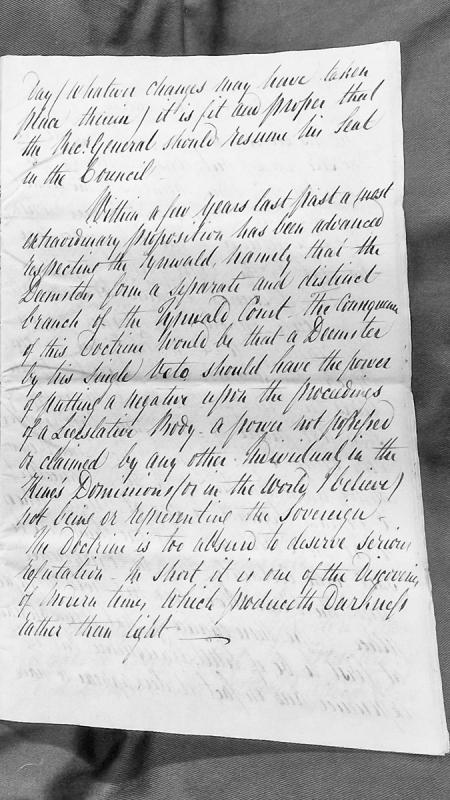
A legal opinion discussing the proper role of the Receiver General in the Manx Council and refuting a recent proposition that Deemsters form a separate branch of the Tynwald Court with veto powers. The author argues this doctrine is absurd and contrary to principles of governance.
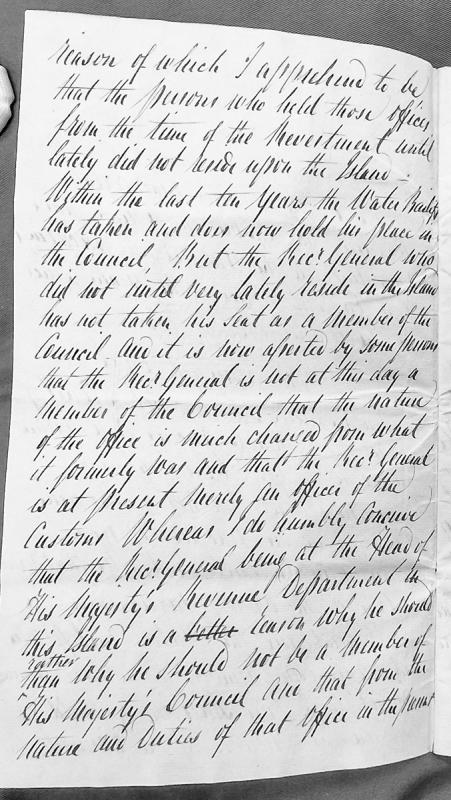
A fragmentary legal opinion discussing whether the Receiver General should hold a seat on the Council. The author argues that the Receiver General's position as head of the Revenue Department justifies Council membership, contrary to assertions that the office has changed in nature and that the current holder is merely a customs officer.
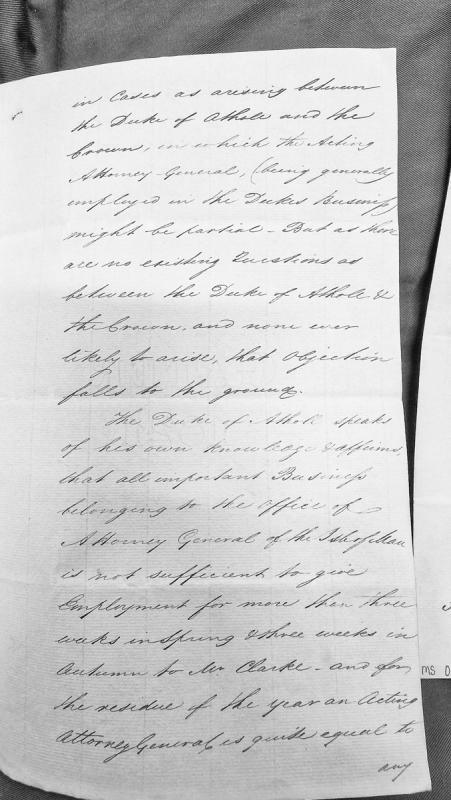
A legal opinion fragment discussing the workload of the Attorney General position in the Isle of Man, specifically addressing objections regarding potential conflicts of interest between the Duke of Atholl and the Crown, and affirming that an Acting Attorney General is adequate for most of the year.
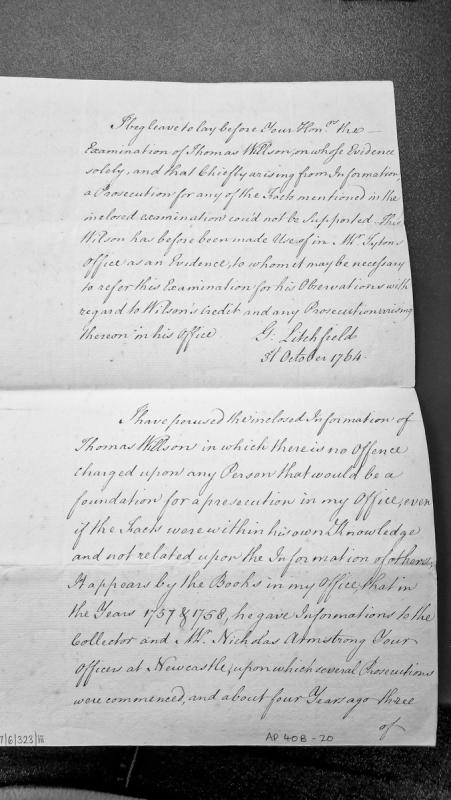
A legal opinion concerning an information submitted by Thomas Wilson. The writer reviews the document and concludes there is insufficient basis for prosecution in their office, even if the facts were within Wilson's personal knowledge. References are made to Wilson's previous informations from 1757-1758 that resulted in prosecutions at Newcastle.
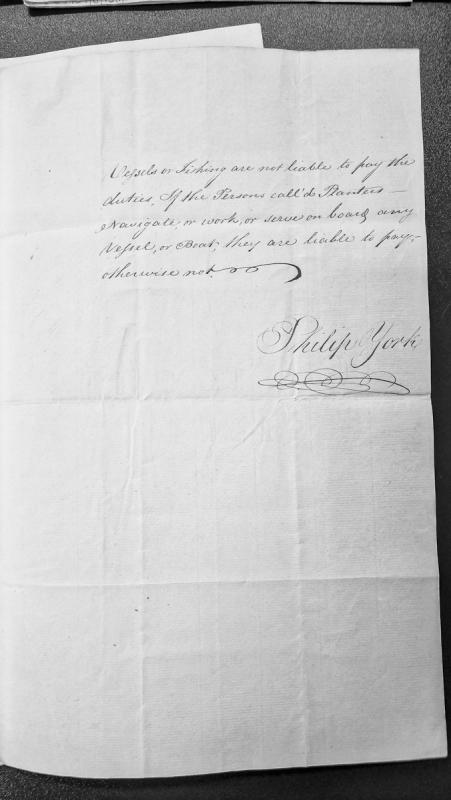
A brief legal opinion concerning the taxation of vessels and fishing boats, clarifying that planters are only liable to pay duties if they actively navigate, work, or serve aboard vessels or boats. Signed by Philip Yorke, likely Attorney General.
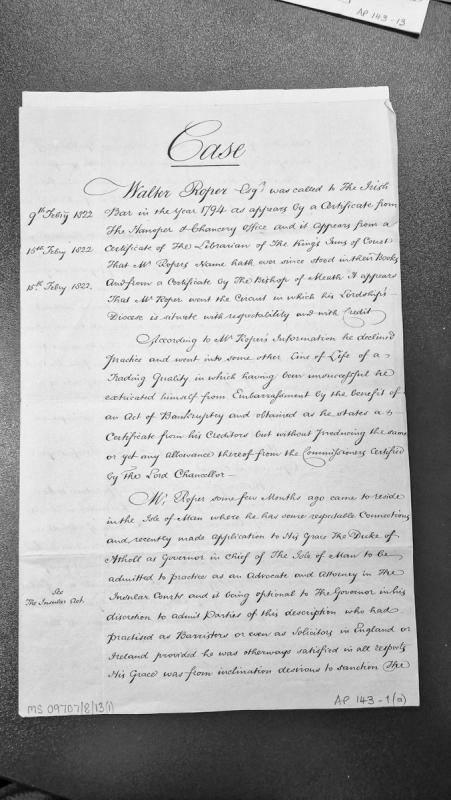
A legal opinion reviewing Walter Roper's qualifications for admission to practice in the Manx courts. The document examines his call to the Irish Bar in 1794, his standing with King's Inns, his circuit practice, and his subsequent bankruptcy and commercial activities, with consideration of the Governor's discretionary powers to admit practitioners.
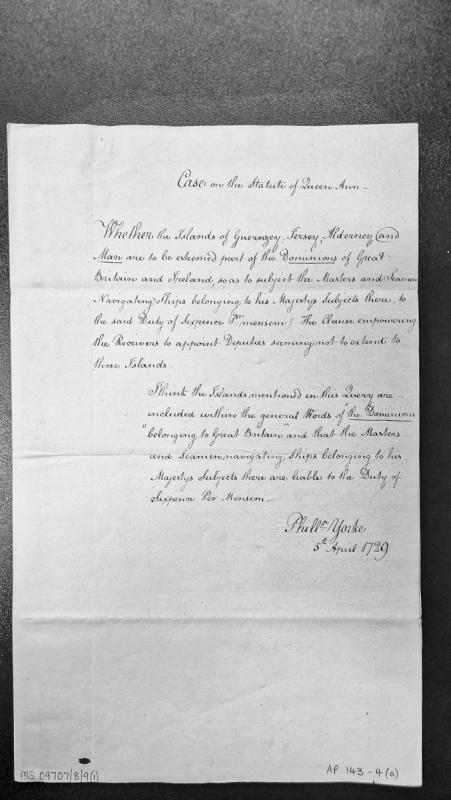
A legal opinion addressing whether Guernsey, Jersey, Alderney, and Man fall within the dominions of Great Britain and Ireland for purposes of imposing a sixpence per month duty on Masters and Seamen. The opinion concludes affirmatively that these islands are included and the duty applies.
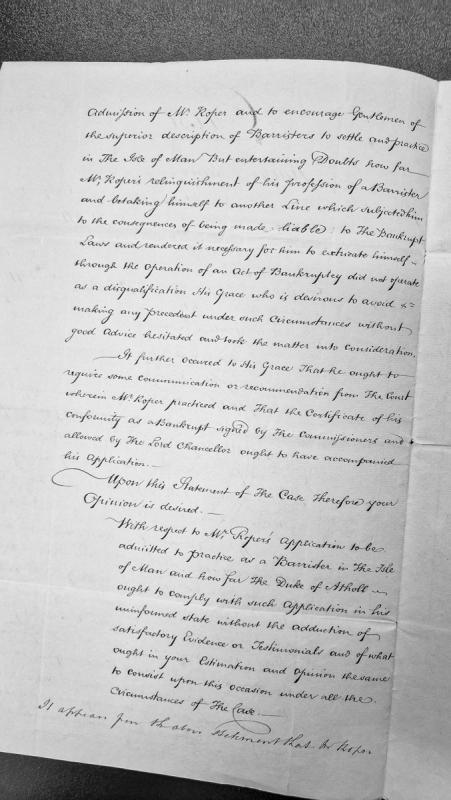
A legal opinion request concerning the admission of Mr Roper to practice as a Barrister in the Isle of Man. The document discusses concerns about Roper's previous relinquishment of his barrister profession, his involvement with bankruptcy laws, and questions whether appropriate testimonials and certificates from the court where he previously practiced have been provided.
A compilation of legal opinions from English Attorneys-General, Solicitors-General, and other eminent lawyers on matters of colonial jurisdiction, the king's prerogative, royal charters, taxation, land grants, escheats, and the extension of English law to the American colonies and other territories. Originally compiled from Board of Trade archives and other depositories by George Chalmers, first published London 1814, this 1858 American edition by C. Goodrich & Company provides primary source material on English constitutional and administrative law as applied to colonial governance.
A comprehensive collection of legal opinions from English attorneys-general, solicitors-general, judges, and other eminent lawyers on constitutional and commercial matters affecting the British colonies, compiled by George Chalmers from Board of Trade archives and other depositories. Originally published in London in 1814; this is the 1858 American edition. Covers the King's prerogative, colonial constitutions, taxation, trade regulation, and sovereignty questions relevant to Isle of Man and American colonial law.
A comprehensive collection of legal opinions from prominent English barristers and law officers (Attorneys-General, Solicitors-General, Chief Justices) spanning the 17th and 18th centuries, compiled by George Chalmers from Board of Trade archives and other depositories. Covers the King's prerogative abroad, colonial constitutions, ecclesiastical authority, land grants, taxation, trade regulation, and statutory extension to colonies and overseas territories, including opinions on the Isle of Man.
A compiled collection of legal opinions from prominent English lawyers on colonial, fisheries, and commerce matters, arranged thematically by George Chalmers. The work draws on original documents from the Board of Trade and other depositories, covering royal prerogative, colonial constitutions, navigation acts, and commercial law from the late 17th century onward. Directly relevant to understanding the legal framework governing the Isle of Man and colonial dependencies during the Revestment period.
George Chalmers's 1784 treatise examining the legal and commercial consequences of American independence for Britain. Addresses the status of American citizens under English law (aliens vs. subjects), rights of loyalists, treaty interpretation, and comparative constitutional parallels (Scotland, Normandy, etc.). Directly relevant to post-Revestment constitutional and commercial policy questions.
A royal mandate from King Edward I (dated 29 August 1296) commanding Robert de Joneby, bailiff of Dumfries, to bring Marc, Bishop of Sodor, to the King at Berwick to perform homage. This document evidences early English Crown assertion of authority over the Isle of Man ecclesiastical hierarchy and broader medieval suzerainty claims.
An Episcopal Registry order from the Isle of Man, dated 1684, directing the executors of the late Bishop Bridgman to refund monies awarded for repairs to the Cathedral at Peel Castle and other ecclesiastical buildings. The document addresses a dispute over repair obligations, specifically regarding reconstruction of the Bishop's Court tower, and clarifies customary practice regarding episcopal maintenance responsibilities.
An official order from the Episcopal Registry of the Isle of Man dated 1684, directing the executors of the late Bishop Bridgman to refund £75 14s 2d to the current Bishop Lake for repairs to the cathedral and parish church chancels. The document also addresses a disputed claim for £30 regarding tower repairs at the Bishop's Court, determining that custom does not obligate the executors to undertake major reconstruction.
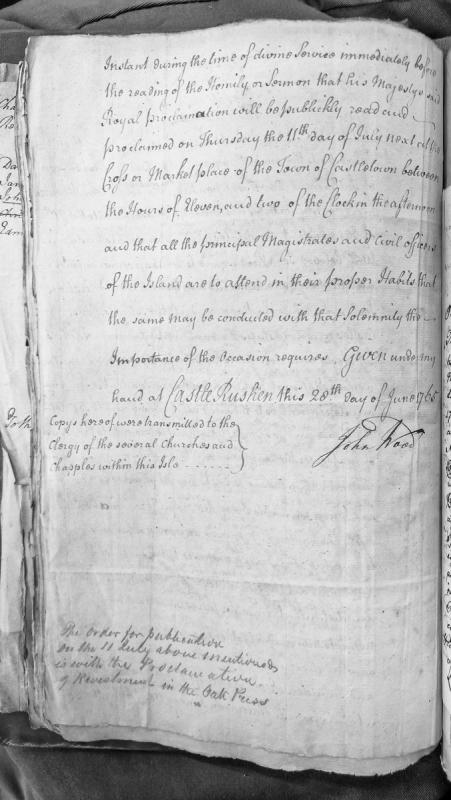
Administrative order directing the public reading and proclamation of a Royal Proclamation at the Market Cross in Castletown on 11 July 1765. The document specifies the time (11 a.m. to 2 p.m.), requires attendance of principal magistrates and civil officers in formal dress, and notes that copies were transmitted to clergy of churches and chapels throughout the Isle of Man.
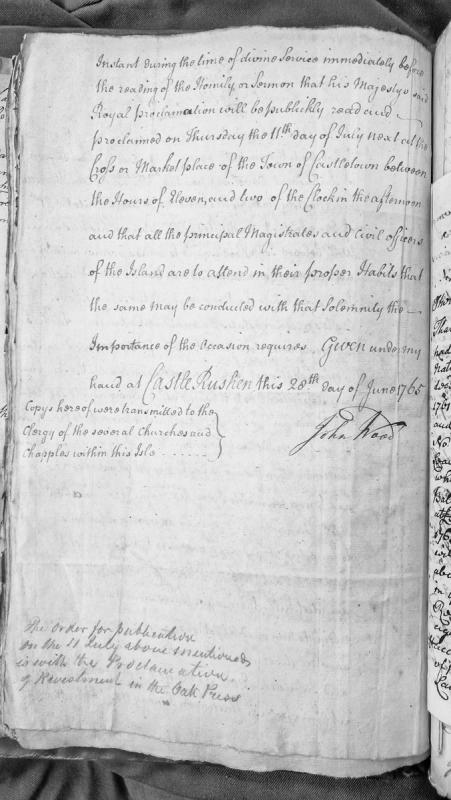
An administrative directive from Castle Rushen dated 28 June 1765 ordering the public reading of a Royal Proclamation at Castletown market cross on 11 July 1765. The proclamation is to be read between 11am and 2pm with all principal magistrates and civil officers attending in formal dress. Copies were transmitted to clergy throughout the island.
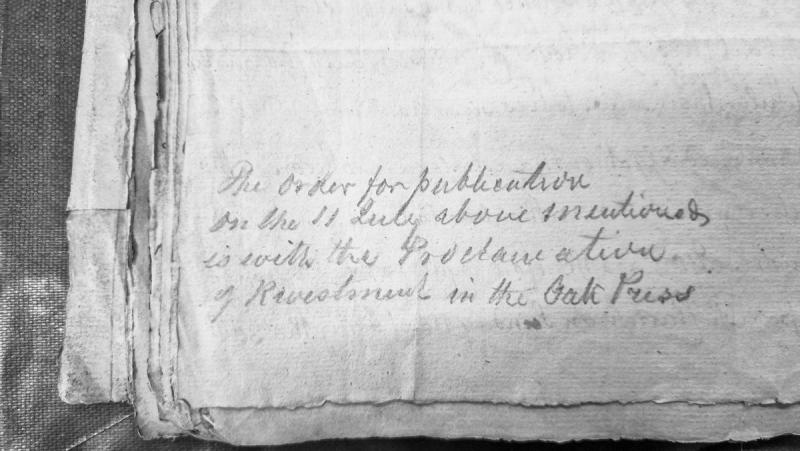
A brief administrative note referencing an order for publication dated 11 July and its association with a Proclamation of Revestment. The document indicates these materials are filed together in the Oak Press archive.
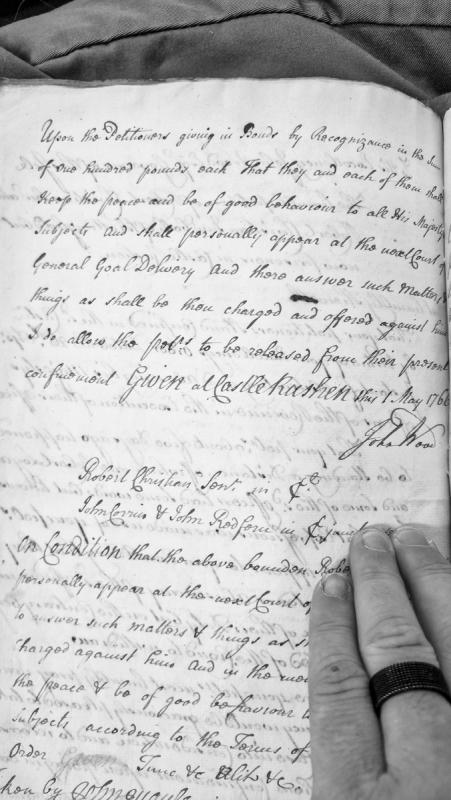
An order authorizing the release of prisoners from confinement at Castle Rushen upon their entering into recognisance bonds of one hundred pounds each, with conditions to keep the peace and appear at the next Court of General Gaol Delivery. Signed by John Wood and witnessed by John Quayle.
A royal order from Charles II dated 16 January 1662, directed to the Earl of Derby, concerning the imprisonment and death sentence of William Christian on the Isle of Man. The King's Counsel has determined Christian is eligible for pardon, and the order directs that Christian be brought before the King and Council to answer the charges of treason. This document is significant for understanding early Stuart governance of Man and the legal authority exercised by the Crown over the island.