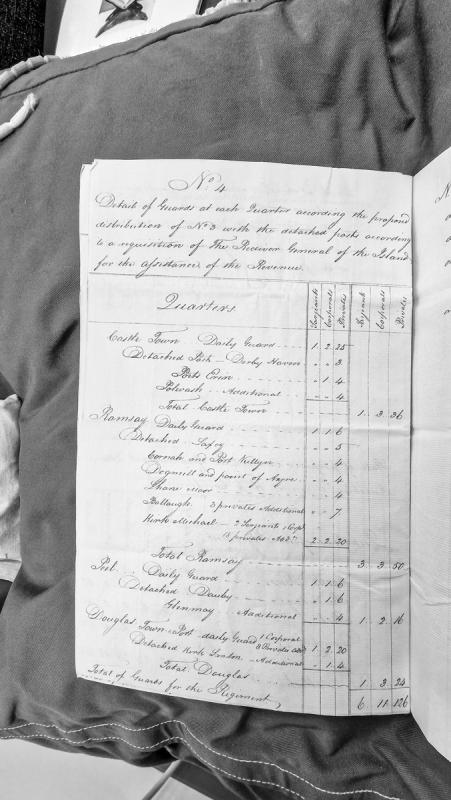
A tabular administrative document detailing the distribution of military guards across various fortified positions and towns on the Isle of Man, including Castle Town, Ramsay, Peel, and Douglas. The table specifies personnel allocations (Sergeants, Corporals, and Privates) for daily guards and detached posts at key locations such as Derby Haven, Port Erin, Laxey, and other strategic points.
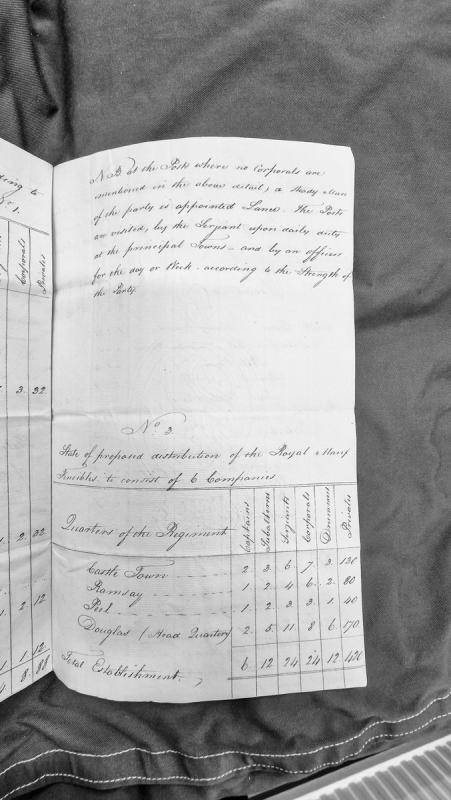
A tabular summary showing numerical distribution across four Manx towns (Castle Town, Ramsay, Peel, and Douglas) with columns representing different categories of establishment or personnel. The table includes totals for each category and a final aggregate column showing 420 as the total establishment figure.
A comprehensive historical survey of Manx military structures from pre-Norman times through the Napoleonic era, covering beacon systems, the Norse ship-levy (skeita-thing), parish militia organisation under the Stanleys, the 1651 rebellion, 18th-century militia decline post-Revestment, volunteer corps, and Fencible regiments. Directly relevant to understanding civil-military organisation before and after the 1765 Revestment, particularly regarding the cessation of militia musters after Crown acquisition.
A detailed historical chapter on Manx military forces following the 1765 Revestment Act, covering the decline of the foot militia, the Royal Manx Fencibles (1779–1810), volunteer corps during the Napoleonic Wars, and fortification history. Directly relevant to understanding post-Revestment governance, defence organization, and social mobilization on the island.
A scholarly chapter on Manx military history covering the period immediately following the 1765 Revestment Act. Traces the decline of the traditional foot militia, the rise and operations of volunteer corps during the Napoleonic Wars, the formation and service record of the Royal Manx Fencibles, and the state of coastal defences. Directly relevant to understanding post-Revestment governance, security arrangements, and social mobilization on the island.
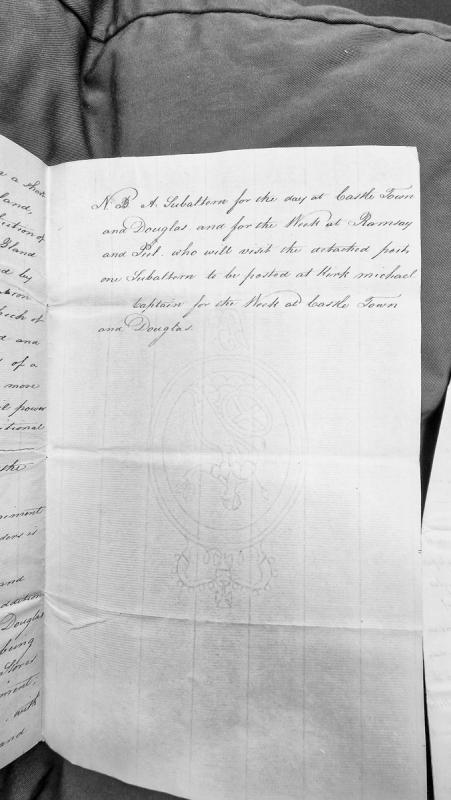
Administrative note detailing military personnel postings across Isle of Man locations, specifying weekly rotations for subalterns at Castle Town, Douglas, Ramsey, and Peel, with an additional post at Kirk Michael and captain assignments.
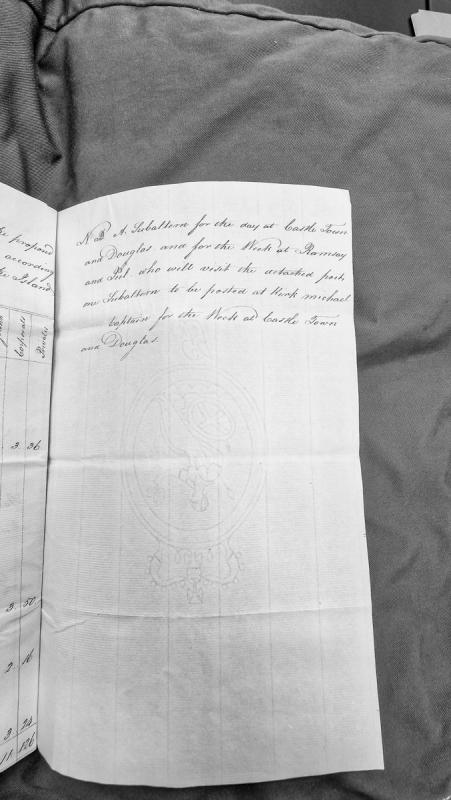
Administrative note detailing the posting assignments for military personnel (subalterns and captain) at various Castle Town, Douglas, Ramsey, Peel, and Kirk Michael locations. The document specifies daily rotations at Castle Town and Douglas, weekly rotations at Ramsey and Peel, with a permanent subaltern at Kirk Michael and a captain assigned weekly.
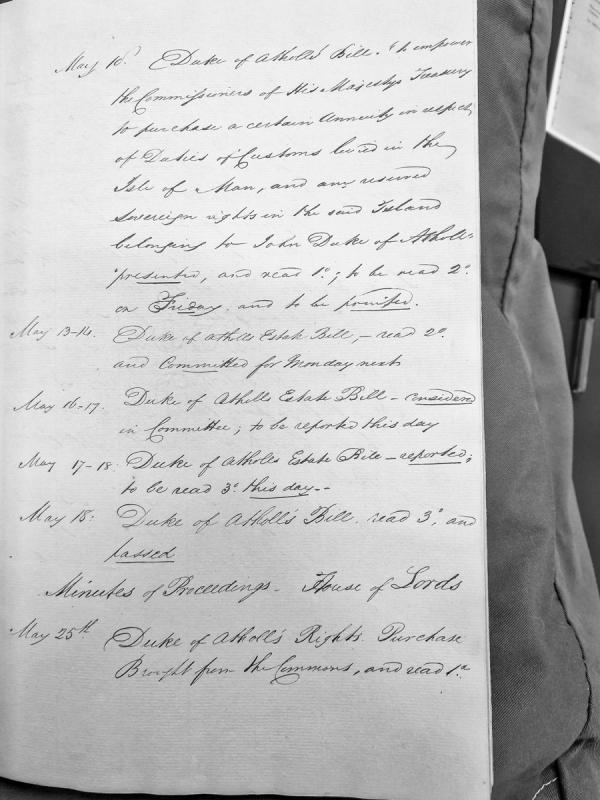
Parliamentary minutes recording the progression of the Duke of Atholl's Bill through the House of Lords in May 1765. The bill concerns purchasing an annuity from customs duties collected in the Isle of Man and reserved sovereign rights belonging to John Duke of Atholl. Documents multiple readings and committee consideration.
Chapter 16 from 'Land of Home Rule' (1893) examines the constitutional and financial settlement of the Isle of Man following the 1765 Revestment. It traces the key financial conflicts between Parliament and the Island (1837-1866), the reform of the House of Keys into a representative body in 1866, and concurrent disputes over the bishopric and church governance.
Chapter 16 of a published history covering the post-Revestment period (1829–1893), focusing on the constitutional and financial struggle between the Island and Parliament over taxation, customs duties, and Tynwald's powers. Examines the gradual evolution of fiscal and representative institutions, including the House of Keys reform, the bishopric controversy, and the relationship between Imperial and insular governance.
A table of contents page for Monumenta de Insula Manniae, a foundational collection of historical documents relating to the Isle of Man. This is a web-based index to a comprehensive documentary source that would cover medieval to early modern Manx history, likely including materials relevant to constitutional, administrative, and legal history of the island.
This is a web-based table of contents page for Monumenta de Insula Manniae, a collection of historical documents and records relating to the Isle of Man. The page appears to be from an early web implementation using HTML frames technology, indicating mid-1990s to early 2000s origin. It serves as a finding aid and navigation tool for accessing primary source materials relevant to Manx history.
This is a table of contents / index page from Manx Society Volume 7 (Monumenta de Insula Manniae Vol 2), cataloguing medieval documents from 1282 relating to Isle of Man, Scotland, and Norway. It lists charters, donations, and agreements involving King Magnus of Man, Scottish kings, Norwegian kings, and the monastery of Rushen. The documents cover territorial compositions, royal confirmations, and administrative records relevant to Manx sovereignty and ecclesiastical holdings.
Volume II of a published collection of historical documents relating to the Isle of Man, edited and translated by J. R. Oliver, M.D., and published by the Manx Society. Contains medieval charters, legal documents, and administrative records spanning from 1134 to the reign of Henry IV. Includes explanatory maps, an extensive table of Latin abbreviations used in ancient records, and detailed administrative and ecclesiastical documents relevant to Manx constitutional and legal history.
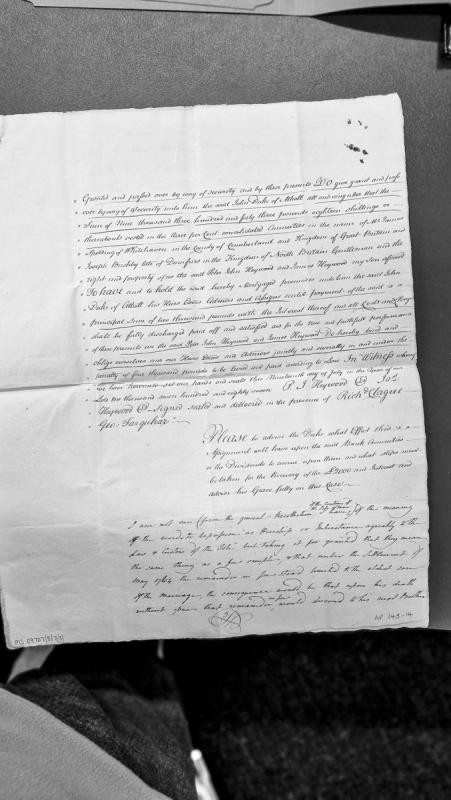
A mortgage deed dated 19 July 1787 wherein Peter John Heywood and James Heywood pledge £9,343 18s in three per cent consolidated annuities to John Duke of Atholl as security for a principal sum of £2000 with interest. The document includes a request for legal advice on the effect of the assignment on bank annuities and recovery procedures.
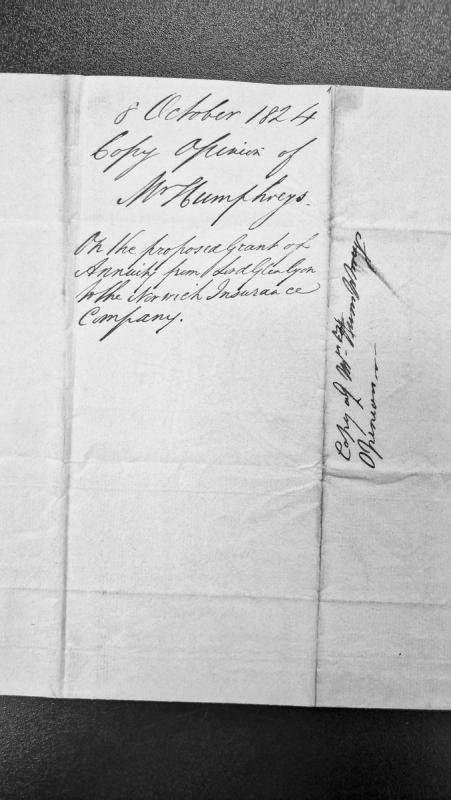
A legal opinion by Mr Humphreys concerning a proposed grant of annuity from Lord Glenlyon to the Norwich Insurance Company, dated 8 October 1824. The document appears to be a copy of the original opinion.
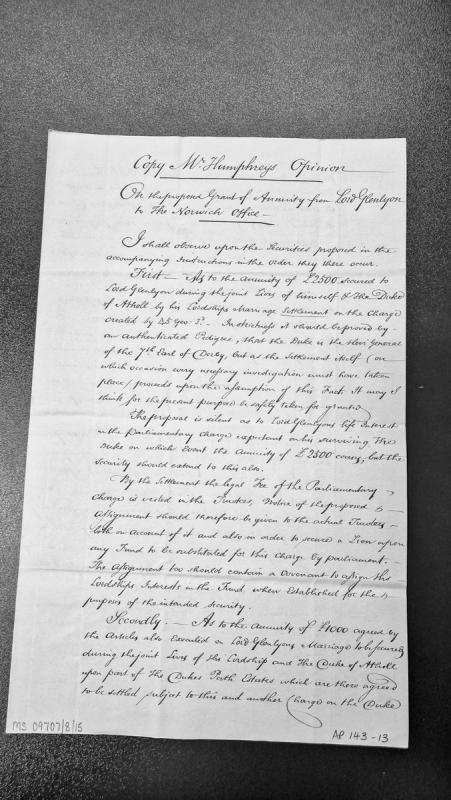
A legal opinion analysing the securities proposed for an annuity grant from Lord Glenlyon to the Norwich Office. The opinion examines the proposed annuities of £2500 and £1000 secured through Lord Glenlyon's marriage settlement and charges, with detailed commentary on required authentication and trustee notification.
Charles Lutwidge reports to Treasury officials on the suppression of East India goods smuggling from the Isle of Man, noting the effectiveness of naval patrols and merchant fear. He details recent vessel movements and recommends making rum an enumerated commodity to combat brandy and rum smuggling from colonial plantations.
Charles Lutwidge reports to Treasury officials on suppression of East India goods smuggling and brandy/rum imports to the Isle of Man. He describes impacts of naval patrols by sloops of war and cutters, notes counter-orders preventing merchant vessels from delivering contraband, and recommends adding rum to enumerated commodities. This is a key intelligence document on the effectiveness of revenue enforcement measures in 1764.
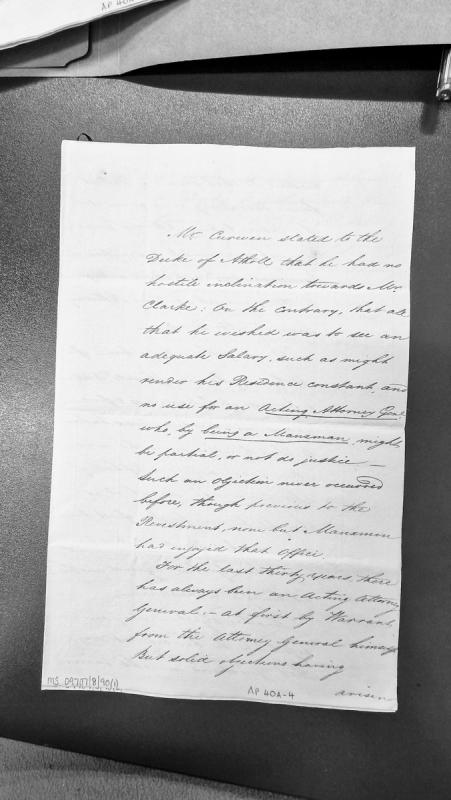
A record of Mr. Curwen's statement to the Duke of Atholl concerning the adequacy of the Attorney General's salary and his objection to appointing a Manxman to the position. The document discusses the history of acting Attorney General appointments over the preceding thirty years and notes that such objections to Manxmen holding the office had not previously occurred.
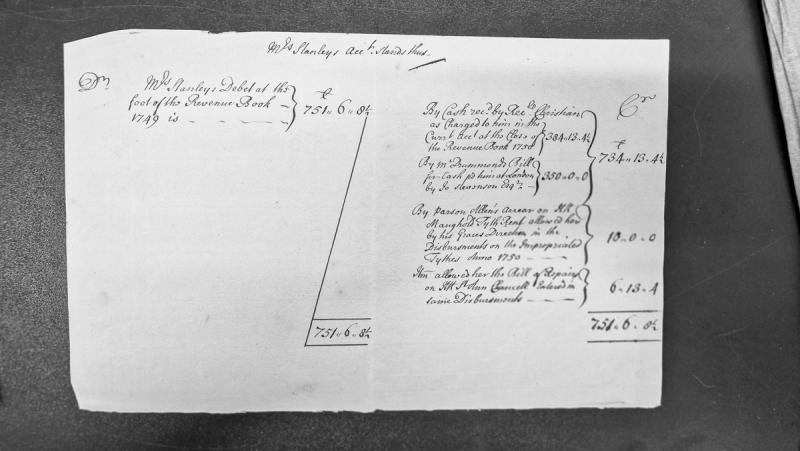
A financial account showing Mrs Stanley's debt and credits for the period 1749-1750. The account records her initial debt of £751 6s 8½d against the Revenue Book for 1749, balanced by receipts including cash from Revd Christian, Mr Drummond's bill, and allowances for various ecclesiastical expenses.
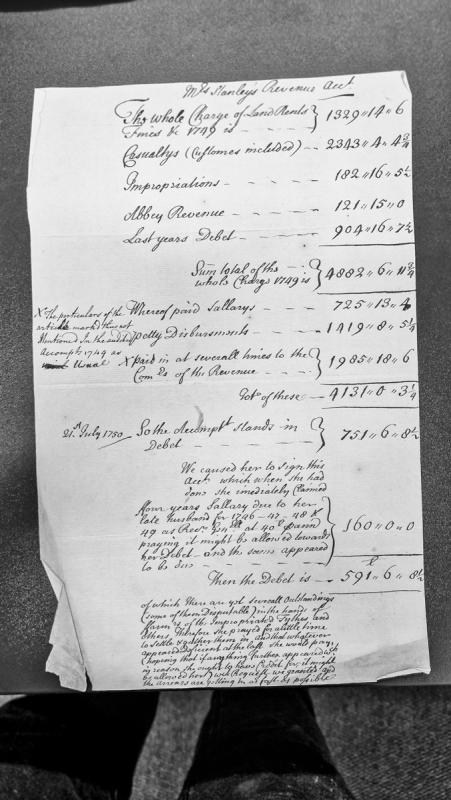
A revenue account for Mrs Stanley covering the year 1749, detailing charges from land rents, fines, casualties, impropriations, and abbey revenue, with disbursements and a final accounting as of 21 July 1750. The document records a debit balance and notes Mrs Stanley's claim for four years of salary due to her late husband as Receiver General.
Letter from James Murray, British Ambassador to Venice, to Earl of Halifax analysing the failure of the Order in Council to prevent smuggling at the Isle of Man. Murray argues that the Lord's extensive original grant powers make suppression impossible and recommends Crown purchase of the island as the only effective remedy. Includes revenue estimates and observations on the island's population and foreign smugglers.
Ambassador James Murray reports from Venice to the Earl of Halifax on the ineffectiveness of the Order in Council against smuggling at the Isle of Man. Murray argues that purchase of the island by the Crown is the only viable solution, given the extensive powers of the Lord Proprietor and the geography making enforcement impossible. He notes the island's revenue potential (£4,000–5,000 p.a.) and the political stability of its largely Anglican population.
Dan Mylrea, Isle of Man's chief revenue officer, confirms to Charles Lutwidge that import and export books for the past ten years can be made available upon proper authority. This correspondence evidences the transfer of commercial records to Westminster officials investigating the Island's trade and smuggling activity immediately after the Revestment.