Memoranda from the Duke of Atholl to Governor Cochran documenting administrative instructions and directives for the governance of the Isle of Man. Topics include financial accounts settlement, property conveyances, bridge construction at Douglas, clerical appointments, religious matters, and communications with Liverpool merchants regarding port navigation. Directly relevant as a primary source showing ducal authority and administrative concerns pre-Revestment.
A 1292 memorandum from Rotuli Parliamentorum (20 Edward I) recording delivery of ecclesiastical legal records to G. de Thornton and companions for adjudication by the King's Bench. The document references disputes involving the Bishop of Winchester, the Abbot de Rupe, and various other parties. Provides context for medieval English administrative and legal procedures relevant to understanding Isle of Man's earlier jurisdictional framework before the 1765 Revestment.
A memorandum recording instructions from the Duke of Atholl to Governor Cochrane regarding fortifications (Castle Rushen, Douglas, Ramsey, Peel, and Derby forts), financial matters (receipt of £4186, coinage orders), administrative appointments (naturalisations, officers), and legal proceedings (appeals commission, Crebbin v. Taubman case). Documents the Duke's direct governance of the Isle of Man prior to the 1765 Revestment.
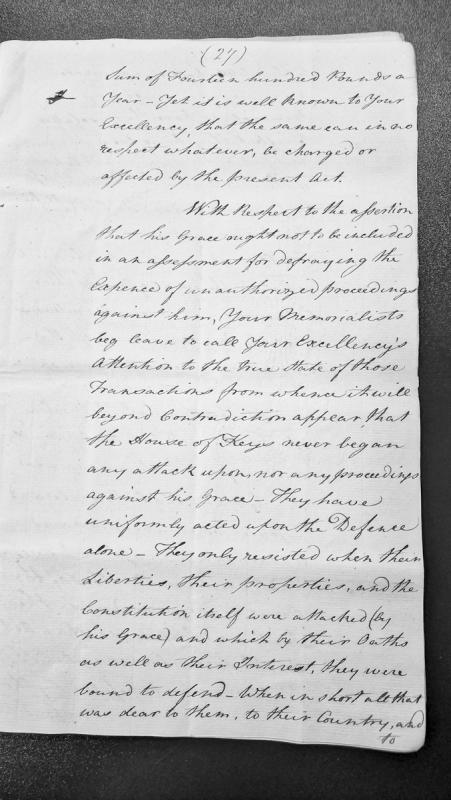
A page from a memorial or petition addressing assertions about financial assessment and the House of Keys' defensive proceedings. The document defends the House of Keys' position, arguing they acted only in defense when their liberties, properties, and the constitution were attacked, rather than initiating proceedings against 'his Grace'. The text argues that such defensive actions should not result in assessment charges.
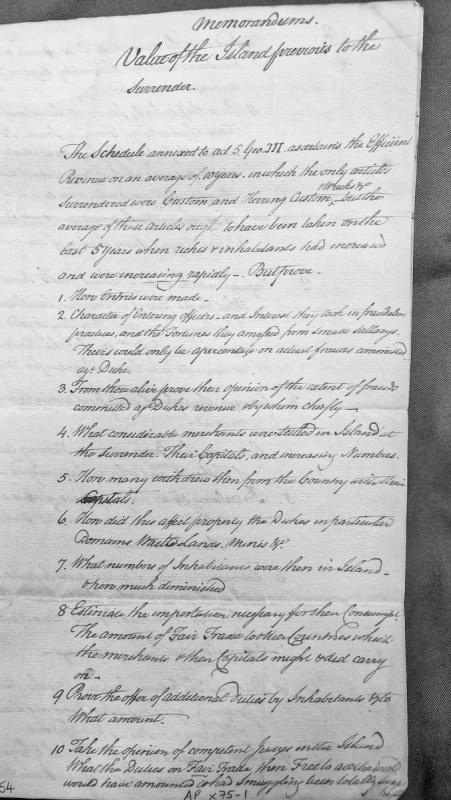
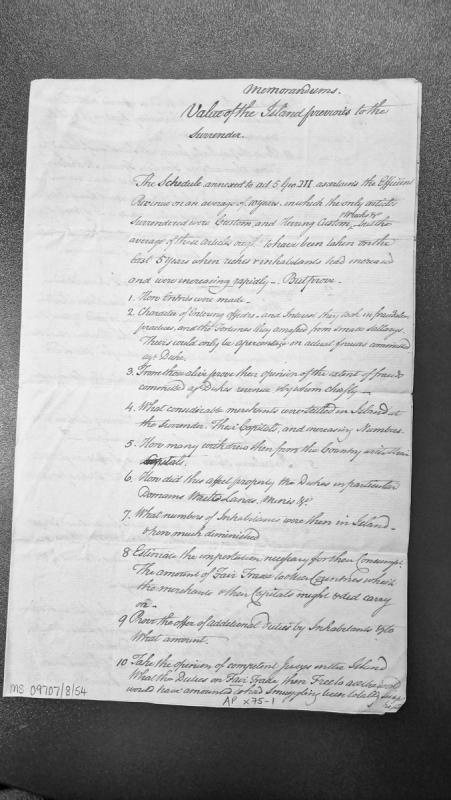
A memorandum outlining proposed evidentiary approaches to establish the true value of the Isle of Man's revenue before its surrender to the Crown under Act 5 of George III. It challenges the accuracy of the official Revenue Schedule and proposes ten lines of inquiry regarding customs fraud, merchant capital, population changes, and fair trade estimates.
A memorandum outlining arguments and evidence points regarding the valuation of the Isle of Man's revenue before its surrender to the Crown. The document proposes ten key evidentiary steps to establish the true revenue, including examination of customs fraud, merchant activities, population changes, and lost duties from smuggling suppression.
A parliamentary memorandum from 1292 recording delivery of various legal records to G. de Thornton and his companions for submission to the King's Bench. Involves disputes concerning the Bishop of Winchester, abbots, and a Manxman ("quidam Mancus"). Relevant as an early documentary reference to Isle of Man within English parliamentary and legal proceedings.
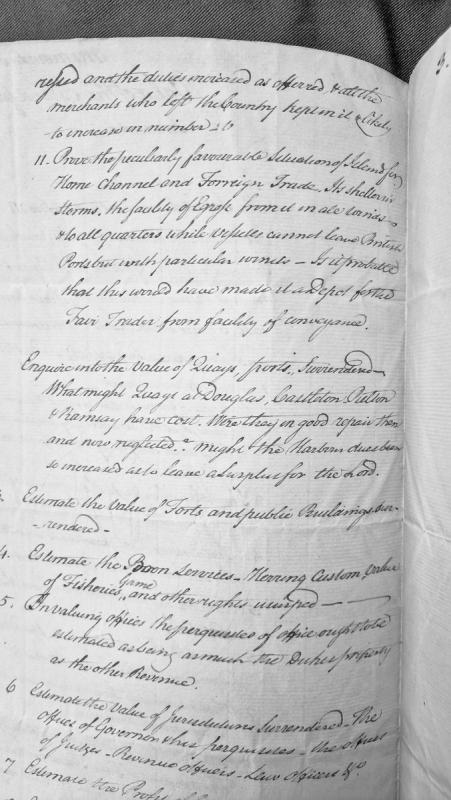
A numbered memorandum outlining instructions for estimating the value of various rights, properties, and offices surrendered by the Duke of Atholl to the British Crown. Items include trading privileges, ports and quays, forts, fisheries, and judicial offices. The document appears to be part of a valuation exercise related to the acquisition of Isle of Man.
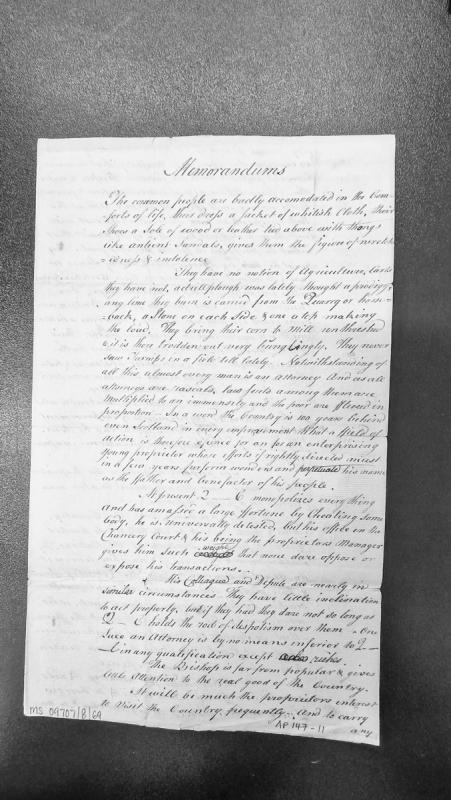
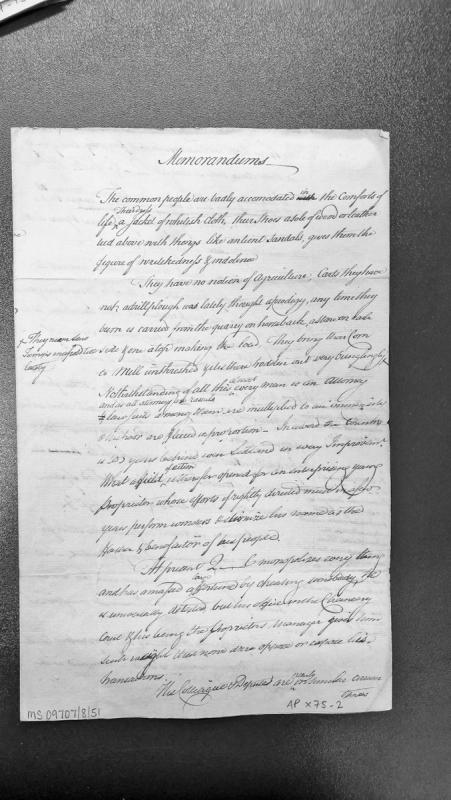
A critical memorandum describing the poor conditions of common people on the Isle of Man, their lack of agricultural knowledge and modern improvements, the prevalence of litigation, and commentary on current officials including a powerful figure identified as '2—C' and Bishop. The author advocates for an enterprising proprietor to modernize the island.
A set of memorandums critiquing the state of the Isle of Man's common people, their poverty, lack of agricultural knowledge, propensity for litigation, and general backwardness. The author comments on a monopolistic figure 'C' who controls affairs through his office in the Chancery Court, and suggests opportunities for an enterprising proprietor to improve the island.
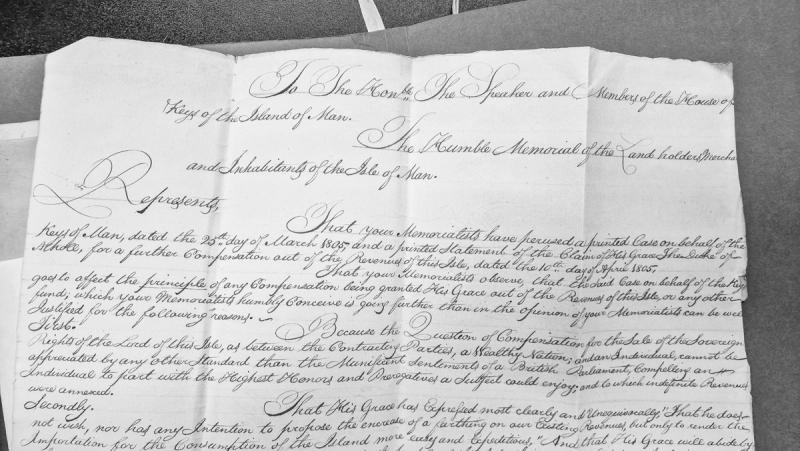
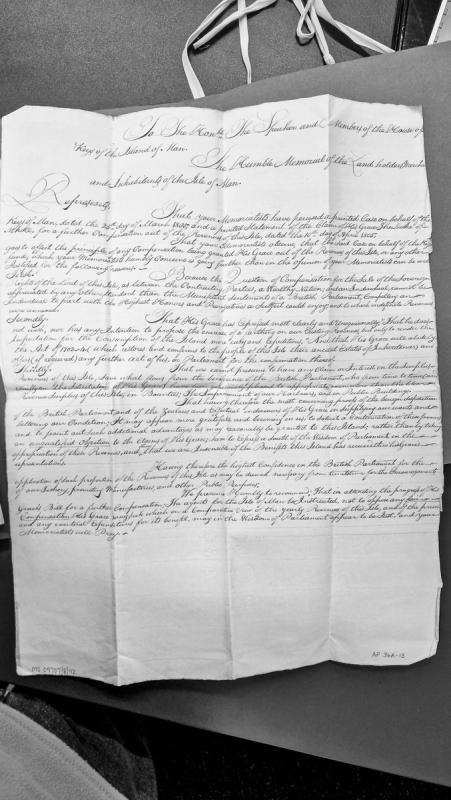
A petition from landholders, merchants and inhabitants of the Isle of Man addressed to the Speaker and Members of the House of Keys, responding to printed cases dated March and April 1805 concerning compensation for the Duke of Athol for sale of sovereign rights. The memorial argues against the Keys' position and defends the Duke's claim.
A petition from landholders, merchants and inhabitants of the Isle of Man to the House of Keys, responding to printed documents dated March and April 1805 concerning the Duke of Athol's claim for compensation from island revenues. The memorialists argue for supporting a fair compensation rather than opposing the Duke's claim, citing Parliament's benevolence and the Duke's efforts to improve the island.
A petition from the merchants and inhabitants of Peel, Isle of Man, addressed to John, Duke of Atholl (the sovereign lord), requesting his influence with the British Government to fund improvements to Peel harbour. The memorial emphasizes Peel's strategic location, fishing industry importance, and the economic benefits to surrounding regions (Dublin, Liverpool, Cumberland, Ireland). It provides context on post-Revestment economic development and the continuing role of the Duke of Atholl as a figurehead after the 1765 sale of sovereignty.
A petition from the merchants and inhabitants of Peel town to John, Duke of Atholl (Governor of the Isle of Man), requesting his patronage and influence to secure government support for the construction of an improved harbour. The memorial emphasizes Peel's natural advantages, its importance to the herring fishing trade, and the need for better facilities to accommodate larger trading vessels serving markets in Dublin, Liverpool, Scotland and Ireland. It is dated 23 July 1799, during the period after the 1765 Revestment when the Duke retained significant influence over the island's development.
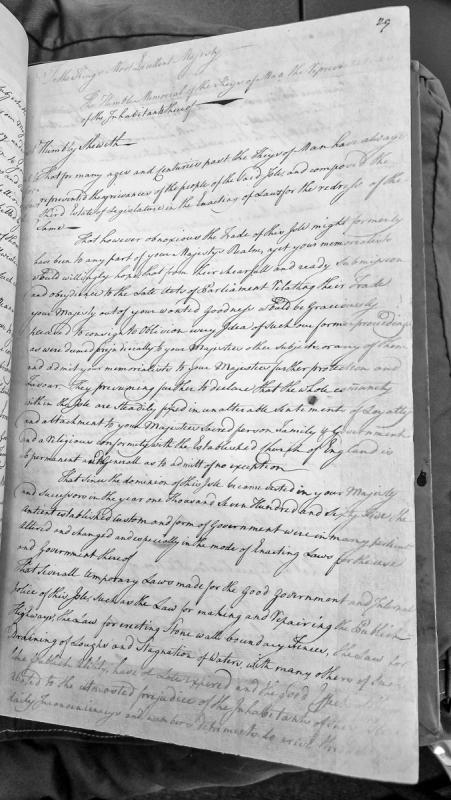
A petition from the Keys of Man (the island's representatives) to the King, requesting protection and favour following changes in trade policy and the transfer of dominion to the Crown in 1765. The memorial emphasizes loyalty and conformity with the Church of England, and complains of expired temporary laws affecting public utilities such as highways, boundary fences, and drainage.
Charles Lutwidge, Receiver General of Revenue for the Isle of Man, petitions the Treasury Lords for clarification on whether he is authorized to pay civil officers' salaries under the King's Warrant of 18 July 1770, or whether surplus revenue must be paid to the Exchequer for redistribution. The memorial reflects post-Revestment administrative confusion about revenue disposal and officer compensation.
A memorial submitted to the Treasury Lords by Charles Lutwidge in 1768 addressing revenue shortfalls from the 1765 Act regulating Isle of Man trade. Lutwidge explains why the proposed duties on spirits, tea, coffee, and tobacco have failed to generate expected income, citing pre-purchase stockpiling and competition from lower Irish tea duties. He proposes export permissions for spirits and reduced tea duties to revive the revenue fund and prevent smuggling.
A memorial from Charles Lutwidge to the Lords Commissioners of the Treasury seeking to address shortfalls in the Isle of Man revenue fund established by the 1765 Revestment Act. Lutwidge proposes allowing spirits exports and reducing tea duties to combat smuggling from Ireland and stimulate trade. The document reveals practical challenges in implementing the new revenue regime post-Revestment.
Charles Lutwidge's 1769 memorial to the Treasury Lords explaining revenue shortfalls following the 1765 Revestment and proposing duty reductions on tea and export allowances for spirits to stimulate trade and reduce smuggling. Documents the failure of the 1765 revenue legislation and requests emergency financial relief for government officers.
Charles Lutwidge's memorial to the Lords Commissioners of the Treasury explaining shortfalls in revenue from the 1765 Isle of Man Revestment Act and proposing remedies: allowing spirit exports and reducing tea duties to prevent smuggling from Ireland. Discusses the economic impact of advance stockpiling by Islanders and competition from lower Irish duties.
A 1771 memorial from Charles Lutwidge, Receiver General of Revenue in the Isle of Man, to the Lords Commissioners of the Treasury requesting clarification on whether he is authorized to pay civil officers' salaries from island revenue under the Royal Warrant of 18 July, or whether surplus funds must be remitted to the Exchequer. This document illuminates post-Revestment administrative procedures, revenue collection, and uncertainty over the distribution of Manx revenues between local government and the Imperial Treasury.
A petition from Charles Lutwidge, Receiver General of Revenue for the Isle of Man, to the Treasury Lords seeking clarification on whether he is authorized to pay civil officers' salaries under the King's Warrant of 18 July 1770, or whether surplus revenue must be paid into the Exchequer for subsequent issuance. The document highlights administrative confusion over post-Revestment revenue and salary procedures.
Charles Lutwidge, Receiver General of His Majesty's Revenues in the Isle of Man, petitions the Crown to designate port authority post-Revestment under powers granted by Parliament. He requests Douglas be appointed Head Port with Darby Haven, Ramsay, and Peel as subsidiary ports. This document reflects the administrative reorganisation of Manx customs infrastructure following the 1765 parliamentary purchase of sovereignty.
Memorial from Charles Lutwidge, Receiver-General of Revenue for the Isle of Man, to the Lords Commissioners of the Treasury seeking clarification on whether he is authorized to pay civil officers' salaries directly under a Royal Warrant of 18 July 1770, or whether surplus revenue must be paid into the Exchequer. This document directly addresses post-Revestment administrative and financial arrangements.
A petition from Charles Lutwidge, Receiver General of the Isle of Man, to the Lords Commissioners of the Treasury requesting appointment of a salary for his office. Lutwidge outlines his role in implementing the Revestment Acts and establishing customs controls to suppress smuggling following the Crown's purchase of sovereignty in May 1765. The memorial was read on 22 May 1766 and again on 24 June 1766.