A detailed calendar/index of Home Office papers (HO 99/16) sent to the Isle of Man governors and lieutenant governors between 1765 and 1817. Lists recipients, dates, and brief summaries of official correspondence relating to appointments, military matters, quarantine orders, revenue issues, and governance. This is a finding aid to the original documents held at the National Archives.
A comprehensive finding aid and catalogue to transcribed Home Office documents (SP 48 and HO 98 series) held at The National Archives, covering governance, administration, and revenue control on the Isle of Man during and after the 1765 Revestment period. The index includes references to governors, lieutenant-governors, revenue officials (notably Charles Lutwidge), and administrative correspondence from 1765 to 1840, with notes on archival location, coverage gaps, and transcription methodology.
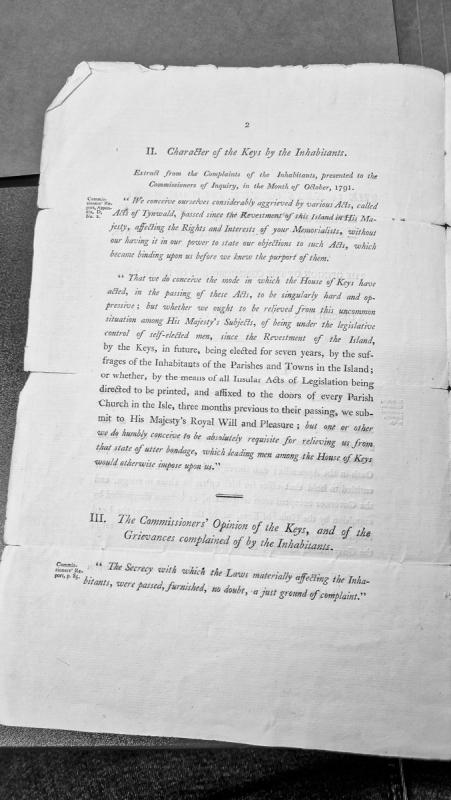
Extract from complaints presented by Isle of Man inhabitants to the Commissioners of Inquiry in October 1791, addressing grievances about Acts of Tynwald passed without public consultation or inhabitant input since the Revestment. Includes the Commissioners' response acknowledging the justness of complaints regarding the secrecy of law-making.
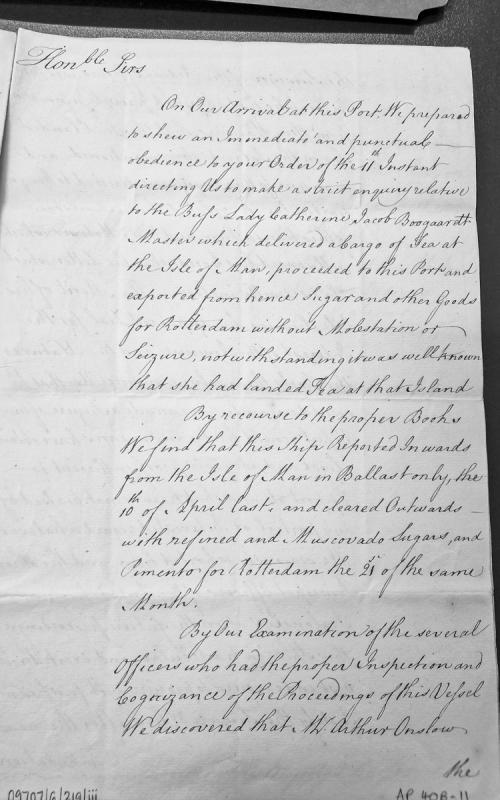
Official correspondence reporting on an inquiry into the ship Buss Lady Catherine, commanded by Jacob Boogaardt, which delivered tea to the Isle of Man and subsequently exported sugar and goods from port without seizure despite known tea landing. The document references official records and officer examinations.
A legal opinion from the Court of Wards regarding the dower rights of Anne, Countess Dowager of Derby, following Thomas Earl of Derby's death. The opinion establishes that the Isle of Man is not part of the English realm and therefore not subject to English law or Chancery jurisdiction, drawing comparisons to Normandy, Gascony, and Calais. This document is foundational to understanding the constitutional status of the Isle of Man as a separate jurisdiction.
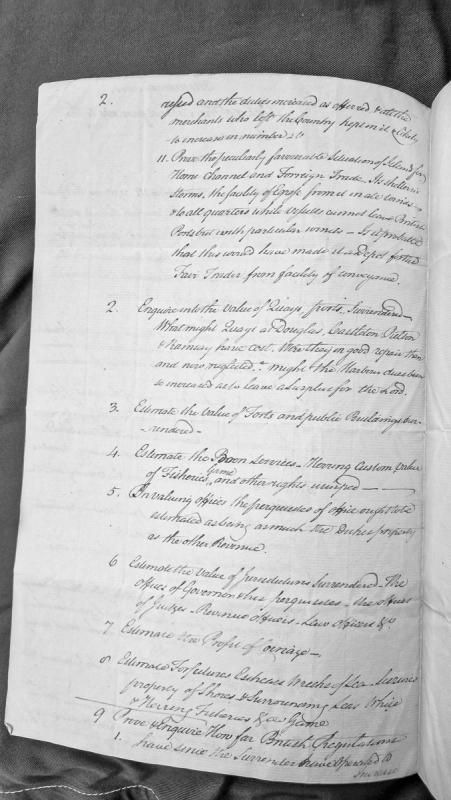
A numbered list of instructions or guidelines for estimating the value of various properties, rights, and revenues that were surrendered by the Duke of Atholl to the British Crown. The document addresses the valuation of quays, ports, forts, fisheries, offices, jurisdictions, coinage, and other feudal rights, with particular attention to lost merchant trade opportunities and the strategic position of the Isle of Man.
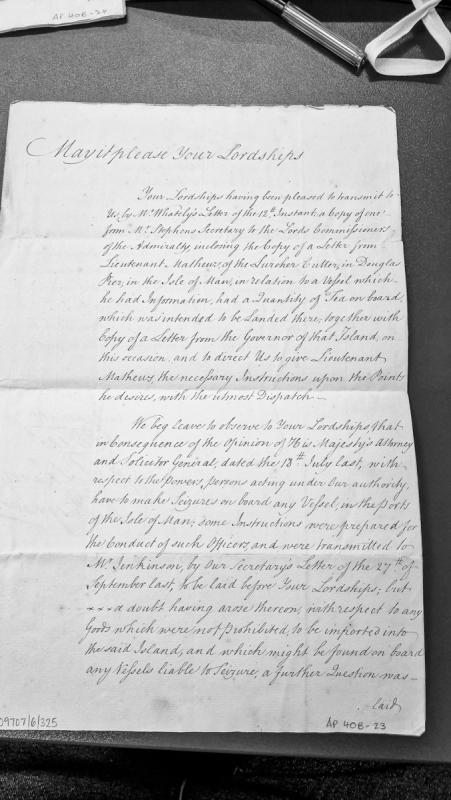
Official correspondence from revenue authorities to their lordships regarding instructions for Lieutenant Mathews of the Lurcher Cutter concerning seizure powers in Isle of Man ports. References an incident involving a vessel suspected of carrying tea for illegal landing, and discusses legal opinions on seizure authority and procedures.
Formal instructions from the Commissioners of Customs to Charles Lutwidge, Surveyor General, detailing his appointment to the Isle of Man effective 1 June 1765 to enforce customs law and suppress smuggling. Covers revenue protection, coast surveillance, officer deployment, population assessment, and coordination with military and civil authorities. A key administrative document implementing the 1765 Revestment Act.
Official instructions from the Commissioners of Customs to Charles Lutwidge, directing him to travel to the Isle of Man by 1 June 1765 to establish customs enforcement and suppress smuggling following the 1765 Revestment. The document outlines his authority, duties (revenue assessment, port inspection, officer deployment), expectations regarding population decline, and military support arrangements.
Royal instructions from King James I (15 Jas I) establishing William Lord Compton as President of the Council of Wales and Marches, dated November 1617. Lists prominent councillors including bishops, earls, and chief officers of state. Notable for inclusion of the Bishop of Mann among the royal commissioners, demonstrating early Stuart administrative integration of the Island with English governance structures.
Royal instructions from King James I (15 Jac. I) establishing governance procedures for the Lord President and Council of Wales and the Marches. Notably includes John, Bishop of Mann, among the named counsellors, illustrating the Isle of Man's constitutional position within English royal authority and the participation of Manx ecclesiastical figures in Westminster-level governance structures during the early 17th century.
A 2020 progress report to the Isle of Man Council of Ministers on the implementation of the National Development Strategy for Culture and the Arts. Documents achievements and ongoing projects in arts funding, cultural engagement, digital innovation, and creative sector support during the COVID-19 pandemic. While contemporary rather than historical, it reflects current Manx cultural institutions and governance structures relevant to understanding the modern administrative context.
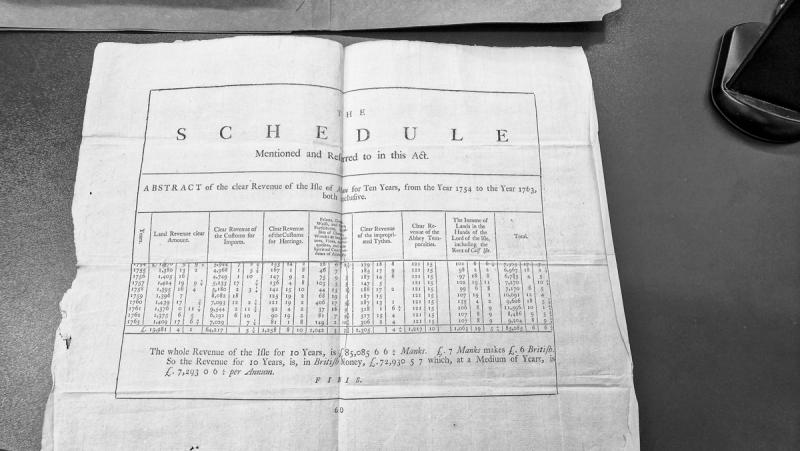
A financial abstract presenting annual revenue figures for the Isle of Man across a ten-year period (1754-1763), with totals calculated in Manks currency and converted to British money. The document shows various revenue categories organized in columns with amounts in pounds, shillings, and pence.
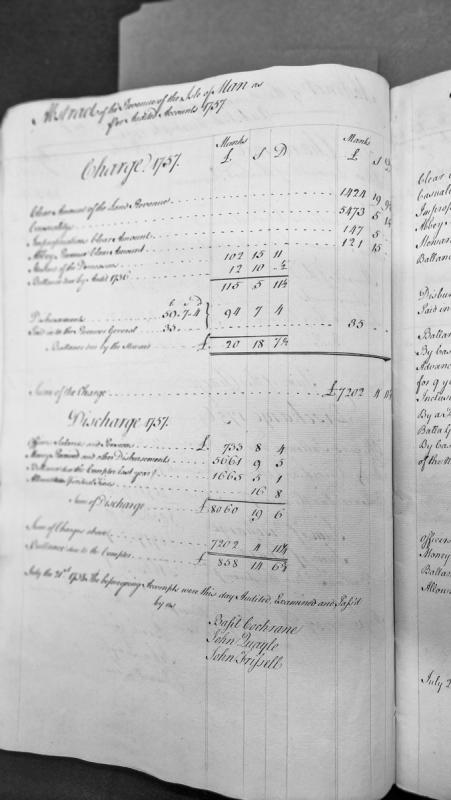
A financial abstract showing the revenue charges and discharges for the Isle of Man for the year 1757, including land revenue, casualties, impropriations, abbey revenue, and steward accounts. The document concludes with an audit certification dated July 21, 1758, signed by three auditors confirming the accounts have been examined and passed.
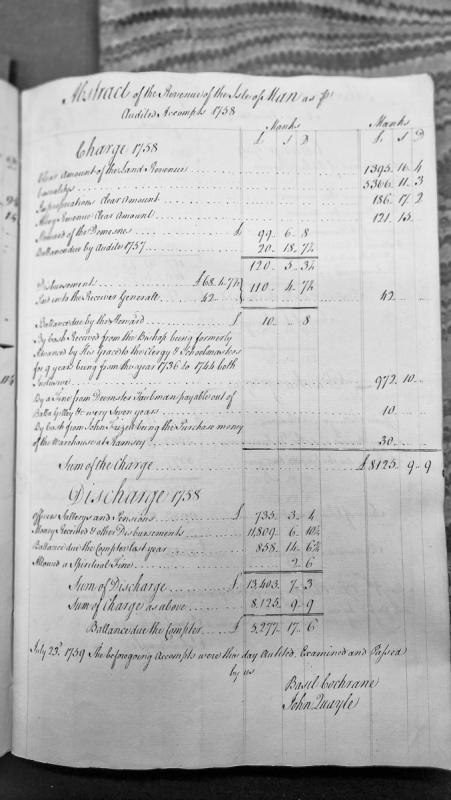
A financial account for the Isle of Man covering the year 1758, detailing charges and discharges of revenue from land, casualties, impropriations, and abbey revenues. The document records receipts, disbursements, and balances, with a final balance due to the Comptroller of £5,277.17.6. It was audited and passed by Basil Cochrane and John Quayle on 23 July 1759.
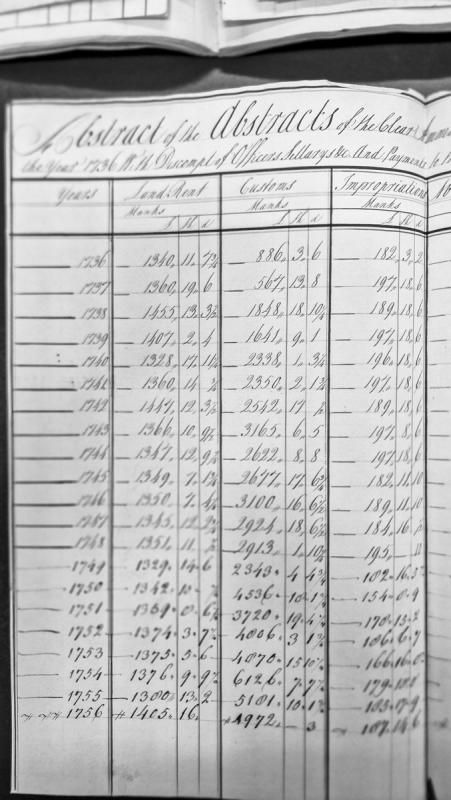
A financial table recording annual revenue data for the Isle of Man spanning from 1736 to 1756. The document presents multiple columns of numerical values in pounds, shillings, and pence, likely representing different categories of revenue or taxation. Several entries contain uncertain or partially legible readings indicated by question marks.
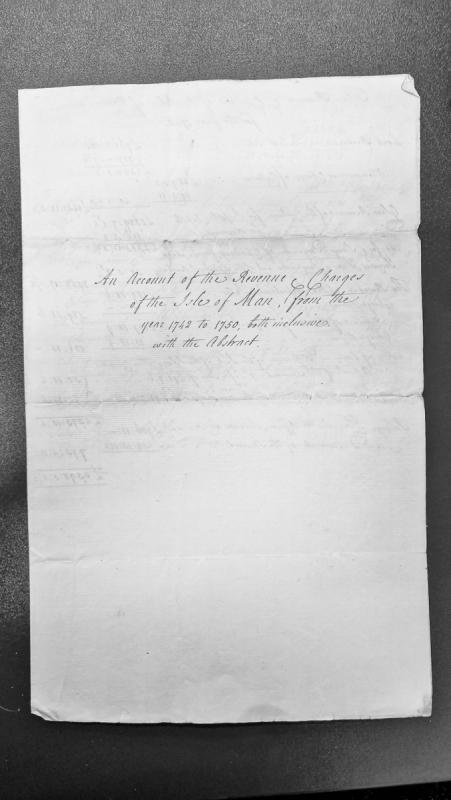
A revenue abstract document detailing the financial accounts and charges for the Isle of Man spanning the period from 1742 to 1750 inclusive. This document appears to be an official administrative record of governmental revenues and expenditures for the island during this eight-year period.
An extract from a medieval Issue Roll (Royal Exchequer record) documenting a payment of £66 13s. 4d. to the Bishop of Man in 1393, issued via the Bishop of Salisbury and Treasurer of England. The payment compensated the Bishop for charges and labour in prosecuting affairs for the Crown in the Islands. This is a primary administrative/revenue document from the Manx Society's published collection of medieval Manx records.
A medieval Issue Roll entry (A.D. 1393, 16 Ric. II) recording a payment of £66 13s. 4d. to the Bishop of Man from royal funds, in discharge of 100 marks commanded by the King for charges and labour in prosecuting affairs for the Crown in the Islands. This document provides early evidence of Crown financial administration of the Isle of Man and episcopal roles in royal service.
An extract from the 1399 English Exchequer Issue Roll recording a payment to William le Scroop, Earl of Wiltshire, for expenses incurred in securing and maintaining Thomas, late Earl of Warwick, on the Isle of Man following parliamentary judgment in 1398. The document demonstrates early evidence of the Isle of Man as a place of royal custody and exile, and the financial mechanisms of English royal administration.
An extract from the 1399 Issue Roll (22 Ric. II) recording a payment of £1074 14s. 5d. to William le Scroop, Earl of Wiltshire (Treasurer of England) for expenses related to the custody and support of Thomas, late Earl of Warwick, on the Isle of Man following his condemnation in Parliament (21st year). This document evidences early English Crown involvement in Isle of Man administration and the island's use as a place of exile/imprisonment.
Letter from James Clark (likely a Manx official) to Hobhouse at the Home Office regarding the inefficiency of Douglas police, salary augmentation for constables, and the need to route mail via steam packet rather than Whitehaven. Reflects post-Revestment administrative challenges and economic development of the Island following the 1765 purchase of sovereignty.
A letter from James Clark (likely a local official) to Hobhouse at the Home Office regarding the inefficiency of Douglas police, the need for proper constable recruitment, and the defects of the circuitous mail route via Whitehaven. The letter reflects post-Revestment administrative developments and the growing importance of Douglas as a commercial hub due to steam packet services.
Three interconnected private letters from James Clarke (Attorney General of Isle of Man) to Henry Hobhouse (Under Secretary Home Dept), Robert Peel (Home Secretary), and the Duke of Atholl, dated 7-10 March 1822. Clarke reports on the Duke's financial difficulties (£40,000 loan), deteriorating relations between the Duke and House of Keys, and tensions over Post-Revestment governance, particularly regarding parliamentary authority and corn import regulations.
Private correspondence from James Clarke (likely a Home Office official) to Henry Hobhouse regarding tensions between the Duke of Atholl and the Acting Attorney General of the Isle of Man. Clarke discusses the Duke's revival of the McCrone prosecution case and his harsh treatment of officials, advising the Governor to adopt conciliatory measures. References the complexities of holding dual Crown appointments (Receiver General and Collector of Customs) and a forgery case.