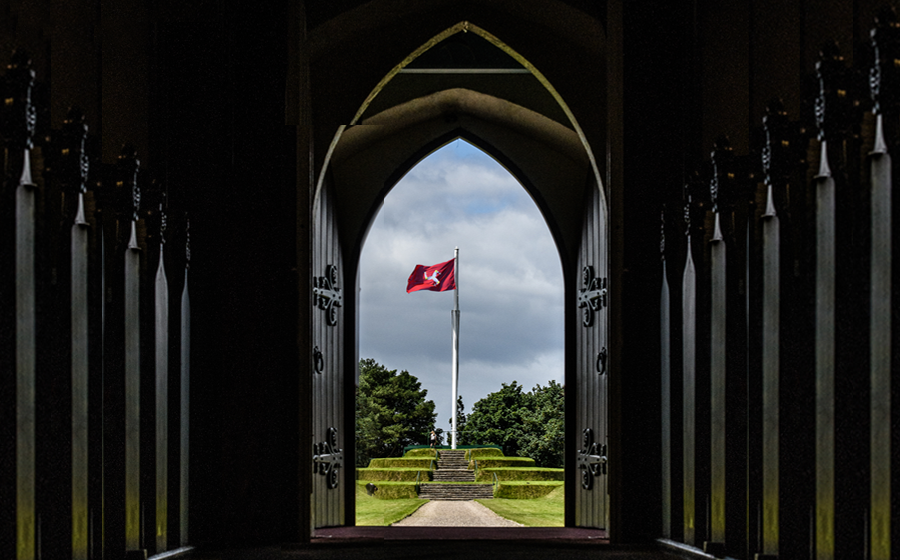
James Stanley, 7th Earl of Derby, standing on South Barrule and imagining the commercial prosperity the Isle of Man could achieve. A vision of the Island's potential from the lord who loved it most — and who would die for his king.
1513 battle between England and Scotland, referenced as the subject of the Percy Folio poem (composed 1515–1528) that calls Thomas Stanley 'king of Man.'
21 November 1918. HMS King Orry, a Manx Steam Packet vessel serving as an Armed Boarding Vessel, was given the place of honour as sole representative at the surrender of the German fleet at Scapa Flow. Admiral Beatty awarded the Manx vessel this distinction.
During the Second World War, the Isle of Man was again used for mass internment. Camps at Hutchinson Square in Douglas, Mooragh in Ramsey, and Rushen Camp at Port Erin and Port St Mary held thousands of civilian internees, many of them refugees from Nazi persecution.
During the First World War, the Isle of Man became the site of the largest internment operation in the British Isles. Knockaloe camp near Peel held over 23,000 men at its peak. The Island's geographical isolation made it the natural choice for mass internment.
The TT motorcycle race, held on the Isle of Man since 1907. The most famous sporting event on the Island and a defining element of modern Manx identity. Run on public roads over a 37.73-mile mountain course.
The dynastic civil wars in England (1455–1487) through which Thomas Stanley, Lord of Mann, navigated with extraordinary political skill. He survived every king and kept his options open until Bosworth, where he chose the winning side.
28 May 1644. James Stanley, 7th Earl of Derby, led an infantry assault on Bolton that killed an estimated 1,600 people. When he was captured at Worcester seven years later and executed at Bolton, the town remembered.
3 September 1651. The final battle of the Civil War in England. The Great Stanley (James, 7th Earl of Derby) was captured here after fighting for Charles II. He was tried at Chester and executed at Bolton — the same town where he had led the 1644 massacre.
22 August 1485. The decisive battle of the Wars of the Roses. Thomas Stanley, Lord of Mann, held the balance with his forces uncommitted until the critical moment, then placed the crown on Henry Tudor's head. The battle that confirmed the Stanley lordship and created the Earl of Derby.
The Manx-medium primary school opened at St John's — within sight of Tynwald Hill. Children learning in the language that was supposed to have died, at the centre of the Island's constitutional life. The survival of Manx identity is the people's achievement, not the Crown's.
Ned Maddrell, the last native speaker of Manx Gaelic, died at Cregneash. His death was reported internationally as the death of a language. But by then, Brian Stowell and Douglas Faragher and others had already begun the revival work that would prove the reports premature. The language was not dead. It was waiting.
The Manx Language Society — Yn Cheshaght Ghailckagh — was founded to preserve and promote the Manx language. A.W. Moore and others recognised that the language was dying and that its loss would mean the loss of the Island's cultural identity. The Society's work would eventually feed the revival that produced Bunscoill Ghaelgagh a century later.
The Isle of Man granted property-owning women the right to vote — decades before Westminster. The Island that had been treated as constitutionally insignificant led the British Isles in democratic reform.
The House of Keys Election Act gave Manx people the right to elect their own representatives for the first time. Previously the Keys had been a self-electing body. The Act was the culmination of forty-five years of petitioning — the constitutional machinery that the Revestment had silenced, slowly restarting.
Press gangs operated in Douglas, seizing Manx men for the Royal Navy. The Island that had lost its merchant fleet to Crown seizure now lost its men to Crown impressment. The fishermen and sailors who had worked the Irish Sea routes were taken for service in wars that had nothing to do with them.
Parliament debated the condition of the Isle of Man. The devastation was acknowledged. And then Parliament voted to send Manx surplus revenues to the Consolidated Fund. The Island paid for its own dispossession. The circle was complete.
Captain John Quilliam of Inch, Isle of Man, served as First Lieutenant aboard HMS Victory at Trafalgar. He took the helm after the original helmsmen were killed, steering the flagship through the battle. Other Manx sailors were among the wounded. The Island that had been stripped of its men by impressment still sent them to fight Britain's wars.
Parliament sent Commissioners to investigate conditions on the Island twenty-seven years after the Revestment. The Commission documented the devastation — economic collapse, population decline, infrastructure decay — and recommended remedies. The Duke of Atholl testified with remarkable candour about the coercion, administrative chaos, and the rushed nature of the original transaction. The recommendations were largely ignored.
A storm destroyed Douglas harbour, killing fishermen. The harbour had been neglected under Crown administration — the infrastructure that the Manx people depended on for their livelihoods left to rot because the Crown had no interest in maintaining what it had purchased.
George Moore and others travelled to London repeatedly to petition for relief from the consequences of the Revestment. The deputations were received politely and achieved nothing. Moore's letters from London, preserved in the Bridge House Papers, document the experience of a Manx patriot confronting parliamentary indifference.
For over a decade after the Revestment, Tynwald was effectively silenced. No petitions heard in the old way. No laws promulgated as the constitution required. The ancient ceremony continued in form but the substance — the living governance the Prologue describes — was hollowed out. The silence is the book's recurring structural motif: told, acknowledged, ignored.
The formal transfer of sovereignty from the Duke of Atholl to the Crown. Crown officers took possession of Castle Rushen. The Duke's administration ended. The ceremony marked the moment when the custodianship — held by the Stanleys and then the Atholls for three and a half centuries — passed to a Crown that had no interest in the Island beyond stopping the trade.
The Isle of Man Purchase Act (5 Geo. III, c. 26) received Royal Assent. Parliament purchased the Duke of Atholl's sovereignty and revenue rights for £70,000. The Act was titled 'for the more effectual preventing of the mischiefs arising to the Revenue and Commerce of Great Britain and Ireland, from the illicit and clandestine Trade to and from the Isle of Man.' Parliament bought a feudal title. It did not acquire the Manx nation. It did not assume the duty of governance.
The House of Keys passed a formal resolution opposing the sale of the Island. The signatories — the elected representatives of the Manx people — recorded their opposition 'as much as in them lies.' They sent Hugh Cosnahan to London to deliver the petition. Parliament received it and ignored it.